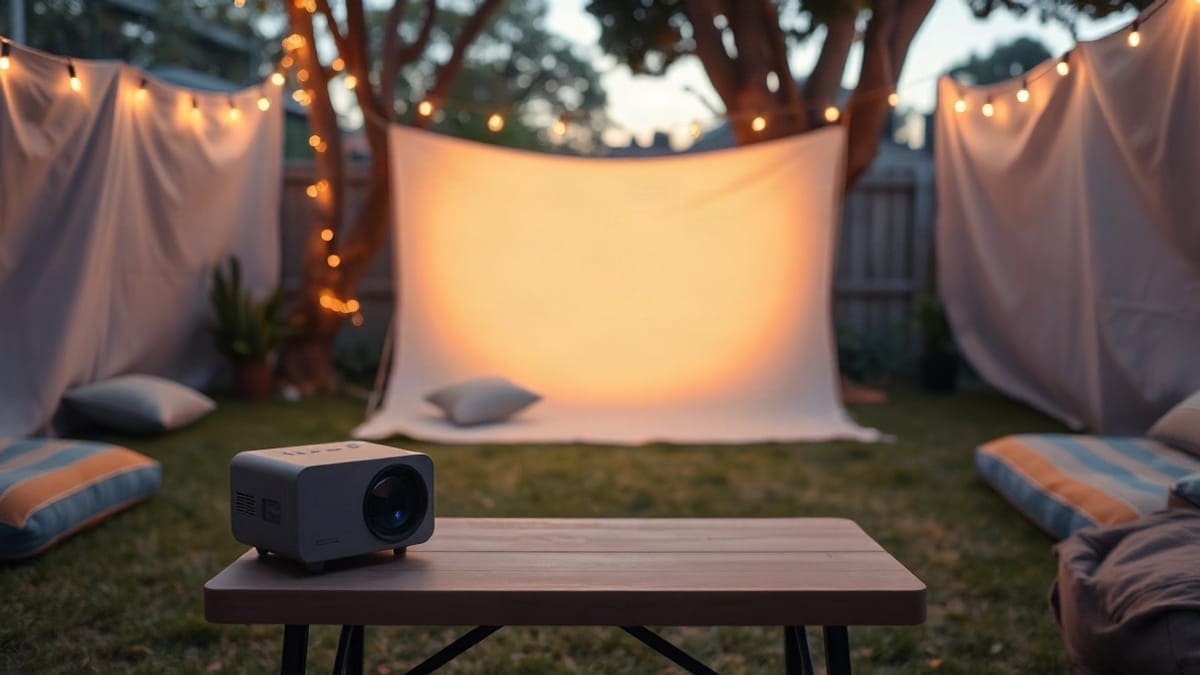
For a backyard movie night, buy the Nebula Mars 3: 1,000 ANSI lumens (959 measured), a battery and IPX3 splash resistance. Past about 110 inches, or at dusk, a brighter plug-in model such as the JMGO N1S Ultra (3,000 ANSI lumens listed) does better. The wider field, from 4K to bright lamp models, is in our best projector guide.
Get the Nebula Mars 3 if you want one carry-out unit for an 80 to 110 inch screen.
Get the JMGO N1S Ultra 4K if your screen is 120 inches or more and you have an outlet.
Neither if your screen is 60 to 80 inches for camping. Then take the Nebula Mars 3 Air (3.7 lb).
Quick answer: what to know before you buy
- Brightness comes first. For a 100-inch picture in full darkness, plan on about 800 rated ANSI lumens. At 150 inches, about 1,800. If streetlights, dusk or a patio lamp are in view, double both numbers.
- Daylight is a different category. Under open sky in the afternoon, a normal white screen washes out. Plan for shade, an ambient-light-rejecting screen and 3,000 lumens or more.
- Weather rating matters less than you think. Only the Nebula Mars 3 in this guide carries a published rating (IPX3, which is splashes, not rain). Treat every projector as indoor gear that you bring out for the evening.
- Built-in speakers are a stopgap. A projector speaker will not fill a yard. A cheap powered Bluetooth speaker usually beats any projector's own sound.
- Distance is arithmetic. At a 1.2:1 throw ratio, a 100-inch image needs the projector about 8.7 feet (2.7 m) from the screen.
Our picks at a glance
- 1Nebula Mars 3families and campers who want one self-contained unit, screens up to about 110 inches in full darkness, and anyone who wants a…Check price
- 2JMGO N1S Ultra 4K120 to 180 inch screens, evenings that start at dusk, and anyone who wants 4K and a laser source that never needs a lamp. OurCheck price
- 3Nebula Mars 3 Aira 60 to 80 inch screen on a dark night, trips, a balcony, a tent or the side of a houseCheck price
Which outdoor projector should you buy?
Four projectors cover almost every outdoor case. Each one is the answer to a different question: how big is the screen, is there a power outlet nearby, and how dark will it be when the movie starts.
| Model | Rated brightness | Resolution | Light source | Power | Weather facts | Best for |
|---|---|---|---|---|---|---|
| Nebula Mars 3 | 1,000 ANSI lm | 1080p | LED | 185 Wh battery, up to 5 h in Eco mode | IPX3, 0.5 m drop resistance | Most backyards, patios, camping |
| Nebula Mars 3 Air | 400 ANSI lm | 1080p | RGB LED, 30,000 h | 52 Wh battery, 2.5 h in Eco mode | No rating published | Small screens, travel, dark nights |
| JMGO N1S Ultra 4K | 3,000 ANSI lm (listed) | 4K UHD | Triple laser, over 30,000 h | Plug-in, 143 W measured | No rating published | Big screens, dusk starts, 4K |
| Epson Home Cinema 2350 | 2,800 lm white and color rated (about 2,000 ANSI per GearLab) | 1080p, 4K enhancement | Lamp, 4,500 h | Plug-in | No rating published | Bright image from a lower-cost lamp projector |
Our order of picks follows the questions you actually have to answer. If you want a single projector that you can carry out, set up in two minutes and use without an extension cord, the Mars 3 is the one. If you want the biggest and brightest picture and you do have power, the JMGO is the stronger buy. For a plan that splits the difference by budget, see our page on the best budget outdoor projectors, and for movie-night setups specifically, the best outdoor movie projectors.
Nebula Mars 3: the all-round pick
The Nebula Mars 3 is the only projector here built for the job. Nebula lists 1,000 ANSI lumens from an LED engine, a 185 Wh battery, a 40-watt speaker system with Dolby Audio, autofocus, keystone correction and an IPX3 rating. ProjectorCentral measured the brightness instead of trusting the box: 959 ANSI lumens in Bright mode at full power, 785 in Standard and 686 in Movie. That is within 4 percent of the claim in its brightest mode and 21 percent below it in Standard.
The battery has a trade-off that the headline hides. ProjectorCentral lists up to 5 hours of video in Eco mode but only 2 hours at standard power. In Eco mode, the same review measured 442 lumens in Bright mode. So the numbers you get depend on how you run it: full brightness for a 2-hour film, or about half the light for a long evening on battery. If you have an outlet, you can keep the full 959.
It weighs 9.9 pounds and measures 9.8 by 6.3 by 9.8 inches, so it moves like a small cooler. The fan reads 35.2 dBA at standard power, which is quiet enough that you will not hear it over a speaker.
Best for: families and campers who want one self-contained unit, screens up to about 110 inches in full darkness, and anyone who wants a handle and a drop-resistant body.
Not for: screens of 150 inches or more, or daylight. The review also lists inconsistent computer compatibility, no Netflix app and Bluetooth audio sync issues, so plan to stream from a stick or phone.
JMGO N1S Ultra 4K: big screens and dusk starts
The JMGO N1S Ultra is the brightest projector in this guide that is built as a home projector first. JMGO's datasheet lists 3,000 ANSI lumens, marked "TBC" (to be confirmed), from a triple-laser DLP engine rated over 30,000 hours at 4K UHD. The throw ratio is 1.2:1, the speakers are two 10-watt drivers, the fan is rated under 26 dB, and the unit weighs 9.92 pounds. The gimbal base tilts 135 degrees and rotates 360 degrees, which lets you aim at a screen without a tripod. It has two HDMI 2.1 ports, one with eARC.
The honest caveat is brightness. We found no independent lab measurement of the N1S Ultra. Its predecessor, the N1 Ultra, was claimed at 4,000 ANSI lumens and measured 2,670 ANSI lumens by ProjectorCentral, about 67 percent of the claim. If the N1S Ultra lands near the same ratio, expect roughly 2,000 real lumens. That is still more than twice the Nebula Mars 3. The Gadgeteer reviewer found the picture held up with every light on in a living room on a 60-inch screen, though that is not an outdoor test.
There is no battery and no published weather rating, so it needs an outlet or a portable power station, and it goes under a canopy.
Best for: 120 to 180 inch screens, evenings that start at dusk, and anyone who wants 4K and a laser source that never needs a lamp. Our JMGO N1S 4K page covers the family in detail.
Not for: campsites without power, or a yard where you want to leave the projector outside.
Nebula Mars 3 Air: small screens and travel
The Mars 3 Air is a different tool from the Mars 3. Nebula rates it at 400 ANSI lumens, 1080p, with a 52 Wh battery, two 8-watt speakers and a weight of 3.7 pounds (1.69 kg). ProjectorCentral measured 399 lumens in Conference mode, 383 in Standard and 372 in Movie. On battery in Eco mode, Standard measured just 145 lumens, and the review says that suits only a fully dark room or a night outdoors.
Nebula's spec page quotes a 30 to 150 inch size range, but the reviewer notes images wash out beyond about 80 inches. Battery life was 3 hours 10 minutes in testing, against 2.5 hours rated. Input lag is 44.1 ms, so it is for casual gaming only. It has no USB-C video input.
Best for: a 60 to 80 inch screen on a dark night, trips, a balcony, a tent or the side of a house.
Not for: a large screen, any ambient light, or a projector that must handle sprinklers: Nebula does not list an IPX rating for it.
Epson Home Cinema 2350: a bright lamp projector
The Epson Home Cinema 2350 is not an outdoor product. It is an indoor 3LCD lamp projector that happens to be bright: 2,800 lumens rated in both white and color brightness (1,900 in Eco mode), against about 2,000 ANSI lumens measured by GearLab. ProjectorCentral lists a 1.62x manual zoom, plus or minus 60 percent vertical lens shift, a 4,500-hour lamp (7,500 hours in Eco mode), 10-watt mono sound and a weight of 9.0 pounds. The fan runs at 36 dB, or 28 dB in Eco mode.
Two things make it useful outside. The zoom lens and lens shift mean you can put it on a table and square the image without keystone distortion. And equal white and color brightness keeps colors from looking washed out when the screen picks up stray light. The price you pay is a lamp to replace, no battery, no weather rating and sound that cannot cover a yard.
Best for: a fixed patio setup where the projector lives indoors or under a roof and the screen goes up for the evening.
Not for: campers, and anyone who wants to leave it outside. The Epson Home Cinema 2350 page has the full review of this model.
Types of outdoor projectors: LED, laser and lamp
The light source decides weight, lifespan and brightness. LED projectors run about 30,000 hours, laser ones over 30,000, and lamp projectors 4,500 to 7,500. The three types in this guide show the trade-off clearly.
LED engines are small, cool and cheap to run, which is why battery projectors use them. The Nebula Mars 3 Air lists an RGB LED source at 30,000 hours, and the Mars 3 uses an LED engine at 1,000 ANSI lumens. Laser engines, like the triple-laser unit in the JMGO N1S Ultra (over 30,000 hours), reach 3,000 listed lumens in a 9.92 pound body. Lamps are the oldest option. The Epson Home Cinema 2350 gives 2,800 lumens, but its lamp lasts 4,500 hours, or 7,500 in Eco mode, and it needs replacing.
| Type | Example here | Rated brightness | Source life | Power | Trade-off |
|---|---|---|---|---|---|
| LED | Nebula Mars 3 | 1,000 ANSI lm | Not stated on the pages we read | 185 Wh battery | Mid brightness, portable |
| RGB LED | Nebula Mars 3 Air | 400 ANSI lm | 30,000 h | 52 Wh battery | Dim, very light at 3.7 lb |
| Triple laser | JMGO N1S Ultra 4K | 3,000 lm (listed) | Over 30,000 h | AC, 143 W | Bright, no battery |
| Lamp | Epson Home Cinema 2350 | 2,800 lm (1,900 Eco) | 4,500 h (7,500 Eco) | AC | Bright for the cost, lamp to replace |
A second split is the imaging chip. DLP (JMGO, Nebula) uses a mirror chip, and 3LCD (Epson) uses three panels, which is how it holds equal white and color brightness at 2,800 lumens. Neither is better outdoors. For the technology question on its own, read DLP vs LCD vs LED projectors, and see the laser projector guide if you are weighing the brightest type.
How to choose an outdoor projector
Check six numbers in this order: brightness (ANSI), screen size, throw distance, power, weather rating and sound. Each one has a pass mark you can read off a spec sheet.
Start with brightness and screen size together, since they depend on each other. Then check that your yard fits the throw ratio, because a projector that needs 13 feet in a 10-foot yard is the wrong projector. After that, ask where the power comes from, then what the weather can do, then how loud the audience will be.
| Check | Pass mark | Where to read it | Example from this guide |
|---|---|---|---|
| Brightness | At least 800 ANSI lm for 100 in; 1,800 for 150 in (dark) | Spec sheet, ANSI or ISO 21118 | Mars 3: 959 lm measured |
| Screen size | 80 to 200 in, matched to lumens | Our lumens table | Air: about 70 in in the dark |
| Throw distance | Fits your yard: 8.7 ft for 100 in at 1.2:1 | Throw ratio on the spec sheet | Epson: 9.7 to 15.8 ft for 100 in |
| Power | 2 h of battery for a film, or an outlet | Battery in Wh | Mars 3: 185 Wh |
| Weather | IPX3 or better if it may get splashed | IP rating, if published | Mars 3: IPX3 |
| Sound | A powered speaker over 20 W for a yard | Speaker watts, 3.5 mm or eARC out | JMGO: 2 x 10 W, eARC |
Skip these if you are tempted by them: "9,000 lumens" with no ANSI label, 8K, and any claim of "waterproof" that gives no IP code.
How many lumens does an outdoor projector need?
For a 100-inch picture after dark, about 800 rated ANSI lumens. For 150 inches, about 1,800. Double either number if the sky is still bright or a light shines on the screen. Those numbers come from a short calculation, and the sources disagree on them by a factor of three, so it helps to see the work.
The unit that matters is light per square foot of screen. Open Air Cinema's outdoor projector tutorial plans on about 15 lumens per square foot for a solid picture after dark and about 20 with headroom, assuming a 1.0-gain screen. A 100-inch 16:9 screen is 29.7 square feet, so 20 lumens per square foot means 594 lumens landing on the screen. But a projector never delivers its rated number: ProjectorCentral measured 785 of 1,000 lumens in the Mars 3's Standard mode (79 percent) and 383 of 400 on the Mars 3 Air (96 percent), and 2,670 of a claimed 4,000 on the JMGO N1 Ultra (67 percent). We divide by 0.75 to land on a rated figure.
| Screen diagonal (16:9) | Screen area | Rated lumens, full darkness | Rated lumens, dusk or a nearby light |
|---|---|---|---|
| 80 in (6.8 ft wide) | 19 sq ft | about 510 | about 1,000 |
| 100 in (7.3 ft wide) | 29.7 sq ft | about 790 | about 1,600 |
| 120 in (8.7 ft wide) | 42.7 sq ft | about 1,140 | about 2,300 |
| 150 in (10.9 ft wide) | 66.8 sq ft | about 1,780 | about 3,600 |
| 200 in (14.5 ft wide) | 118.7 sq ft | about 3,160 | about 6,300 |
Our calculation: area times 20 lumens per square foot, divided by 0.75 to allow for the gap between rated and real output. The dusk column doubles it.
Brightness guides from projector makers are higher. AWOL Vision recommends at least 3,000 lumens for a 150-inch screen at night, and 3,500 to 5,000 if you start at dusk. Our table says 1,780 for the same case. The difference is mostly how much headroom each author wants. A projector maker has a reason to point you toward a brighter model, and an event provider has a reason to avoid a dim image in front of 500 guests. For a family yard, our numbers will give a watchable picture. If you want a punchy one, move up one row.
Brightness also ought to be an ANSI or ISO 21118 figure. Those are standardized measurements, and ISO 21118 is the strictest of the lumen tests. Terms like "LED lumens," "source lumens" or a bare "9,000 lumens" are not, and the CVIA lumen figure JMGO uses for some models is not interchangeable with ANSI. For the full explanation, read what projector brightness means and our dedicated page on how many lumens an outdoor projector needs.
What brightness do the four projectors in this guide support?
Run the same formula backward. The Mars 3 at 1,000 rated lumens covers about a 110-inch screen in full darkness, or about 80 inches at dusk. The Mars 3 Air at 400 lumens covers about 70 inches in the dark, which matches the reviewer's remark that it washes out past about 80 inches. The JMGO at 3,000 rated lumens (about 2,000 if it follows its predecessor's gap) covers roughly 180 inches in the dark and about 130 at dusk. The Epson at 2,800 lumens covers roughly 185 inches in the dark and 130 at dusk. In every case, the picture size that works is a function of the darkness, not of the projector alone.
How close are the claims to measured brightness?
Measured output ran from 67 to 100 percent of the claim in the cases we found. ProjectorCentral measures with a light meter in each picture mode, and the mode you pick matters more than the label.
| Projector and mode | Rated | Measured | Share of rating |
|---|---|---|---|
| Nebula Mars 3, Bright, full power | 1,000 ANSI lm | 959 lm | 96% |
| Nebula Mars 3, Standard, full power | 1,000 ANSI lm | 785 lm | 79% |
| Nebula Mars 3, Movie, full power | 1,000 ANSI lm | 686 lm | 69% |
| Nebula Mars 3, Bright, 70% power (AI) | 1,000 ANSI lm | 623 lm | 62% |
| Nebula Mars 3, Bright, Eco | 1,000 ANSI lm | 442 lm | 44% |
| Nebula Mars 3 Air, Conference | 400 ANSI lm | 399 lm | 100% |
| Nebula Mars 3 Air, Standard | 400 ANSI lm | 383 lm | 96% |
| Nebula Mars 3 Air, Standard, Eco on battery | 400 ANSI lm | 145 lm | 36% |
| JMGO N1 Ultra (predecessor), brightest | 4,000 ANSI lm claimed | 2,670 lm | 67% |
A film mode costs you light, and so does saving battery. If you run the Mars 3 on battery in Eco mode, treat it as a 300 to 440 lumen projector and shrink the screen to about 75 inches in the dark.
What do the four projectors weigh, and how loud are they?
Carry weight and fan noise decide whether you will bother to set it up. Ratings come from the spec pages and review labs, and the table marks which is which.
| Spec | Mars 3 | Mars 3 Air | JMGO N1S Ultra | Epson 2350 |
|---|---|---|---|---|
| Weight | 9.9 lb | 3.7 lb | 9.92 lb | 9.0 lb |
| Speakers | 40 W, 3 speakers | 2 x 8 W | 2 x 10 W | 10 W mono |
| Fan noise | 35.2 dBA measured | 28 dB rated, 40 dBA measured | Under 26 dB rated | 36 dB (28 dB Eco) |
| Throw ratio | 1.2:1 | 1.2:1 | 1.2:1 | 1.34 to 2.17:1 |
| Ports named | USB-C, USB-A, HDMI | No USB-C video input | 2 HDMI 2.1 (1 eARC), USB-A | Not read |
| Contrast | Not stated | Not stated | 1,600:1 | Not stated |
Do you need 4K outdoors?
Usually not. Open Air Cinema points out that viewers who sit about 30 feet from a 16 to 25 foot screen see little difference between 1080p and 4K. Resolution helps when you sit close to a smaller screen. Brightness helps everywhere. If you must pick, pick brightness. Our page on 4K outdoor projectors explains where the extra pixels actually show.
Can you use an outdoor projector in daylight?
Not well. A projector with 3,000 to 4,000 ANSI lumens, a shaded spot and an ambient-light-rejecting screen gives a usable picture in daylight; anything dimmer gives a gray ghost. Daylight is the hardest test an outdoor projector faces, and most "daylight" claims are marketing.
The sun lights the screen as strongly as your projector does. Pure white screens reflect that light back at the viewer, which raises the black level until the picture goes flat. Three things change the result.
- Shade the screen, not the projector. A porch roof or a screen on the shaded side of a house does more than doubling the lumens.
- Use a screen that rejects ambient light. An ALR screen reflects projector light toward the viewers and absorbs more of the light that comes from the side. Our guide to ALR projector screens explains the types, and note that ALR works best with a projector placed in a specific position.
- Go brighter. The Ceedo brightness guide lists 3,000 to 4,000 ANSI lumens for daytime use. Guides like this come from sellers, so read the number as what it takes for a good picture, not the least that works.
In our table, a 100-inch screen at dusk wants 1,600 lumens. A bright afternoon is several times worse than dusk. Even the 959 measured lumens of the Mars 3 will look pale at noon. ProjectorCentral's review of the Mars 3 Air notes that its brightest mode was merely "just okay" against sunlight streaming into a room. The reviewer judged this indoors, not on a lawn. For the afternoon use case, read our page on projectors that work in daylight.
Do outdoor projectors work during the day?
Yes, in a shaded spot with 3,000 or more lumens and a smaller screen. In direct sun, not in a way that makes a movie enjoyable.
Is there an outdoor projector that works in daylight?
No outdoor projector beats the sun on a standard screen. The brightest ones in this guide, the JMGO and the Epson, get closest, and only with shade or an ALR screen.
What screen should you use for an outdoor projector?
A matte white screen of 80 to 120 inches suits most yards; inflatable screens suit parties, and a painted wall or a tensioned sheet will do for a first night. The screen is half the picture, and it is cheaper to fix than the projector.
Fixed-frame and tensioned screens give the flattest surface and survive wind. Inflatable screens set up fast, but wind and a projector placed too close can make the picture sway. Open Air Cinema warns that short-throw projectors (below about 0.8 throw ratio) are less forgiving with swaying inflatable screens. Our guides compare the best outdoor movie screens, inflatable movie screens and the best outdoor projector and screen combos.
How do you make an outdoor projector screen?
Tension a smooth white fabric or a blackout cloth on a frame and keep the surface wrinkle-free. We keep the full build instructions, fabric choices and sizing in the DIY outdoor movie screen guide.
How do you hang an outdoor projector screen?
Use a frame or ties on all four sides, and keep the screen taut so wind does not make ripples. The DIY outdoor movie screen guide has the details on frames, grommets and anchoring.
How do you shade an outdoor projector screen?
Put it under a roof edge, an awning or on the shaded side of a house, and keep stray light off the surface. Shading the screen is the cheapest brightness upgrade there is, and it works with every projector.
How do you clean an outdoor projector screen?
Use a soft cloth and a mild soap solution, then let it dry fully before you roll it up. For a specific screen, follow its maker's instructions, since coatings differ, and avoid rubbing ALR surfaces.
Where do you buy an outdoor projector screen?
Our screen pages link to specific models. Start with the best projector screens and the outdoor pages above.
What size outdoor projector screen should you pick?
Choose the largest screen that your lumen budget supports using the table above: 80 inches for the Mars 3 Air, 100 to 110 inches for the Mars 3, and 120 to 180 inches for the JMGO or Epson. Then check how far away your viewers sit. At 30 feet, a 120 inch picture looks small in a way that a 150 inch one does not.
How far should an outdoor projector be from the screen?
Multiply the screen width by the throw ratio. At 1.2:1, a 100-inch image needs about 8.7 feet; an Epson with a 1.34 to 2.17 range needs 9.7 to 15.8 feet. The throw ratio is the distance divided by the image width, and every projector lists it.
The Mars 3 and the JMGO N1S Ultra both have a 1.2:1 throw ratio. The Mars 3 spec page lists a throw distance range of 2.6 to 17.4 feet. The Epson Home Cinema 2350 has a zoom lens: 1.34:1 at the wide end and 2.17:1 at full zoom.
| Image size (16:9) | Width | Nebula Mars 3, Mars 3 Air, JMGO N1S Ultra (1.2:1) | Epson Home Cinema 2350 (1.34 to 2.17:1) |
|---|---|---|---|
| 80 in | 5.8 ft | 7.0 ft | 7.8 to 12.6 ft |
| 100 in | 7.3 ft | 8.7 ft | 9.7 to 15.8 ft |
| 120 in | 8.7 ft | 10.5 ft | 11.7 to 18.9 ft |
| 150 in | 10.9 ft | 13.1 ft | 14.6 to 23.6 ft |
Place the projector behind or beside the seating, not in the front row. Open Air Cinema notes that brighter projectors run louder fans, from the mid-20s dB in Eco mode to 40 dB or more at full power, and that you should square the projector to the screen instead of leaning on digital keystone. For the math and a tool, use our throw distance calculator and the guide on how far a projector should sit from the screen.
How do you mount an outdoor projector?
For a fixed spot, use a ceiling or beam mount under a roof or pergola. For a temporary one, a tripod or a table at about eye height is fine. Our projector stand and tripod page lists options. Whatever you choose, keep it level and out of the reach of rain and sprinklers.
How do you set up an outdoor projector?
Place the screen, measure the distance from the table above, connect the source and speaker, then focus after dark. Our outdoor projector setup guide takes you through the full process.
How do you use an outdoor projector?
Plug in or charge it, point it at the screen, let it focus, then stream from a stick or your phone. The Mars 3 and the JMGO both run Google or Android TV, so apps are built in, though the Mars 3 has no Netflix app according to ProjectorCentral. Add a streaming stick if you need it.
Can you use an outdoor projector without wrecking it in the rain?
No projector in this guide should be left in rain. The Nebula Mars 3 is rated IPX3, which means it survives water sprayed at an angle, not a downpour; the others have no published rating. Weather is where outdoor projectors get misunderstood the most.
IPX3 is the third step of the IEC ingress-protection scale for water, and it covers spraying water up to 60 degrees from vertical. It does not cover immersion, a hose or a night in a storm. The Mars 3 also lists 0.5 meter drop resistance and dust resistance. The JMGO, the Mars 3 Air and the Epson have no rating on the pages we read.
Open Air Cinema's guidance is blunt: projectors are not weatherproof. Typical limits are about 41 to 104 degrees Fahrenheit and below 80 percent humidity, with no condensation. Run the projector under a tent, keep it off wet grass, never leave it out overnight, and let a cold or hot unit acclimate for 15 to 30 minutes before powering on. Dew is the biggest threat. For the narrower question of weatherproof models, see our page on waterproof outdoor projectors.
Can outdoor projectors get wet?
Only the Mars 3, and only splashes. Treat the rest as indoor equipment that you carry out for the evening.
Can outdoor projector screens get wet?
Many outdoor screens tolerate light moisture, but they must dry fully before you fold them, or they can mildew. Check the screen maker's care notes.
How do you waterproof an outdoor projector?
You cannot add a rating to a projector with a cover. Use a canopy, a covered porch or a purpose-built projector enclosure with ventilation, and keep the vents clear so the unit does not overheat.
Can outdoor projectors be used indoors?
Yes. All four projectors here work indoors too, and the Mars 3 gives you 959 measured lumens for a room with some light in it. Our indoor and outdoor projector guide covers the models that handle both.
What sound does an outdoor projector need?
Plan on a separate speaker. Projector speakers range from 2 by 8 watts on the Mars 3 Air to 40 watts on the Mars 3, and none of them will carry across a large yard. Open Air Cinema states that built-in speakers "cannot carry an outdoor crowd" and that a backyard may need only one good powered speaker.
Judge a speaker by placement and distance, not wattage alone. Put it beside the screen, not beside the projector, so the sound seems to come from the picture. If you connect over Bluetooth, expect some lag: ProjectorCentral lists audio sync issues on the Mars 3. A wired connection, or the projector's 3.5 mm output on models that have one, avoids it. The JMGO N1S Ultra has a 3.5 mm headphone jack and an eARC HDMI port, which suit a wired soundbar or a receiver.
For specific options, see our page on outdoor projectors with speakers and Bluetooth.
Do outdoor projectors have sound?
Yes, built-in speakers on all four, from 10 watts mono on the Epson to 40 watts on the Mars 3.
Do outdoor projectors have speakers?
Yes. Speaker power runs from two 8-watt drivers on the Mars 3 Air to a 40-watt, three-speaker system on the Mars 3.
How do outdoor projectors get power?
Either a built-in battery or an outlet: the Mars 3 runs about 2 hours at full brightness or up to 5 hours in Eco mode, and the Air runs 2.5 hours; the JMGO and Epson need AC power. Battery is the biggest practical split among outdoor models.
A battery runtime always depends on brightness. ProjectorCentral measured the Mars 3 Air at 3 hours 10 minutes in Eco mode, but at 145 lumens, which is dim. The Mars 3 holds 442 lumens in Eco mode. For a film of 2 hours, the Mars 3 can run at full power on its 185 Wh battery. For a plug-in projector, a portable power station with enough capacity works: the JMGO draws 143 W in operation, so a 500 Wh station gives a bit over three hours. Our camping projector page and portable outdoor projector page cover battery models in more depth.
Which outdoor projector fits your yard?
Choose by the screen size and the amount of light, not by the label. The table below turns the earlier numbers into a decision.
| Your situation | Screen | Best pick | Why |
|---|---|---|---|
| Dark yard, family movie night, outlet far away | 80 to 110 in | Nebula Mars 3 | Battery, IPX3, 959 measured lumens |
| Camping, balcony, tent | 60 to 80 in | Nebula Mars 3 Air | 3.7 lb, battery, 400 lumens |
| Large screen or dusk start | 120 to 180 in | JMGO N1S Ultra 4K | 3,000 listed lumens, laser, 4K |
| Fixed patio, lower-cost bright picture | 100 to 150 in | Epson Home Cinema 2350 | 2,800 lumens, lens shift, zoom |
| Daylight, shaded | 80 to 100 in | JMGO or Epson with an ALR screen | Highest brightness |
For a backyard focus, our backyard and patio projector page picks by yard type, and the outdoor laser projector page covers the brightest models.
How does an outdoor projector work, and are they worth it?
An outdoor projector is a regular projector with a brighter light source, an easier setup and sometimes a battery and a weather seal. A light engine (LED, laser or lamp) lights a small imaging chip, which in these models is DLP or 3LCD, and a lens throws the picture onto the screen. Nothing in the process is special to outside.
What makes a projector "outdoor" is the package: brightness, a handle, a battery, autofocus and keystone so you can set it up in minutes, a stand, and speakers. Of the four here, only the Mars 3 was designed with the outdoors in mind.
Are they worth it? If you watch at night and have a place to put a screen, a projector gives you a 100 to 150 inch picture for far less than a TV that size, and it packs away. If you want daytime TV on a patio, a weatherproof outdoor TV is a better answer.
What is an outdoor projector?
A projector chosen or built for outdoor use: bright enough for open air, portable, and often battery-powered or weather-resistant.
Do outdoor projectors work?
Yes, after dark with a suitable screen and enough lumens. They struggle in daylight.
Are outdoor projectors worth it?
Yes, for night viewing on a big screen. For daytime viewing, no.
How much do outdoor projectors cost?
We do not print prices because they move weekly. What drives cost is brightness, a battery, a laser source and 4K, so the Mars 3 Air sits at the low end here and the JMGO at the high end. Use the buttons to see today's price.
Where do you rent an outdoor projector?
Local AV rental shops and party suppliers rent projector and screen kits, often with a speaker and a technician for larger events. Rental makes sense for one party; for repeat use, buying a projector pays off quickly.
FAQ
What is the best outdoor projector?
The Nebula Mars 3 for most yards: 1,000 ANSI lumens, a 185 Wh battery and IPX3. For screens over 110 inches, the JMGO N1S Ultra at 3,000 listed lumens.
What projector is best for outdoor movies?
The Mars 3 for 80 to 110 inch screens in the dark; the JMGO N1S Ultra or Epson Home Cinema 2350 for larger screens. See the outdoor movie projector page.
How many lumens do you need for an outdoor projector?
About 800 rated ANSI lumens for 100 inches after dark and 1,800 for 150 inches, doubled for dusk or a nearby light.
How bright should an outdoor projector be?
Bright enough for your screen: about 20 lumens per square foot of image after real-world losses. Open Air Cinema plans 15 to 20 per square foot.
What ANSI rating do you need for an outdoor projector?
Between 500 and 3,200 ANSI lumens for 80 to 200 inches in full darkness, and double that for dusk.
Is the Nebula Mars 3 waterproof?
It carries an IPX3 rating, which means protection against sprayed water, not rain, immersion or a hose.
What is the brightest outdoor projector in this guide?
The JMGO N1S Ultra at 3,000 listed ANSI lumens, followed by the Epson Home Cinema 2350 at 2,800 lumens.
Do you need a screen for an outdoor projector?
A smooth white wall works for a first night, but a screen gives better contrast and flatness. See our screen guide.
Can you use an outdoor projector during the day?
Only in shade, with 3,000 lumens or more and ideally an ALR screen.
How long does an outdoor projector battery last?
The Mars 3 lasts about 2 hours at standard power and up to 5 hours in Eco mode; the Mars 3 Air lasts 2.5 hours rated and about 3 hours 10 minutes measured in Eco mode.
What size screen is best for an outdoor projector?
80 inches for 400 lumens, 100 to 110 for 1,000 lumens, 120 to 180 for 2,800 to 3,000 lumens.
How far should an outdoor projector be from the screen?
At a 1.2:1 throw ratio, 8.7 feet for 100 inches and 13.1 feet for 150 inches.
Is the Nebula Mars 3 loud?
ProjectorCentral measured 35.2 dBA at standard power and 34.2 dBA in Eco mode, about the level of a quiet conversation at a few feet. A projector speaker or a crowd will cover it.
How long does an outdoor projector light source last?
The Nebula Mars 3 Air's LED is rated 30,000 hours, the JMGO's laser over 30,000, and the Epson's lamp 4,500 hours (7,500 in Eco mode). At 3 hours a night, 4,500 hours is about four years.
Can you power an outdoor projector from a power station?
Yes. The JMGO draws 143 W in operation, so a 500 Wh station runs it a little over three hours. Match the station's rated output to the projector's draw and leave some margin.
What is the difference between ANSI lumens and LED lumens?
ANSI lumens follow a standard measurement. LED or source lumens rate the light engine, not what reaches the screen, and they run higher. JMGO also uses CVIA lumens for some models, which are not interchangeable with ANSI.
Sources
Every number on this page comes from a maker or a named review lab, shown side by side where they disagree. We print no prices.
- Nebula Mars 3 specifications: Nebula by Anker and the Notebookcheck launch report
- Measured brightness, battery, weight and noise: ProjectorCentral review of the Nebula Mars 3
- Nebula Mars 3 Air: Nebula/Anker spec page and the ProjectorCentral review
- JMGO N1S Ultra: JMGO datasheet and The Gadgeteer review
- JMGO N1 Ultra measurements: ProjectorCentral
- Epson Home Cinema 2350 specifications: ProjectorCentral
- Lumens per square foot, weather limits and speakers: Open Air Cinema outdoor projector tutorial
- Brightness guidance from makers: AWOL Vision and Ceedo
Keep comparing
 Portable Projector 2026Nine real models compared on weight, rated and measured lumens, battery life and ports, with picks for travel
 Home Theater ProjectorEight home theater projectors compared for 2026 by contrast, black level, HDR, lens, noise and screen size
 Mini Projectors for 2026Nine real pocket models compared on weight, ANSI lumens, battery, ports and picture size
 Phone ProjectorsEight real models checked for AirPlay, Google Cast, USB-C video, Netflix, weight and lumens