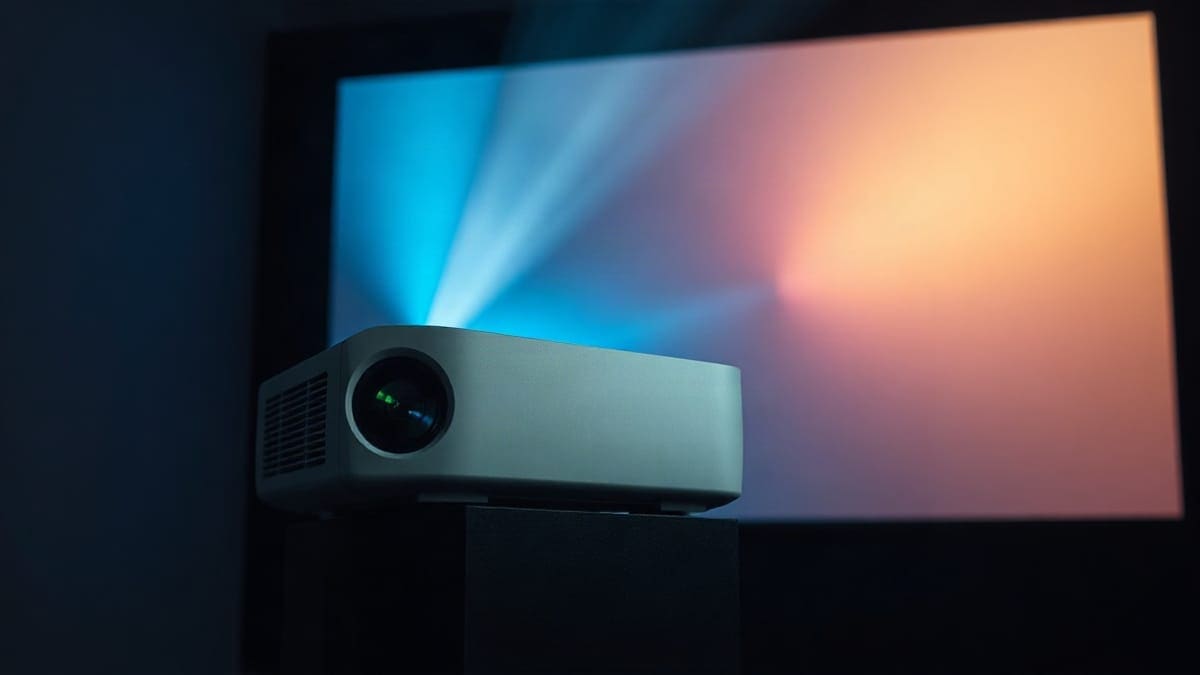
For most people, the cheap projector to buy is a 1080p lamp model rated at 3,400 to 3,800 lumens, such as the Optoma HD146X, unless you need apps or a battery: then take the JMGO PicoFlix. A low price often hides a dim, soft, loud picture, so read what a spec sheet really promises. Every figure comes from maker pages and ProjectorCentral, and we left out four models that guides still list but ProjectorCentral shows as discontinued.
Which cheap projector should you get? Pick by room and habit
This block turns "which one is cheapest" into "which one fits the way you watch".
- Get the Optoma HD146X home theater projector picks if the room can be dim and you want the most picture per dollar of effort: 3,600 ANSI lumens, 1080p, 26 dB and 16 ms of input lag. It has no apps, so plan on a streaming stick.
- Get the JMGO PicoFlix if the projector must stream on its own, run on a battery and focus itself: Google TV, autofocus, 3.3 lb and a rated 450 ANSI lumens. Keep the picture under 100 inches, in a dark room.
- Get the Optoma Photon Life PH31 if you want a quiet LED projector (32 dB) rated at 1,500 ISO lumens with a 30,000 hour light source, and you will add a stick for apps.
- Get the Samsung Freestyle 2nd Gen or Nebula Capsule 3 Laser if the projector lives in a bag. Both are 1.8 to 2.1 lb and both are dim: 40 to 80 inches, lights off.
- None of these if you want a bright picture in a lit living room. Then a TV is cheaper and better: read projector vs TV, or step up to a best projector class model.
Our picks at a glance
- 1Optoma HD146Xa dim room, 80 to 120 inches, gaming with a console (seeCheck price
- 2Epson Home Cinema 1100a small room that needs a big picture from close range, and for lamp lifeCheck price
- 3BenQ TH575ia console in a dim room, 80 to 120 inches, from one box with appsCheck price
Quick answer: what a cheap projector gives you
- Brightness splits the market in two. The lamp models here are rated 3,400 to 3,800 lumens. The LED and laser models are rated 230 to 1,500. That is a gap of about 2 to 17 times in light.
- Native 1080p is the floor you should accept. A 720p chip stretched to a 100 inch wall looks soft, and "4K supported" on a listing often means the projector accepts a 4K signal, not that it shows one.
- Lamp models are loud and dumb, LED models are quiet and smart. The lamp projectors list 26 to 37 dB and have no apps. The LED ones list 28 to 35 dB and run Google TV or Android TV.
- Rated lumens are a ceiling. ProjectorCentral measured the Nebula Capsule 3 Laser at 302 ANSI lumens in Standard mode, and a German test measured the Magcubic HY300 Pro at 165 against 290 claimed.
- We left out four discontinued models. The Epson Home Cinema 1080, BenQ TH585P, ViewSonic PX701HD and Wanbo Mozart 1 are shown as discontinued by ProjectorCentral, so a buying guide should not send you to them. Their current counterparts are the Epson Home Cinema 1100, BenQ TH575i, ViewSonic PX700HDH and Optoma PH31.
- We did not test any of them. Every figure comes from a maker page or ProjectorCentral, and we mark each spot where sources disagree.
What kinds of cheap projector are there?
There are four kinds, and each makes a different trade between light, size and ease. Knowing which kind you are buying matters more than knowing the brand, because the kind sets the brightness, the noise and whether the projector can stream on its own.
The first kind is the 1080p lamp projector, a 5.3 to 6.2 lb box that is rated 3,400 to 3,800 lumens. The second is the LED smart projector, rated 450 ANSI to 1,500 ISO lumens, some with Google TV. The third is the battery pocket projector, 1.8 to 2.4 lb. The fourth is the no-name listing, which makes big claims and rarely documents them.
| Kind | Real examples | Rated light | Weight | Streams alone | Usual weakness |
|---|---|---|---|---|---|
| 1080p lamp | Optoma HD146X, Epson Home Cinema 1100, BenQ TH575i | 3,400 to 3,800 lm | 5.3 to 6.2 lb | Only the BenQ (Google TV) | Lamp ends, little or no apps |
| LED smart | JMGO PicoFlix, Optoma Photon Life PH31 | 450 ANSI to 1,500 ISO lm | 3.3 to 5.2 lb | PicoFlix yes, PH31 no apps listed | Dim next to a lamp |
| Battery pocket | Freestyle 2nd Gen, Capsule 3 Laser | 200 to 450 lm | 1.8 to 2.4 lb | Varies | 40 to 100 in only |
| No-name listing | Magcubic HY300 Pro | 290 ANSI lm claimed, 165 measured | Light | Yes, with bugs | Claims not met |
A cheap projector works like any other: a light source, a chip and a lens, as explained in how a projector works. Lamp and LED are the two light sources. If you want the difference explained in detail, see our guides to the DLP projector and the LED projector.
What do you actually get at each price tier?
You get a different problem solved at each tier, so decide the problem first. We do not print prices because they move weekly and we have no reliable US price feed. A tier here is a class of product, described by what its spec sheet and its tests deliver. For the price ranges by budget, see how much a projector costs.
At the entry level you buy a 720p chip, 165 to 300 real lumens, manual focus and a loud fan. In the middle you buy native 1080p, 450 ANSI to 1,500 ISO lumens, an LED, autofocus on some and Google TV on some. At the top of the budget range you buy a lamp projector with 3,400 lumens or more, which is bright and mostly has no apps.
| Tier | Native resolution | Real brightness | Focus | Apps | Example |
|---|---|---|---|---|---|
| Entry level | 720p | 165 ANSI lm measured (290 claimed) | Manual wheel | Android with bugs | Magcubic HY300 Pro |
| Mid range, LED | 1080p | 450 ANSI to 1,500 ISO lm rated | Auto on the PicoFlix | Google TV on the PicoFlix, none listed on the PH31 | PicoFlix, Optoma PH31 |
| Top of budget, lamp | 1080p | 3,400 to 3,800 lm rated | Manual | None on most, Google TV on the BenQ TH575i | HD146X, Epson Home Cinema 1100, BenQ TH575i |
The step from entry level to mid range is the one that matters. It is the move from a picture you tolerate to one you can watch, and it is why we list no 720p models as picks.
Which nine cheap projectors compare side by side?
Nine models cover the budget field, from a 1.8 lb pocket box to a 6.2 lb lamp projector, and all four desktop models below are current. The first table lines up the specs that matter. Each brightness figure keeps its unit, since an ISO reading and an ANSI reading come from different tests. Every row comes from the pages linked under Sources.
| Model | Brightness | Resolution | Light source | Weight | Noise | Status |
|---|---|---|---|---|---|---|
| Optoma HD146X | 3,600 ANSI lm | 1080p | Lamp, 4,000 h | 6.2 lb | 26 dB | Shipping |
| Epson Home Cinema 1100 | 3,400 ISO lm | 1080p | Lamp, 6,000 h | 6.2 lb | 37 dB | Shipping, Aug 2025 |
| BenQ TH575i | 3,800 ANSI lm | 1080p | Lamp, 6,000 h | 5.5 lb | 34 dB | Shipping, Jul 2026 |
| ViewSonic PX700HDH | 3,700 ANSI lm (3,500 in the highlights) | 1080p | Lamp, 6,000 h | 5.3 lb | Not listed | Shipping, Dec 2024 |
| JMGO PicoFlix | 450 ANSI lm | 1080p | LED, 25,000 h | 3.3 lb | 28 dB | Shipping |
| Optoma Photon Life PH31 | 1,500 ISO lm | 1080p | LED, 30,000 h | 5.2 lb | 32 dB | Shipping, Oct 2025 |
| Nebula Capsule 3 Laser | 300 ANSI lm rated, 302 measured | 1080p | Laser, 30,000 h | 2.1 lb | 28 dB quoted, 38.6 dBA measured | Check stock |
| Samsung Freestyle 2nd Gen | 230 ANSI lm | 1080p | LED, 30,000 h | 1.8 lb | 30 dB | Check stock |
| XGIMI MoGo 3 Pro | 450 ISO lm | 1080p | LED, 25,000 h | 2.4 lb | Not listed | Check stock |
The pattern is the one a physicist would predict: more light needs a bigger lamp, a fan and more weight. No model here gives both a pocket body and a bright picture. The ViewSonic PX700HDH, the plainest of the lamp models, suits an office or a basement with wired sources: it has two HDMI inputs and an RS-232 port. The next table turns that trade-off into a choice by situation.
| Your situation | Picture size | Buy | Why |
|---|---|---|---|
| Dim room, 100 in, most light for the effort | 80 to 120 in | Optoma HD146X | 3,600 ANSI lm, 26 dB, 16 ms |
| Lamp projector, shortest throw | 80 to 120 in | Epson Home Cinema 1100 | 1.00 to 1.21:1, 6,000 h normal, 12,000 h Eco |
| Lamp projector with Google TV | 80 to 120 in | BenQ TH575i | 3,800 ANSI lm, Google TV, 16.7 ms |
| Quiet LED projector with apps | 60 to 100 in | JMGO PicoFlix | 28 dB, Google TV, autofocus |
| Quiet LED, brightest here | 60 to 150 in | Optoma Photon Life PH31 | 1,500 ISO lm, 32 dB, 16 ms |
| Bag or backpack, with battery | 40 to 80 in | Nebula Capsule 3 Laser | 2.1 lb, 52 Wh, 302 lm measured |
| Shelf or hotel desk, 1080p | 40 to 80 in | Samsung Freestyle 2nd Gen | 1.8 lb, 29.6 to 100.4 in |
| Small box, brighter than the rest | 60 to 120 in | XGIMI MoGo 3 Pro | 450 ISO lm, 2 x 5 W speakers |
The nine cheap projectors in detail
Every entry below lists the specs, the strengths, the weak points and the buyer who should look elsewhere. Each Check price button opens the live offer, because prices move too fast to print.
Optoma HD146X: top pick for a dim room
The HD146X is a 6.2 lb 1080p DLP projector rated at 3,600 ANSI lumens, with a 25,000:1 contrast rating and 26 dB of noise. ProjectorCentral lists a 1.47 to 1.62:1 throw ratio, a 1.1x manual zoom, a 28.05 to 301.59 inch picture, a 240 W lamp rated 4,000 hours (15,000 in Eco mode) and 16 ms of input lag at 1080p/60. It was released in February 2020 and is still shipping.
The compromises are plain. There is no lens shift, only vertical digital keystone, and the speaker is 3 W mono. The page lists an HDMI input, USB-A and an audio output, with no port count. ProjectorCentral lists the contrast two ways: 25,000:1 full on/off and a much larger figure in the highlights, which is a dynamic number.
Best for: a dim room, 80 to 120 inches, gaming with a console (see gaming projectors). Not for: a bag, a tent, or anyone who wants to stream without a stick.
Epson Home Cinema 1100: the shortest throw of the lamp models
The Home Cinema 1100 is a 1080p 3LCD projector rated at 3,400 ISO lumens, with color brightness listed at the same 3,400. ProjectorCentral lists 16,000:1 dynamic contrast, a 1.00 to 1.21:1 throw ratio, a 1.21x manual zoom, a 31.29 to 305.10 inch picture, 37 dB of noise (28 dB in Eco) and 6.2 lb. The lamp is a 210 W UHE rated 6,000 hours, or 12,000 in Eco. Ports are two HDMI and two USB-A. It was released in August 2025 and is listed as shipping.
The page has two limits. It has no lens shift, only digital keystone, and the highlights text gives 2,000 lumens and 10,000:1 where the spec table gives 3,400 and 16,000:1, so we use the table. Miracast is listed as a feature, but the wireless field is blank and we found no confirmation of AirPlay on this model. Its short throw puts a 100 inch picture 7.3 to 8.8 feet back, the closest of the lamp models here. See Epson projectors.
Best for: a small room that needs a big picture from close range, and for lamp life. Not for: a quiet bedroom at full power, where 37 dB is audible.
BenQ TH575i: the lamp model with Google TV
The TH575i is a 5.5 lb 1080p DLP projector rated at 3,800 ANSI lumens, with 16.7 ms of input lag at 1080p/60 and a 10 W mono speaker. ProjectorCentral lists 15,000:1 contrast, a 1.49 to 1.64:1 throw ratio, a 1.1x manual zoom, a 30 to 300 inch picture, 34 dB (29 dB in Eco), a 203 W lamp rated 6,000 hours or 10,000 in Eco, two HDMI 1.4a ports, USB-C, Wi-Fi, Bluetooth and Google TV with Google Cast. It was released in July 2026 and is listed as shipping.
It has digital vertical keystone only, and the page lists no lens shift. We found no Netflix statement for it on ProjectorCentral, so check BenQ's page, and use a stick if it is missing. See home theater projectors for the step up.
Best for: a console in a dim room, 80 to 120 inches, from one box with apps. Not for: a bag or a lit room.
ViewSonic PX700HDH: the office and basement lamp model
The PX700HDH is a 5.3 lb 1080p DLP projector rated at 3,700 ANSI lumens, with a 22,000:1 contrast rating and a 10 W mono speaker. ProjectorCentral lists a 1.49 to 1.64:1 throw ratio, a 1.1x manual zoom, a 30.22 to 300.31 inch picture, a lamp rated 6,000 hours or 20,000 in Eco, two HDMI 1.4 ports, USB-A, RS-232 and an audio output. It lists no lens shift. The highlights give 16 ms of input lag. It was released in December 2024 and is listed as shipping.
Sources disagree inside the page: the table says 3,700 ANSI lumens and the highlights say 3,500, so use the lower figure for planning. The noise figure is not listed.
Best for: a classroom or a basement with a wired source, 80 to 150 inches. Not for: a quiet room, since noise is unpublished.
JMGO PicoFlix: the smart pick with autofocus
The PicoFlix is a 3.3 lb 1080p LED projector rated at 450 ANSI lumens, with Google TV, autofocus, Wi-Fi and a battery listed at 4 hours. ProjectorCentral lists a 1.20:1 throw ratio, a 39.93 to 180.13 inch picture, a 25,000 hour LED, 28 dB, two 5 W speakers, HDMI 2.1 with eARC, USB-C and USB-A. The highlights say it has native Netflix support. Release: October 2024, still shipping.
Two numbers hold it back. The contrast is listed at 400:1, which is low, so blacks look gray. And 450 ANSI lumens on a 100 inch picture gives about 15 foot-lamberts in a fully dark room (calculation below), so it needs the lights off. See JMGO projectors for the brand's brighter range.
Best for: a bedroom or dorm, 60 to 100 inches, with the lights off. Not for: a living room with lamps on or a 120 inch wall.
Optoma Photon Life PH31: the quiet, bright LED
The Photon Life PH31 is a 5.2 lb 1080p DLP projector rated at 1,500 ISO lumens (ISO 21118), with an LED engine rated at 30,000 hours and 32 dB of noise. ProjectorCentral lists 200,000:1 dynamic contrast, a 1.50 to 1.65:1 throw ratio, a 60 to 150.35 inch picture, a 5 W mono speaker, HDMI 1.4, USB-A and an audio output. Input lag is 16 ms at 1080p/60, 8 ms at 1080p/120 and 4.6 ms at 1080p/240. It was released in October 2025 and is listed as shipping.
The page lists no operating system, apps or wireless, and the description mentions a battery that the spec table does not list, so plan on an outlet and a streaming stick. 1,500 ISO lumens is a rating, not a measurement, and we found no lab figure for it.
Best for: a bedroom or living room that can be dimmed, 60 to 150 inches, with a console or a stick. Not for: anyone who wants apps built in or a battery.
Nebula Capsule 3 Laser: the battery pick
The Capsule 3 Laser is a 2.1 lb cylinder with a 52 Wh battery and a laser engine rated at 300 ANSI lumens. In ProjectorCentral's lab it reached 341 in Custom mode, 302 in Standard, 236 in Movie and only 123 in Game, on wall power. A film in Standard mode drained the battery in 2 hours 4 minutes. Two versions share the name, the 2023 Android TV model that ProjectorCentral measured and the August 2024 Google TV model with Netflix, so these figures describe the first. The picture is 1080p, the throw ratio is 1.2:1 and one 8 W speaker is built in.
ProjectorCentral also measured fan noise at 38.6 dBA in Standard mode at 36 inches, against the 28 dB Anker quotes. Input lag was 22.4 ms in Game mode at 4K/60 and 129.6 ms in Standard. Read the detail on the Nebula Capsule 3 Laser page and the Nebula Capsule family.
Best for: a dorm, a tent, a trip, 40 to 80 inches in the dark. Not for: a console, since 129.6 ms is too slow in Standard mode.
Samsung Freestyle 2nd Gen: the pocket box for a shelf
The Freestyle 2nd Gen weighs 1.8 lb, is rated at 230 ANSI lumens and shows a 1080p picture from 29.6 to 100.4 inches. The spec table shows one DLP chip, a 30,000 hour LED, a 1.20:1 throw ratio, 30 dB and a 5 W mono speaker, fed by a 50 W adapter. It has no battery and came out in August 2023. No lab brightness figure exists that we could find.
On a 60 inch picture 230 lumens gives about 21.5 foot-lamberts in a dark room, enough for a film. See the Samsung Freestyle page, and for the whole pocket class the best mini projectors and the best portable projectors.
Best for: a nightstand, a desk or a hotel room with a wall socket nearby, at 40 to 80 inches. Not for: a picture above 100 inches or any lit room.
XGIMI MoGo 3 Pro: a bright small box
The MoGo 3 Pro is a 2.4 lb 1080p LED projector rated at 450 ISO lumens, with two 5 W speakers and a 39.9 to 200.1 inch picture range. Its 1.20:1 lens works from 3.5 to 17.4 feet, the light source is rated 25,000 hours, and the ports are HDMI, USB-A and USB-C. It came out in September 2024, and no lab brightness figure turned up. XGIMI also sells a successor, covered on the XGIMI MoGo 4 page; the full line-up sits under XGIMI projectors.
ISO 21118 is the stricter test, so 450 ISO should not be read against the 300 ANSI of the Capsule 3 Laser as the same unit. There is no battery listed.
Best for: 60 to 120 inches in a dim room from a small box. Not for: off-grid use, because it needs an outlet.
Which traps catch cheap projector buyers?
Five traps cost buyers the most: lumens without a test, "4K supported" on a low-resolution chip, no Netflix, a loud fan and manual focus. All five have a documented example, so none is a guess.
Are the lumens on the listing real?
Often not. A listing's lumen figure is a marketing number unless it names ANSI or ISO 21118. In 2014 ProjectorCentral measured three no-name projectors: one claimed 2,800 lumens and measured 137, one claimed 1,500 and measured 87, and one claimed 2,000 and measured 190. In February 2024 Epson won a US court order against the Amazon brand AuKing, which had claimed 9,500 lumens; Epson said the measured figure was under 1 percent of that, or under about 95 lumens, and the court ordered about 529,000 dollars in damages and a stop to the false claims.
The Magcubic HY300 Pro shows the same gap today: a German test measured 165 ANSI lumens against the 290 claimed, with 220 lumens in the center and 110 at the edges. Anker's explainer says ISO 21118 is the stricter test, so a projector usually scores lower in ISO than ANSI lumens. For the full lumen guide see how many lumens you need.
| Brand and model | Claimed | Measured | Source |
|---|---|---|---|
| Digital Galaxy DG-757 (2014) | 2,800 lm | 137 lm | ProjectorCentral |
| Fugetek FG-637 (2014) | 1,500 lm | 87 lm | ProjectorCentral |
| HTP-LED33 (2014) | 2,000 lm | 190 lm | ProjectorCentral |
| AuKing (2024) | 9,500 lm | Under 95 lm per Epson | ChannelNews |
| Magcubic HY300 Pro | 290 ANSI lm | 165 ANSI lm | smartzone.de |
| Nebula Capsule 3 Laser | 300 ANSI lm | 302 ANSI lm (Standard) | ProjectorCentral |
Read the last row as the contrast: a brand with a published measurement lands on its claim, and a no-name listing lands far under it.
Does "4K supported" mean a 4K picture?
No. It means the projector accepts a 4K signal and scales it down. For a picture that really is 4K, read the best 4K projector guide. The HY300 Pro is a native 720p projector that plays 4K files, according to the German test, and streaming on it runs at 720p. A 2014 ProjectorCentral note found an Amazon title reading "Full HD" beside a 1280 x 768 spec. Look for "native 1920 x 1080" on the spec sheet. A 4K picture on a budget projector is rare, and when it exists it is usually pixel shifting: see native 4K vs pixel shifting and the budget 4K projector picks.
Why is there no Netflix on my projector?
Netflix certifies each device itself, and a Google TV or Android TV label is not enough. BenQ states that Netflix ended service for the app version on its QS01 in October 2025. Some projectors list Netflix on the spec page, like the PicoFlix. Others list Google TV with no Netflix mention on ProjectorCentral, like the BenQ TH575i. The safe fix is an HDMI streaming stick. See why Netflix won't work on a projector and the projector for Netflix guide.
How loud is a cheap projector fan?
Louder than the box says. The Magcubic HY300 Pro is quoted at under 25 dB and measured 44 dB(A) in the German test. The Capsule 3 Laser is quoted at 28 dB and ProjectorCentral measured 38.6 dBA at 36 inches. The quietest listed figure among the lamp models here is the HD146X at 26 dB. A fan near 40 dB is easy to hear in a quiet bedroom.
Does it focus and square the picture itself?
Only some do. The PicoFlix lists autofocus and auto keystone. The HY300 Pro has no autofocus, a manual wheel and a gyroscope keystone that works only on flat, straight surfaces. The Optoma HD146X and the Epson Home Cinema 1100 are manual focus with digital keystone. If you do not want to move the projector, buy autofocus. If the picture looks soft, see why a projector looks blurry.
How do you read a cheap projector spec sheet?
Read five lines and ignore the rest: the unit beside the lumens, native resolution, throw ratio, noise and light source life. The headline number is usually the one a seller most wants you to see, and the unit beside it tells you whether it was tested.
| Spec line | What good looks like | Red flag | Example from this page |
|---|---|---|---|
| Brightness unit | ANSI or ISO 21118 | "Lumens" alone, "LED lumens" | 8,000 lm on retailer pages for a 165 lm unit |
| Native resolution | 1920 x 1080 | "4K supported" with 720p | HY300 Pro, native 720p |
| Throw ratio | 1.2:1 or lower for small rooms | Not listed | Home Cinema 1100, 1.00 to 1.21:1 |
| Noise | Measured dB at 36 in | A claim with no distance | Capsule 3 Laser, 38.6 dBA |
| Light source life | LED 25,000 h or lamp 4,000 h | "50,000 hours" with no mode | HD146X, 4,000 h normal |
Contrast also matters. A figure under 1,000:1 gives gray blacks, as on the PicoFlix at 400:1. A figure of 10,000:1 or more is typical of the lamp models but is often a dynamic number that depends on an iris, so ProjectorCentral lists it as full on/off or dynamic.
How many foot-lamberts does a cheap projector give you?
For a dark room about 16 foot-lamberts is a good target, and that means 1.0 times lumens divided by the screen area in square feet. The method is the one our home theater guide uses. We assume a white screen with a gain of 1.0 and a 16:9 picture. A 100 inch picture is 29.7 square feet, a 60 inch picture 10.7, an 80 inch 19.0 and a 120 inch 42.7.
The calculation uses the rated figure, because most of these models have no published measurement. The real number is usually lower. The Capsule 3 Laser showed 302 ANSI lumens in Standard mode, so the rated and measured figures there are almost the same.
| Model | Rated lumens | fL on a 100 in picture | Largest picture at 16 fL |
|---|---|---|---|
| Optoma HD146X | 3,600 | 121.3 | 275 in |
| BenQ TH575i | 3,800 | 128.1 | 283 in |
| ViewSonic PX700HDH | 3,700 | 124.7 | 279 in |
| Epson Home Cinema 1100 | 3,400 ISO | 114.6 | 268 in |
| Optoma Photon Life PH31 | 1,500 ISO | 50.6 | 178 in (lens tops out at 150 in) |
| JMGO PicoFlix | 450 | 15.2 | 97 in |
| XGIMI MoGo 3 Pro | 450 | 15.2 | 97 in |
| Nebula Capsule 3 Laser | 302 measured | 10.2 | 80 in |
| Samsung Freestyle 2nd Gen | 230 | 7.7 | 70 in |
The table shows why the lamp models can stand a lit lamp or a half-open curtain and the pocket models cannot. A picture at 120 foot-lamberts is not a goal in itself: it only says there is light to spare. Our how many lumens you need guide explains the other direction, a bright room and a big screen.
Where do you put each cheap projector for a 100 inch picture?
A 100 inch picture is 7.26 feet wide, and the throw ratio times that width gives the distance. The ratio is the distance divided by the picture width. The Epson Home Cinema 1100 reaches the same picture from 7.3 to 8.8 feet, and the models with a 1.47 to 1.65 ratio need 10.7 to 12.0 feet.
| Model | Throw ratio | Distance for a 100 in picture |
|---|---|---|
| Epson Home Cinema 1100 | 1.00 to 1.21 | 7.3 to 8.8 ft |
| JMGO PicoFlix, Freestyle 2nd Gen, MoGo 3 Pro, Capsule 3 Laser | 1.20 | 8.7 ft |
| Optoma HD146X | 1.47 to 1.62 | 10.7 to 11.8 ft |
| BenQ TH575i, ViewSonic PX700HDH | 1.49 to 1.64 | 10.8 to 11.9 ft |
| Optoma Photon Life PH31 | 1.50 to 1.65 | 10.9 to 12.0 ft |
A projector that sits on a coffee table 9 feet from the wall suits the 1.2 ratio models. One that is ceiling mounted at 11 feet suits the long-throw lamp models: see ceiling-mounted projectors. For a shelf-to-wall plan use the throw distance calculator. The Capsule 3 Laser and the Freestyle 2nd Gen top out at about 100 inches, so those two cannot fill a bigger wall.
Lamp or LED: which one costs less to keep?
A lamp is a consumable you will replace, and an LED is a part you will not. At 2 hours a day you run 730 hours a year, so the hours convert to years in one step. A lamp is cheaper to buy in the projector and costs more later. Use the lamp model number to find the replacement.
| Model | Light source | Hours (normal) | Years at 2 h a day | Hours (Eco) |
|---|---|---|---|---|
| Epson Home Cinema 1100 | Lamp (ELPLP97) | 6,000 | 8.2 | 12,000 |
| ViewSonic PX700HDH | Lamp | 6,000 | 8.2 | 20,000 |
| BenQ TH575i | Lamp | 6,000 | 8.2 | 10,000 |
| Optoma HD146X | Lamp (BL-FU240H) | 4,000 | 5.5 | 15,000 |
| JMGO PicoFlix | LED | 25,000 | 34.2 | not listed |
| XGIMI MoGo 3 Pro | LED | 25,000 | 34.2 | not listed |
| Optoma Photon Life PH31, Freestyle 2nd Gen | LED | 30,000 | 41.1 | not listed |
Eco mode lowers brightness, so the longer figure comes with a dimmer picture. An LED outlasts the electronics around it, which is why the built-in battery or the software fails first.
Are cheap projectors worth it?
Yes, for movies in a dim room, and no, for a lit living room. A lamp model rated 3,400 to 3,800 lumens gives a 100 inch picture at over 100 foot-lamberts in the dark, which is far above what a film needs. An LED model at 450 lumens is worth it for a bedroom wall or a trip.
The same product is a poor buy when you expect it to work like a TV: daytime viewing, a bright white wall, fast game response. A 129.6 ms lag on the Capsule 3 Laser in Standard mode and a 44 dB fan on the HY300 Pro show where the savings come from. Whether a projector is cheaper than a TV at the same size, and what to use instead of a projector when the room is bright, is answered in projector vs TV: in short, a large TV is the usual substitute. For a bedroom, see the bedroom picks.
What do you need besides the projector?
A cheap projector needs a surface, a source and sound. A smooth white wall works in a dark room, but a screen gives more contrast: see do you need a screen and the projector screens guide. For a low-cost screen read cheap projector screens. A tight plan is a projector and screen combo.
For outdoor movies a pull-down is optional: an inflatable movie screen works with the lamp models, and a camping projector runs from a battery. To compare where to buy, see where to buy a projector. For the source, a streaming stick or a phone: see connecting a phone to a projector. To mount and level it, read how to set up a projector and projector on a wall.
How do you choose a cheap projector in six checks?
Check the room, the size, the source, the noise, the stock and the warranty, in that order. Each check removes models from the list, and the last two remove the discontinued ones and the unwarranted ones.
- Room. Dark: any model works. Dim: lamp models or the Photon Life PH31. Lit: none of these.
- Picture size. Over 100 inches rules out the Freestyle 2nd Gen and Capsule 3 Laser.
- Source. Need built-in apps: PicoFlix, or the BenQ TH575i for a lamp model. Have a stick or a console: any lamp model or the PH31.
- Noise. A quiet room favors the HD146X at 26 dB, the PicoFlix at 28 dB or the PH31 at 32 dB.
- Stock. The four discontinued models we left out are still listed by some guides and sellers, so confirm a current US seller.
- Warranty. ProjectorCentral lists 2 years for the Epson Home Cinema 1100 and 1 year for the Optoma PH31. A used or gray-market unit may have none.
A broader checklist is in our guide to how to choose a projector. Prefer 1080p over a higher "supported" figure: see the best 1080p projector guide.
What did we read to compare these cheap projectors?
We read, we did not test. For each model we used the maker page and the ProjectorCentral listing, and where a lab test existed (ProjectorCentral on the Capsule 3 Laser, a German review on the HY300 Pro) we put the measured figure beside the rated one. We did not use Amazon ratings. A figure we could not confirm is not in the text. Where two sources differ, as on the ViewSonic PX700HDH brightness (3,700 ANSI in the table, 3,500 in the highlights) and the Epson Home Cinema 1100 brightness (3,400 in the table, 2,000 in the highlights), the page says so. We left out the Epson Home Cinema 1080, BenQ TH585P, ViewSonic PX701HD and Wanbo Mozart 1 because ProjectorCentral lists them as discontinued.
FAQ: more questions about cheap projectors
What is a good inexpensive projector?
A good inexpensive projector is a native 1080p model with a published ANSI or ISO lumen figure. The Optoma HD146X (3,600 ANSI lumens, 26 dB) is the lamp pick, and the JMGO PicoFlix (450 ANSI lumens, Google TV, autofocus) is the smart pick. Avoid listings that give only "lumens" or "4K supported".
What is the best and cheapest projector?
There is no single winner, because the cheapest ones are the least bright. The HY300 Pro class is the cheapest, but measured at 165 ANSI lumens against 290 claimed. For the best value we pick the HD146X in a dim room and the PicoFlix for streaming. The best projector guide covers the step up.
Are cheap projectors worth it?
They are worth it for movies in a dark or dim room and not for a lit living room. A 3,600 lumen lamp model gives a 100 inch picture at about 121 foot-lamberts, and a 450 lumen LED model gives about 15. Check the noise, the lag and the stock before you buy.
Which budget projector is best?
For a dim room, the Optoma HD146X: 3,600 ANSI lumens, 1080p, 16 ms of lag. For a bedroom with apps, the JMGO PicoFlix. For a bag, the Nebula Capsule 3 Laser at 2.1 lb. Each is best only for its use, so pick the row in the table that matches your room.
Cheap projector to buy: which one fits you?
Buy by room and source. Dim room and a stick: HD146X. Dark room, no stick, autofocus: PicoFlix. Dorm or trip: Capsule 3 Laser. If the brand is unknown, find a lab measurement first, because a claim with no ANSI or ISO unit has missed by 40 to 99 percent in the cases above.
What is the best cheap projector for gaming?
The Optoma HD146X lists 16 ms of input lag at 1080p/60 and the BenQ TH575i 16.7 ms, which suit a console at 60 frames. The Capsule 3 Laser measured 22.4 ms in Game mode but 129.6 ms in Standard, so switch the mode. See the gaming projector and budget gaming projector guides, and the picks for the Nintendo Switch.
Which cheap projector suits a bedroom?
The PicoFlix: 28 dB, autofocus, Google TV and 3.3 lb. The Freestyle 2nd Gen (30 dB, 1.8 lb) also works on a shelf. A lamp model at 34 to 37 dB is easier to hear in a silent room. See the best projector for a bedroom guide.
Can a cheap projector work for business presentations?
Yes, with a lamp model: the ViewSonic PX700HDH has an RS-232 port and two HDMI inputs, and 3,700 ANSI lumens (3,500 in the highlights) suit a dim meeting room better than any LED model here. Check the room light first, and read the projector for daylight picks for bright rooms.
Can a cheap projector work outdoors for movies?
At night, with a screen, yes. A 3,400 to 3,800 lumen model fills a 100 to 120 inch screen outside, but it needs power. The PicoFlix and Capsule 3 Laser run on batteries but only to about 80 to 100 inches. See the budget outdoor projector guide.
Does a cheap projector come with Netflix?
Only some do. The PicoFlix lists native Netflix on ProjectorCentral. The BenQ TH575i lists Google TV but ProjectorCentral does not mention Netflix, and the other lamp models and the PH31 list no apps. An HDMI stick is the safe fix, since Netflix certifies each device itself.
How long does a cheap projector last?
The light source lasts 4,000 to 6,000 hours on the lamp models here and 25,000 to 30,000 hours on the LED ones. At 2 hours a day that is 5.5 to 8.2 years for a lamp and 34 to 41 years for an LED. The fan, battery and electronics wear out first.
Are no-name projector listings on Amazon safe?
It is safe for a known brand with a published ANSI or ISO figure, and risky for a no-name brand. AuKing's 9,500 lumen claim ended in a US court order in 2024. Buy a model with a maker page. For sales dates see Black Friday projector deals.
Do you need a screen with a cheap projector?
No, a smooth white wall works in a dark room. A screen adds contrast, which matters for models with low contrast such as the 400:1 PicoFlix. See the projector screens page.
Can a cheap projector replace a TV?
In a dark room for movies it can, at a bigger size. In a lit room it cannot, because 450 lumens loses to daylight. Read projector vs TV before you drop the TV.
Sources
- ProjectorCentral: Optoma HD146X
- ProjectorCentral: Epson Home Cinema 1100
- ProjectorCentral: BenQ TH575i
- ProjectorCentral: best cheap home theater projectors
- ProjectorCentral: ViewSonic PX700HDH
- ProjectorCentral: JMGO PicoFlix
- ProjectorCentral: Optoma Photon Life PH31
- ProjectorCentral: Anker Nebula Capsule 3 Laser review
- ProjectorCentral: Samsung Freestyle 2nd Gen
- ProjectorCentral: XGIMI MoGo 3 Pro
- ProjectorCentral: Cheap Projectors, how bad are they? (2014)
- ChannelNews: AuKing and deceptive projector brightness claims (February 2024)
- smartzone.de: Magcubic HY300 Pro test
- Anker: ISO lumens vs ANSI lumens
- Sound & Vision: Epson and accurate projector brightness standards
- BenQ: Netflix app on the QS01 Android TV
- Acoustic Frontiers: image brightness targets and foot-lamberts
Keep comparing
 Phone ProjectorsEight real models checked for AirPlay, Google Cast, USB-C video, Netflix, weight and lumens
 Outdoor Projectors in 2026The outdoor projectors for backyards, patios and campsites, with real brightness numbers, screen sizes
 Short Throw ProjectorEight short throw projectors on sale in the US compared by throw ratio, feet from a 100 inch screen
 Ultra Short Throw ProjectorInches from the wall at 100 and 120 inches, lumens by test, screens, sound and console use