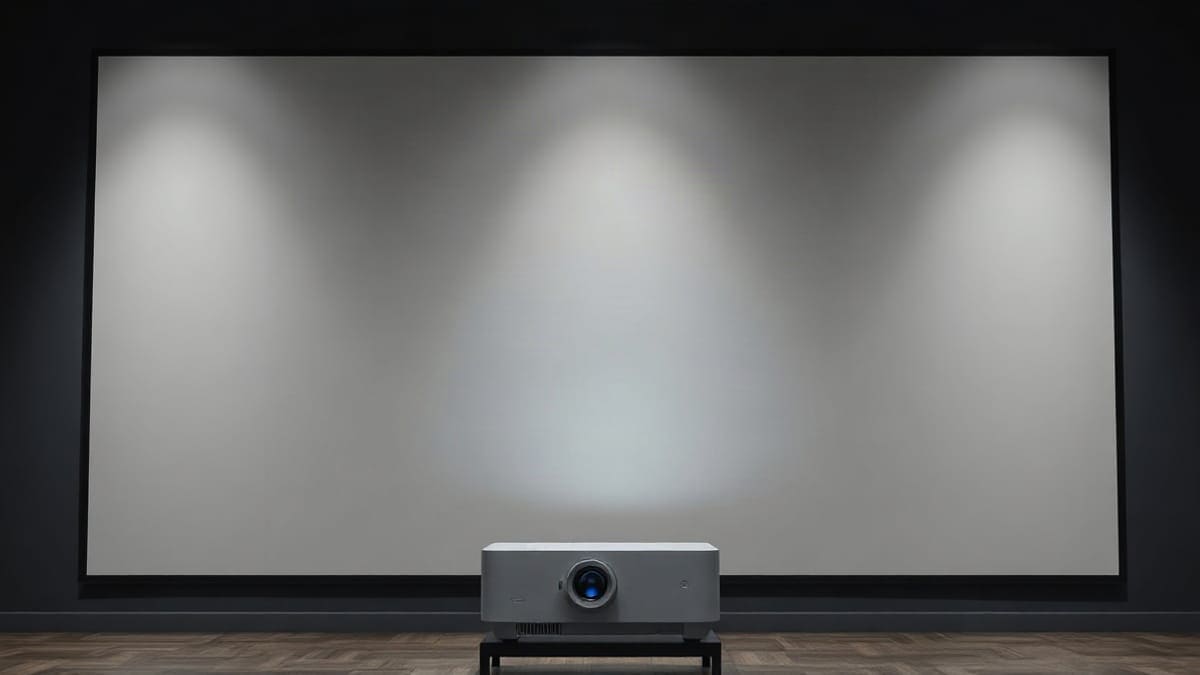
Buy a matte white fixed frame screen with a gain of 1.0 to 1.3 for a dark room, and an ambient light rejecting (ALR) screen of 0.6 to 0.8 gain for a lit one. A 120 inch picture covers 42.7 square feet, and that area sets how much light each foot gets. We checked ten screens and tested none.
Get a white or light gray frame if lamps stay off.
Get an ALR screen if lamps stay on, matched to your lens.
Neither if the screen travels: see the portable projector screen guide.
Quick answer: what to know before you buy a projector screen
- Gain is a ratio, not a boost. A screen is passive. A gain of 1.0 matches a reference white surface, and a gain of 1.3 sends 30 percent more light toward the middle seats by narrowing the cone of light, according to Elite Screens' terminology guide.
- Light per square foot falls fast as the picture grows. A projector that measures 1,000 lumens makes 33.7 foot-lamberts on a 100 inch, 1.0 gain screen and 23.4 on a 120 inch one. The dark-room target is 16.
- Ultra short throw projectors need a screen built for them. A standard white screen shows a UST picture in the dark, but a lit room needs a lenticular or Fresnel ALR surface.
- Size for the seat, not the wall. A 36 degree picture from 12 feet is a 107 inch diagonal; a 30 degree one is 89 inches.
- No prices appear here. Without a trusted US price feed, each button says "Check price", and the screen should be priced together with the projector.
Our picks at a glance
- 1Elite Screens Sable Frame 2a dedicated dark room and a standard throw projectorCheck price
- 2Elite Screens Aeon CineWhite UHD-Ba wall where the frame should almost vanishCheck price
- 3Elite Screens Aeon CLR 3an ultra short throw projector on a cabinet in a room with some lightCheck price
Which projector screens can you buy right now?
Ten screens cover every common case: a dark-room fixed frame, an edge-free frame, a motorized drop screen, a manual roller, three ALR types, a gray screen, an ultra short throw screen and a reference-grade fixed frame. We kept a screen in the table only when a maker page or a dealer listing named its material, gain and size range.
Gain and sizes are the figures each maker or dealer prints. Where two listings disagree, the table shows both. Prices are left out on purpose.
| Screen | Type and material | Listed gain | Listed view angle | 16:9 sizes (diagonal) | Fits |
|---|---|---|---|---|---|
| Elite Screens Sable Frame 2 | Fixed frame, CineWhite UHD-B | 1.3 (some dealers 1.1) | 180° | 105 to 200 in | Standard throw, dark room |
| Elite Screens Aeon CineWhite UHD-B | Edge-free fixed frame | 1.3 | 180° | 100 to 200 in (one page says 84) | Standard throw, dark room |
| Elite Screens Aeon CLR 3 | Edge-free ALR for ultra short throw | 0.8 | 170° | 103 and 123 in | Ultra short throw, lit room |
| Elite Screens VMAX Tab-Tension 3 | Motorized, tab-tension, CineWhite ISF | 1.1 | 180° | 105 to 138 in (120 in also listed) | Ultra short, short or standard throw, ceiling or wall |
| Silver Ticket STR series | Fixed frame, matte white | 1.1 on axis | 160° (dealer) | 92 to 150 in | Standard throw, dark room |
| AWOL Vision Cinematic ALR | Fixed frame, lenticular ALR | 0.6 peak | 170° | 100 to 150 in (pages differ) | Ultra short throw, lit room |
| AWOL Vision Daylight ALR | Fixed frame, Fresnel ALR | 1.1 peak (the New Gen version is listed at 1.5) | 90° | 100 and 120 in (New Gen 120 to 150 in) | Ultra short throw, daylight |
| Spectra Shadowscape ALR | Fixed frame, ALR for standard throw | 0.6 | 170° | 100 to 130 in | Standard throw, lit room |
| Stewart StudioTek 130 G4 (WallScreen 2.5) | Fixed frame, reference white | 1.3 peak | half-gain at 80° | 120 and 135 in listed | Standard throw, dark theater |
| Draper Luma 2 | Manual spring roller | 1.0 (Matt White XT1000E) | not stated here | 92 and 106 in HDTV, more in other shapes | Standard throw, budget wall |
The picks below follow one rule. Each screen is matched to the projector class it suits, because a great screen on the wrong projector loses light. Our projector and screen combo guide covers kits that bundle both.
Elite Screens Sable Frame 2: the standard dark-room fixed frame
Best for a dedicated dark room and a standard throw projector. Not for a living room with lamps, because a gain of 1.3 also reflects room light back.
Elite's shop page lists CineWhite UHD-B with a gain of 1.3 and a 180 degree viewing angle, in 16:9 from 105 to 200 inches and in 2.35:1 at 138 and 158 inches. The frame ships in pieces to cut freight, with sliding wall brackets for centering, and carries a 2 year limited warranty.
Dealers disagree on gain. Adorama lists the 120 inch ER120WH2 at 1.1, while Elite's own dimensions sheet for the M-type version prints 1.3. Read the sheet for your exact model number. The 120 inch version has a 104.7 by 59.0 inch picture area and a 109.3 by 63.5 inch overall size, and Adorama gives its weight as 28.7 pounds.
Elite Screens Aeon CineWhite UHD-B: the same surface with a thin edge
Best for a wall where the frame should almost vanish. Not for a very bright room, since it shares the 1.3 gain surface of the Sable Frame 2.
The Aeon uses the same CineWhite UHD-B material with a gain of 1.3 and a 180 degree viewing angle, but the frame is edge free, so the picture runs close to the border. Elite lists 16:9 sizes from 100 to 200 inches and 2.35:1 sizes at 103, 125, 138 and 158 inches. One shop page starts at 84 inches, so confirm the size you want.
Choose it over the Sable Frame 2 for looks. The picture and gain match; the difference is the bezel. For the acoustically transparent sibling, see the A8K version in the materials section below.
Elite Screens Aeon CLR 3: the ultra short throw screen from Elite
Best for an ultra short throw projector on a cabinet in a room with some light. Not for a standard throw projector, which sends light from the wrong direction.
Elite's shop page lists a gain of 0.8, a 170 degree viewing angle, a black backing, an edge-free frame and ambient light rejection of up to 90 percent. That last number is Elite's claim, not a lab test. Sizes are 103 and 123 inches in 16:9. The older Aeon CLR is rated at 0.6 gain with 180 degrees and is sold in the same two sizes.
At 0.8 gain, a 3,000 lumen projector on a 100 inch picture lands near 81 foot-lamberts by our formula, which clears even the 60 foot-lambert target for a bright room. Our ultra short throw projector guide lists models to pair with it.
Elite Screens VMAX Tab-Tension 3: the motorized drop screen
Best for a family room where the screen should disappear into a ceiling or wall case. Not for a bright room with an ultra short throw beam, where a white surface washes out.
Elite lists CineWhite ISF at a gain of 1.1 with a 180 degree viewing angle, and a CineGrey option at 1.0 gain and 160 degrees. The 16:9 sizes are 105, 115, 125, 135 and 138 inches, with a 120 inch listing too. Tab-tension cords pull the sides of the fabric, which Elite says reduces side curling, and the page lists ultra short, short and standard throw projectors as compatible. We took these values from our motorized projector screen guide, which read the Elite page on 15 to 17 November 2026. Elite's older VMAX2 is now listed as discontinued, so it only matters as a used reference.
Motorized screens need an outlet near the case. They also unroll, so a wave in the fabric is the usual complaint; the flatness section explains why.
Silver Ticket STR series: the plain, well-priced wall frame
Best for a first screen on a wall with a standard projector in a dark room. Not for a lit room, because the matte white surface has no ambient light rejection.
Silver Ticket's STR-169110 lists a 110 inch diagonal, a 96 by 54 inch viewing area, a 2.375 inch frame and a gain of 1.1 on axis. The maker calls it recommended for 4K and flame and mildew resistant. The line runs from 92 to 150 inches in 16:9, and perforated versions, such as the STR-169120-P, are made to sit over speakers.
Dealers list other surfaces for the same sizes, including a gray vinyl at 1.0 and a dark gray at 0.95, and a woven acoustic version at 1.15. Match the model suffix before you pay.
AWOL Vision Cinematic ALR: lenticular ALR for ultra short throw
Best for an ultra short throw projector in a lit living room, such as the one in our JMGO O2S Ultra page. Not for a standard throw projector.
AWOL's page lists a peak gain of 0.6, 95 percent ceiling light rejection and a 170 degree viewing angle. The size range reads 100 to 150 inches on one page and 120 to 150 on another, so choose the size from the order screen. The company also sells it in bundles with its own ultra short throw projectors, and a floor-rising motorized version at 0.8 peak gain in 100 to 130 inches.
Lenticular surfaces trade gain for contrast: a 0.6 screen needs 1.7 times the lumens of a 1.0 screen to reach the same brightness.
AWOL Vision Daylight ALR: the Fresnel screen for a bright room
Best for a lit room with an ultra short throw projector and seats mostly in front. Not for wide seating, because a Fresnel surface dims off axis.
AWOL's spec sheet for the 100 and 120 inch sizes lists a peak gain of 1.1 and a 90 degree viewing angle. The 1.5 gain belongs to the New Gen version, sold in 120 to 150 inches; our ALR projector screen guide compares the two. Even at 1.1 it is brighter than a lenticular screen in the same room, at the cost of a narrower sweet spot. On our formula a 3,000 lumen projector at 1.1 gain reaches about 111 foot-lamberts on a 100 inch screen and 77 on a 120 inch one.
The gain and the angle come from that guide's reading of the maker's sheet; AWOL's page did not load for a second check on 17 November 2026, so confirm which version ships before you order.
Spectra Shadowscape ALR: ALR for a standard throw projector
Best for a standard throw projector in a living room with lamps on. Not for an ultra short throw projector, because the surface is made for a level beam.
Dealer listings give a gain of 0.6 and a 170 degree viewing angle, in 16:9 at 100, 110, 115, 120, 125 and 130 inches, with 2.40:1 and custom sizes at higher cost. The listings state 4K and 8K readiness and a wall-mounted fixed frame. A 120 inch version has a 104.6 by 58.8 inch picture.
These are dealer figures, not a maker datasheet, and the surface needs a bright projector: at 0.6 gain, 2,000 lumens give 28 foot-lamberts on a 100 inch picture.
Stewart StudioTek 130 G4: the reference white fixed frame
Best for a dedicated theater where color accuracy and uniformity come first. Not for a lit room or a tight budget.
Stewart's StudioTek 130 G4 data sheet lists a peak gain of 1.3 at 0 degrees, a half-gain angle of 80 degrees and THX certification. Dealers sell it in the WallScreen 2.5 fixed frame, with listings at 120 inches (58.75 by 104.5 inches) and 135 inches (66 by 118 inches). A Sound and Vision bench test judged the StudioTek 130 only slightly brighter than Stewart's Cima screen.
Dealers print the same fabric at 1.0 and 1.3, so use the data sheet figure and ask the dealer to confirm.
Draper Luma 2: the manual pull-down roller
Best for a classroom, an office or a spare room where a roller on the wall is enough. Not for a theater, because a rolled fabric has more waves than a tensioned frame.
Draper lists Matt White XT1000E at a gain of 1.0 and Contrast Grey XH800E at 0.8. Dealer pages show the Luma 2 in 92 inch (45 by 80 inches) and 106 inch (52 by 92 inches) HDTV sizes, plus 4:3, 16:10 and square formats. It is a heavy duty spring roller, mounted to a wall or a ceiling. Draper says its gain is measured against the magnesium carbonate reference rated at 1.0.
Our classroom projector guide pairs it with rooms of that size.
What is a projector screen, and how does a screen projector work?
A projector screen is a flat surface made to send the projector's light back to the audience in a controlled way. The projector makes the picture; the screen decides how bright, how even and how contrasty it looks. A white wall does the same job unevenly.
Two things happen on the surface. The material reflects part of the light toward the seats, and its coating or structure decides which directions get more of it. ALR screens add a second job: they send light from the projector toward the viewer and reject light from the sides or the ceiling.
What is a projector screen used for? Movies and sports at home, slides in a classroom, and sales decks in an office. The surface sets the picture, the projector sets the pixels, so a "4K screen" label describes a smooth surface and adds no detail. Our how a projector works guide covers the optics inside the projector, and the combo guide shows how the two parts match.
Where do mirroring and laptop questions belong?
Questions about duplicating a laptop, casting a phone or freezing the image are about the source, not the screen. Follow how to connect a projector to a laptop and how to connect a phone to a projector. The same goes for rotating the picture and for the technology inside an LCD projector.
Which types of projector screens exist?
Eight formats cover almost every purchase. They differ by how the fabric is held, and that decides how flat, how portable and how permanent the screen is.
| Type | How the fabric is held | Flatness | Moves? | Best use |
|---|---|---|---|---|
| Fixed frame | Stretched on an aluminum frame | Best | No | Dedicated theater, living room wall |
| Edge-free fixed frame | Same, with a thin bezel | Best | No | Modern living room |
| Motorized drop | Roller in a case, motor unrolls it | Good, can wave | Yes, from a remote | Family room, ceiling |
| Tab-tensioned motorized | Side cords pull the fabric | Better than plain roller | Yes | Theater with a hidden case |
| Manual spring roller | Pull down by hand | Fair | Yes | Classroom, office |
| Floor-rising | Rises from a base on the floor | Good | Yes | Living room with no ceiling room |
| Tripod portable | Pull-up on a stand | Fair | Yes, carried | Garage, patio, travel |
| Inflatable | Air-filled frame | Fair | Yes, carried | Backyard movie nights |
The surface is a separate choice. A fixed frame can carry white, gray or ALR cloth. Our inflatable movie screen guide covers the last type, and the portable projector screen page the tripod and fold-up types.
The standard that most guides quote for brightness is SMPTE 196M, which sets the 16 foot-lambert film target. A screen never raises that number on its own, but the right gain lets a modest projector reach it at a larger size.
Reading a screen listing takes four checks. First, the gain and the angle together, because a gain without an angle hides the trade. Second, the throw type the screen is built for. Third, the frame and the overall width, which can add 5 inches to the picture. Fourth, the exact model number, because the same size can carry a different fabric.
Which type should you pick? Pick a fixed frame if a wall is free and flatness matters. Pick motorized if the wall has to stay clear. Pick tripod or inflatable only when the screen moves.
Is a projector screen transparent?
A normal screen is not. Acoustically transparent screens are perforated or woven so sound passes through from speakers placed behind; Elite's Aeon CineWhite A8K is rated at 1.1 gain with 170 to 180 degrees, and Silver Ticket sells perforated "-P" versions. A truly see-through film for windows is a different product, covered on our page for transparent projector screens.
What is projector screen gain, and what gain do you need?
Gain is the brightness of the screen's center compared with a reference white surface rated 1.0. It is a ratio, and it comes with a trade. High gain concentrates light into a narrow cone; low gain spreads it wider.
The reference is a NIST traceable white standard, and the maker quotes the ratio of reflected light to that standard. Elite's guide adds that viewing angle here means the half-gain angle, the horizontal angle where brightness drops by 50 percent. A screen with gain above 1.3 is called high gain, and one below 1.3 low gain in its terms.
A high gain also changes the look across the room. The center seat sees the peak, while a seat 40 or 50 degrees off axis can see the picture drop toward half. Stewart prints an 80 degree half-gain angle for its 1.3 gain StudioTek 130 G4, and AWOL a 170 degree angle for its 0.6 gain lenticular. The lower the gain, the more even the picture looks from the side seats.
The rule of thumb: pick the lowest gain that still reaches 16 to 40 foot-lamberts in your room. The formula is lumens times gain divided by the screen area in square feet. Our table uses a projector that measures 1,000 lumens, so you can scale it by your own number.
| Gain | 100 in (29.7 sq ft) | 120 in (42.7 sq ft) | 150 in (66.8 sq ft) | Typical surface |
|---|---|---|---|---|
| 0.6 | 20.2 fL | 14.0 fL | 9.0 fL | Lenticular or standard throw ALR |
| 0.7 | 23.6 fL | 16.4 fL | 10.5 fL | Soft gray |
| 0.8 | 27.0 fL | 18.7 fL | 12.0 fL | CLR for ultra short throw |
| 1.0 | 33.7 fL | 23.4 fL | 15.0 fL | Matte white reference |
| 1.1 | 37.1 fL | 25.7 fL | 16.5 fL | Common white fabrics |
| 1.3 | 43.8 fL | 30.4 fL | 19.5 fL | High gain white |
| 1.5 | 50.5 fL | 35.1 fL | 22.5 fL | Fresnel for daylight |
Brightness claims on a projector box use a different yardstick. A projector rated in ANSI lumens is measured over nine points of the picture, and ISO 21118 is the stricter international test. Neither says how a screen will treat the light, so the screen math starts only after you know the measured lumens.
To use the table, multiply by your projector's measured lumens divided by 1,000. JMGO rates the N1S Ultimate at 3,500 ANSI lumens, and the labs measured 2,608 (ProjectorCentral) to 2,771 (Projector Reviews) in Standard mode (see our projector on a wall page), so on a 120 inch, 1.0 gain screen it gives about 61 to 65 foot-lamberts. Rated numbers run higher than measured ones, so use the measured figure when you have it.
How many lumens do you need? Our lumens guide sets targets by room. In a dark room, 16 foot-lamberts is the film target quoted by Acoustic Frontiers, and many people accept up to 30 for a brighter picture.
Does a projector screen make a difference?
Yes, in evenness, color and contrast, and less so in raw brightness. A flat surface removes bumps that a wall shows. A neutral surface keeps skin tones stable. A gray or ALR surface lifts perceived contrast when the room has light.
The difference is small in a dark room with a flat, white, matte wall and large in a lit room with a beige or textured one. Our projector vs TV comparison puts the whole image chain in context.
Does projector screen material matter, and does quality matter?
Material matters because it sets the gain, the angle and the texture. Quality matters mostly in flatness and uniformity: cheap fabric waves, shows seams or has hot spots. On the same projector, a high quality 1.0 screen and a poor 1.0 screen can look different at the edges. For the fabric types, see our movie screen material guide.
Which surface material fits which room?
Matte white is the default; gray suits lamps on; ALR suits a lit room. Match the material to your light, not to a brand. Our best projector guide gives the one-line version.
| Material | Gain range quoted by makers | Strength | Weak point | Pick it when |
|---|---|---|---|---|
| Matte white (CineWhite, MaxWhite, XT1000E) | 1.0 to 1.3 | Brightest, widest color range | Reflects room light | Room is dark |
| Soft or contrast gray | 0.7 to 0.95 | Deeper blacks in light | Lower white level | Lamps stay on a little |
| Lenticular ALR | 0.6 to 0.8 | Rejects light from above | Needs UST, shows grid up close | UST in a living room |
| Fresnel ALR | up to 1.5 | Bright in daylight | Dims off axis, ghost at times | Seats mostly in front |
| Standard throw ALR | 0.6 | Contrast with lamps on | Needs lumens | Normal lens in a lit room |
| Acoustically transparent | 1.0 to 1.15 | Speakers behind the screen | Slight texture, lower gain | Theater with hidden speakers |
AWOL lists a soft gray CineContrast fixed frame at 0.7 gain, in 100, 120, 135, 150, 180 and 200 inches. Elite's CineWhite is 1.3 in its UHD-B variant and 1.1 in the standard grade, according to Elite's chart.
How does ALR work? A lenticular screen uses fine horizontal grooves with a dark top and a reflective bottom, so light from above is absorbed while the projector's light bounces to the seats. A Fresnel screen uses concentric rings. ProjectorScreen.com prefers lenticular in almost every living room because the angle is wider.
Which projector screen color is best, and does it have to be white?
White is the best color for a dark room; gray is best for a lit one. Neither is mandatory. A projector screen does not have to be white if the room is lit and the surface is designed for it. Light gray at 0.7 to 0.95 gain keeps blacks deeper, and the white level falls by the gain difference.
Colors other than white, gray or neutral ALR shift every tone the projector makes. Never choose a tinted screen to match a decor scheme.
Why are projector screens white or gray, and can a screen be black?
A screen is white because it must send back all the colors in the picture, and white does that evenly. It is gray when the goal is contrast. A black screen can work, but only an ALR design, because the dark surface absorbs the light and relies on angled microstructure to send the picture back to the viewer.
On a black wall, a standard projector gives a dim picture; see projecting on a black wall. Our pages on black vs white projector screens and gray vs white give the long answer.
Standard throw ALR or ultra short throw ALR: which do you need?
Pick by the projector, not by the room. The throw ratio decides which ALR works: a screen built for an ultra short throw beam rejects light from above, and one built for a standard lens rejects light from the sides.
A mismatch is the most common ALR mistake. An ultra short throw screen under a standard projector sends light toward the ceiling, and a standard ALR under an ultra short throw projector creates dark bands.
| Projector class | Throw ratio | Screen to pick | Examples in this guide | Gain to expect |
|---|---|---|---|---|
| Standard throw | about 1.2:1 | Matte white, gray, or standard throw ALR | Sable Frame 2, Silver Ticket STR, Shadowscape | 0.6 to 1.3 |
| Short throw | about 0.4 to 0.8:1 | Matte white or a flat gray | Sable Frame 2, Aeon CineWhite | 1.0 to 1.3 |
| Ultra short throw | 0.16 to 0.25:1 | Lenticular or Fresnel UST screen | Aeon CLR 3, AWOL Cinematic, AWOL Daylight | 0.6 to 1.5 |
For throw ratios and distances, use our projector throw distance calculator and the page on throw ratio explained. Our short throw projector guide lists models whose picture fills a normal screen from a short distance.
Elite lists the Aeon CLR 3 for throw ratios in the ultra short range. For a laser TV set, the Hisense laser TV page shows how a maker sells the screen with the projector.
What are the drawbacks of an ALR screen?
An ALR surface costs light, narrows the seating area or both. A lenticular screen sits at a gain near 0.4 to 0.6 in ProjectorScreen.com's description, so the projector has to be bright enough to carry it. Its fine grooves cannot be repaired once scratched, and the surface needs a wall that stays dust-free.
A Fresnel screen reaches a higher gain, up to 1.5 on AWOL's New Gen listing (the 100 and 120 inch version is 1.1), but ProjectorScreen.com notes that it dims off axis and can show a ghost image on the ceiling. It also ships only as a pre-assembled fixed frame, which makes a 120 inch unit awkward to carry through a door.
Neither type fixes a poor projector. A screen cannot add resolution, contrast the projector lacks or lumens it does not make. It only decides how the light it receives reaches your eyes, so spend on the projector first and on the screen second, then match them with the table above.
Both surfaces reject light only from the directions they were designed for. A lamp placed beside the screen, or a window that faces it, still lifts the black level. Keep side lamps off the screen wall, and close the curtains for the best contrast.
Our guide to what an ALR screen is and the page on ultra short throw screens will cover these in depth.
What projector screen size do you need?
Size the screen to the seat first, then check lumens. A diagonal near 0.6149 times the seating distance gives the 30 degree SMPTE field of view, and about 0.746 times the distance gives the 36 degree THX field. Those factors come from the 16:9 geometry.
SMPTE's 30 degrees was written for mastering rooms, and THX's 36 degrees is the usual home theater target, according to sources such as Audio Advice. Pick the smaller figure for a bright room, the larger one for a dark theater.
| Diagonal | Width | Height | Area | Seat distance at 36° | Seat distance at 30° | fL at 1,000 lm, gain 1.0 |
|---|---|---|---|---|---|---|
| 80 in | 69.7 in | 39.2 in | 19.0 sq ft | 8.9 ft | 10.8 ft | 52.7 |
| 100 in | 87.2 in | 49.0 in | 29.7 sq ft | 11.2 ft | 13.6 ft | 33.7 |
| 120 in | 104.6 in | 58.8 in | 42.7 sq ft | 13.4 ft | 16.3 ft | 23.4 |
| 135 in | 117.7 in | 66.2 in | 54.1 sq ft | 15.1 ft | 18.3 ft | 18.5 |
| 150 in | 130.7 in | 73.5 in | 66.8 sq ft | 16.8 ft | 20.3 ft | 15.0 |
| 200 in | 174.3 in | 98.1 in | 118.7 sq ft | 22.3 ft | 27.1 ft | 8.4 |
Read the last column against the target: only the 80 to 135 inch rows clear 16 foot-lamberts at 1,000 lumens with a gain of 1.0. A 150 inch picture needs a gain of 1.1 or more at that brightness.
The angle a picture spans depends on the seat. A 100 inch picture spans 43.9 degrees from 9 feet, 33.7 from 12 feet and 27.2 from 15 feet. A 120 inch picture spans 51.7, 39.9 and 32.4 degrees from the same seats. Past 40 degrees you start turning your head for a fast game or a spreadsheet, while a film still feels immersive. Pick the size for the seat you use most, and let the lumens set the upper limit.
Our projector screen size calculator and movie theater screen size page go deeper.
How long and wide is a 100, 120 or 150 inch projector screen?
A 16:9 screen is 87.2 percent as wide as its diagonal. A 100 inch screen is 87.2 inches wide and 49.0 inches high. A 120 inch one is 104.6 by 58.8, and a 150 inch one is 130.7 by 73.5, which is nearly 11 feet of wall.
Add the frame. The Elite ER120WH2 has a 104.7 inch picture inside a 109.3 inch overall width, and the Silver Ticket STR-169110 has a 2.375 inch frame around a 96 inch picture.
What throw distance does the screen call for?
Distance equals the throw ratio times the picture width. A 1.2:1 lens needs 8.7 feet for a 100 inch picture, and an ultra short throw at 0.2:1 about 1.5 feet. Our full method is on how far a projector should be from the screen.
How high should a projector screen be off the floor?
Put the bottom edge 24 to 36 inches above the floor for sofa seating, so the picture sits at eye level and the back row can see over a head. The center of the picture should be near the seated eye height, about 40 to 48 inches. That is our rule of thumb; no maker publishes a single figure. A 120 inch screen is 58.8 inches tall, so its top edge sits at 83 to 95 inches.
Can a projector screen size be adjusted?
A fixed frame cannot. The picture size changes with the projector's zoom or its distance, and the screen stays at its size. Some motorized screens stop at preset heights, so check the maker page. If you want a picture that adapts, leave a margin: a screen 5 to 10 percent bigger than the largest picture you plan to use.
What aspect ratio should a projector screen have?
Buy 16:9 unless you mostly watch widescreen films and use a projector that can zoom into 2.35:1. Most TV, streaming and games are 16:9, and a 16:9 screen has no black bars on them.
A film shot at 2.35:1 on a 16:9 screen uses 75.6 percent of the screen's height, leaving 24.4 percent as black bars. A 2.35:1 screen cuts the bars out, but a 16:9 picture then only fills 75.6 percent of its width.
| Screen shape | Example diagonals | Width x height | Area | Best for |
|---|---|---|---|---|
| 16:9 | 120 in | 104.6 x 58.8 in | 42.7 sq ft | TV, streaming, games |
| 2.35:1 | 103 in | 94.8 x 40.3 in | 26.5 sq ft | Films only |
| 2.35:1 | 138 in | 127.0 x 54.0 in | 47.6 sq ft | Large theater, with zoom |
| 2.35:1 | 158 in | 145.4 x 61.9 in | 62.5 sq ft | Large theater, with zoom |
Elite lists 2.35:1 sizes at 138 and 158 inches on the Sable Frame 2, and at 103, 125, 138 and 158 inches on the Aeon. Our aspect ratio guide covers projector settings.
Why do projector screens wave, and which type stays flat?
A fixed frame stays flattest because the fabric is tensioned on all four sides. A roller fabric hangs from one edge, so creases from the roll and a slight wave at the bottom are normal. Tab-tensioned motorized screens pull the sides with cords and are flatter than a plain roller.
Why does this matter? A bump of a few millimeters shows as a wave in a straight line of the picture. Ultra short throw projectors show it most, because the beam grazes the surface.
Tension matters more as the picture grows. A 135 inch screen is 117.7 inches wide, so a sag of a few millimeters across that span is easy to see on a bright title card. A rigid frame holds the fabric at the same pull on every side, which is why the dedicated-theater picks in this guide are frames.
Edge-free frames, which Elite sells under the Aeon name, shrink the bezel without changing the surface. Frame color matters too. Elite describes the frame of its Sable Frame 2 as velvet covered, which absorbs light that overshoots the picture. A black border also makes the picture look sharper, because the eye reads the edge as a clean line. If the projector overshoots, use the zoom to bring the picture back inside the frame rather than letting light spill onto the wall.
Mount any fixed frame on a flat wall and tighten the fabric as the instructions say; a warped wall warps the frame.
Do you have to use a screen with a projector?
No. A flat, matte white wall works in a dark room, and a screen is the upgrade when the wall is tinted, textured or the room has light. Our projector on a wall guide lists the wall figures and our do you need a screen page gives the decision.
Why use a projector screen at all?
Skipping the screen is a fair choice when budget is tight. The honest cost is color and evenness, not sharpness. A screen gives a known surface: a gain you can read on a datasheet, a flat plane and a clean edge. It makes a picture the same from room to room. It is important in a lit room, where an ALR surface can keep the picture visible and a wall cannot. For the full comparison, see a projector screen vs a white wall.
What is projector screen paint, and does it work?
Yes, paint can work, but flat white paint on a smooth wall is enough in a dark room. Projection paints such as Screen Goo add gray or reflective layers, and a reviewer at Big Picture Big Sound saw deeper blacks on a painted wall. Which paint? Flat, bright white for a dark room, gray for a lit one. We do not print prices, so check the can for the cost per coat.
Our projector on a wall page compares the paints in a table, and our ALR projector screen paint page goes further.
Where can a projector screen hang or stand?
No wall is required. Our combo guide answers whether a screen must sit against a wall. A screen can hang from a wall, drop from a ceiling, rise from the floor or stand on a tripod. A fixed ultra short throw screen has to be flat and rigid, so it usually mounts on a wall or sits in a floor unit.
Can a projector screen go outside or work in daylight?
Yes, with an outdoor model, and only after dark unless the screen is ALR and the projector is bright. Direct sun beats every screen and projector in this guide.
Elite's Yard Master 2 is made for the yard and comes in three versions that differ in gain, angle and size. Elite's Tripod Pro is a separate 1:1 pull-up of 85 to 119 inches at 1.1 gain and 160 degrees.
| Elite Yard Master 2 version | Surface | Gain | View angle | Sizes | Ultra short throw? |
|---|---|---|---|---|---|
| Front projection | CineWhite UHD-B | 1.3 | 180° | 58 to 140 in | Listed as usable |
| WraithVeil Dual (front or rear) | WraithVeil | 0.8 | 150° | 105 to 180 in | Yes, the only one listed |
| Rear projection | WraithVeil | 2.2 | 120° or 160° (pages differ) | 90 to 135 in | No |
The choice follows the projector. A front version works with a portable projector set on a table in front of the audience, and the 1.3 gain helps a dim projector at dusk. The 0.8 gain Dual version is the one to pair with an ultra short throw model, and it trades brightness for a surface that tolerates the steep beam. Pick the size from the number of guests, then check the lumens with the foot-lambert formula above.
Rear projection puts the projector behind the screen, so it suits an event with a hidden crew and not a patio. Size pages on Elite's site differ by a few inches, so confirm the one you order.
For a complete outdoor setup, read the outdoor movie screen guide, the inflatable screen guide and our daylight projector page.
Can a projector screen get wet, and can you wash one?
An indoor tensioned screen is not made to get wet. Water can mark the fabric and affect the frame. An outdoor model is built to take weather for a movie night, and you take it down afterward. We found no maker page that approves washing an indoor surface, so follow the care sheet in the box; a dry brush or a lightly damp cloth is the cautious start.
What sets a projector screen's price and lifespan?
No maker publishes a lifespan. Elite's Sable Frame 2 page states a 2 year limited warranty, or 3 years for education, nonprofit, religious, government and military buyers. A frame lasts as long as the wall; the fabric ages through creases, dust and sunlight.
How much does a projector screen cost? We print no prices, because we have no reliable US source. The figure depends on three things: size, since area rises with the square of the diagonal; surface, since ALR layers cost more than plain white; and type, since a motor adds cost. Price the screen, the mount and the projector together, and use our cheap projector guide if you start from a budget.
For a combined view, see our combo guide, which has a cost section.
Why the price gap? An ultra short throw ALR screen is an engineered optical surface, so its layers must stay flat over 100 inches, while a plain matte screen does less. Our combo guide answers why projector screens cost what they do.
Where and how do you mount a projector screen?
Seat height decides more than people expect. A projector aimed at a screen too low puts the picture in the viewer's lap, while one too high forces a neck tilt. Sit where the sofa will be, mark the eye line, and set the picture center a little above it.
A screen is easier to place before the projector arrives, because the screen has a fixed size and the lens can zoom to fit it. Mark the wall at the planned picture width, check for outlets and studs, and decide how far the case or frame can stand out from the wall.
Mount a fixed frame on studs, using the maker's bracket, and level it before you tighten. A 120 inch Sable Frame 2 weighs about 28.7 pounds per Adorama, so two people can lift it and one should hold it. Elite ships sliding brackets so you can center it after hanging.
For a ceiling drop screen, plan the case length, which is slightly wider than the picture, and an outlet near the motor. A ceiling mounted projector pairs well with a drop screen: see our ceiling mounted projector page and the setup guide.
Where to put the screen in a bedroom? At the foot of the bed with a 80 to 100 inch picture is common; see our bedroom projector guide.
Where do you buy or rent a projector screen?
The same surface sells under several brand names, so compare the datasheet, not the logo. A dealer can ship a frame in pieces, which is common for sizes above 100 inches.
Buy from the maker or from an authorized dealer, because the warranty depends on it. Elite, Silver Ticket and AWOL sell direct, Stewart and Draper sell through dealers, and ProjectorScreen.com lists the Spectra and Stewart models. Check the listing for the model number, the size and the surface.
Where to rent a screen? AV rental companies and party-rental stores supply screens with stands. We have no verified rental prices. For screens near you, a local AV dealer can show a sample; a projector store in your area lets you compare surfaces under real light before you buy.
How do you pick a screen for your room?
Pick the surface from the room light, the type from the wall and the size from the seat. Use the table as the final check.
| Your room | Projector | Pick | Gain to look for | Size |
|---|---|---|---|---|
| Dark theater | Standard throw | Fixed frame, matte white | 1.0 to 1.3 | 110 to 135 in |
| Living room, lamps on | Standard throw | Standard throw ALR, such as Shadowscape | 0.6 | 100 to 120 in |
| Living room, lamps on | Ultra short throw | Lenticular, such as AWOL Cinematic or Aeon CLR 3 | 0.6 to 0.8 | 100 to 123 in |
| Bright room, daylight | Ultra short throw | Fresnel, such as AWOL Daylight | 1.1 (New Gen 1.5) | 100 to 150 in |
| Family room, hidden screen | Standard throw | Motorized, such as VMAX Tab-Tension 3 | 1.1 | 105 to 125 in |
| Classroom or office | Any, 3,000 lumens or more | Manual roller, such as Draper Luma 2 | 1.0 | 92 to 106 in |
| Backyard | Portable | Outdoor frame or inflatable | 1.1 to 1.3 | 90 to 140 in |
What screen suits a dark home theater?
For a dark theater, take a rigid fixed frame with a gain of 1.0 to 1.3 and a 135 inch or smaller picture, such as the Sable Frame 2 or the Stewart StudioTek 130 G4. Add a 2.35:1 screen only if you watch mostly films and your projector can zoom. Our home theater projector page has matching projectors, and the 4K projector guide covers resolution.
What screen suits a living room or the rest of the home?
For most living rooms, the answer depends on the lamps. With lamps on, an ALR screen of 0.6 to 0.8 gain at 100 to 123 inches. With lamps off, a white fixed frame at 100 to 120 inches. If you have no free wall, a floor-rising or a motorized screen keeps the wall clear.
Common mistakes when you choose a projector screen
Most poor screens come from one mismatch. The table lists the ones that cost the most and the fix.
| Mistake | What happens | Fix |
|---|---|---|
| Ultra short throw projector on a standard white screen in a lit room | Blacks turn gray, wall flaws show | Use a lenticular or Fresnel UST screen |
| Standard ALR under a UST projector | Dark bands, light thrown at the ceiling | Match the ALR type to the throw |
| Choosing 150 inches for a 1,000 lumen projector | 15.0 fL at 1.0 gain, below the 16 target | Drop to 100 or 120 inches or raise the gain |
| Buying by diagonal without the frame | The 120 inch Sable Frame 2 is 109.3 inches wide overall | Measure the wall for the frame, not the picture |
| Trusting a gain with no model number | Dealers list 1.0 and 1.3 for the same Stewart fabric | Read the datasheet |
| Putting a roller screen where waves show | Creases in a straight line | Use a fixed frame or tab-tension |
| Buying 2.35:1 for TV | 16:9 content fills 75.6 percent of the width | Buy 16:9 |
How we checked these screens
We read the maker pages for Elite Screens, Silver Ticket, AWOL Vision, Stewart Filmscreen and Draper, and dealer listings for Spectra, between 15 and 17 November 2026. We kept a figure only when a page printed it, and we show both numbers when two pages disagree. We have not tested any screen, and the gain and light rejection numbers are maker claims, not lab results.
Open points: Elite's gain for the 120 inch ER120WH2 (1.1 or 1.3), the AWOL Cinematic size range (100 or 120 inches to 150), the AWOL Daylight New Gen angle, the Stewart StudioTek 130 gain on some dealer pages and the Spectra Shadowscape figures, which come from a dealer.
FAQ
Do projector screens emit blue light or hurt your eyes?
No. A screen emits no light of its own; it reflects what the projector sends. Whatever reaches your eyes is the projector's light, and a lower gain screen shows a softer picture than a high gain one. For the comparison with a TV, see projector vs TV.
Do projector screens work in daylight?
Only an ALR screen with a bright projector gives a usable picture with daylight in the room; a Fresnel type at 1.5 gain does the best. A plain white screen is washed out. Direct sun on the screen beats all of them.
Can projector screens be left outside?
Not an indoor screen. Outdoor models, such as Elite's Yard Master 2, are built for the yard. Take a portable screen down after use, because wind is the main risk to a tripod or inflatable screen.
Does a projector have to be directly in front of the screen?
No, but the further off axis it sits, the more keystone correction it needs, and software correction costs sharpness. Lens shift or a ceiling mount in line with the center gives the cleanest picture. An ultra short throw projector sits below the screen by design.
Why is the projector image upside down?
The projector is mounted on the ceiling and its image mode is set for a table. Open the projection mode in the menu and choose ceiling or rear, as our setup guide shows.
Where can you rent a projector screen near me?
Ask an AV rental company or a party-rental store, and check whether the stand is included. We have no verified rental prices. If you rent more than a few times a year, price a portable screen against the rental quotes.
Where can you buy a projector screen in a store?
Large electronics retailers carry a few sizes, and a local AV dealer can order the maker lines in this guide. A store lets you see a sample under your own light, but the full range is online from the maker.
What does 4K or 8K mean on a projector screen?
It is a label for a smooth, fine-textured surface. A screen has no pixels, so it adds no detail. Choose by gain, surface type and size, and use our 4K projector guide for resolution.
Is a gain of 1.3 always better than 1.0?
No. Higher gain is brighter in the center and dimmer off axis. In a room with lamps, it also reflects the lamps back. A 1.0 gain screen is the safer choice for wide seating.
How do you hang a projector screen on a wall?
Find the studs, hang the maker's bracket level and lift the frame onto it. A 120 inch frame weighs about 28.7 pounds, so use a helper. Center it with the sliding brackets if the maker supplies them.
Does a bigger screen always look better?
No. A larger picture has less light per square foot, so 150 inches needs 2.25 times the lumens of 100. Past a 36 degree field of view you also turn your head. Choose the size from the seat.
Can a ceiling projector and a drop screen work together?
Yes, and it is the classic family room setup. Align the center of the projector lens with the screen, and leave a margin so zoom changes do not spill over the case.
Sources
- Elite Screens: Sable Frame 2 shop page
- Elite Screens: Aeon series
- Elite Screens: Aeon CLR 3
- Elite Screens: VMAX Tab-Tension 3 series
- Elite Screens: Yard Master 2
- Elite Screens: Tripod Pro white paper
- Elite Screens: screen terminology
- Silver Ticket: STR-169110
- AWOL Vision: Cinematic ALR fixed frame
- AWOL Vision: Daylight ALR screen
- AWOL Vision: CineContrast soft gray screen
- Stewart Filmscreen: StudioTek 130 G4 data sheet
- Draper: Matt White XT1000E surface
- ProjectorScreen.com: Spectra Shadowscape 120 inch
- Audio Advice: choosing a home theater screen size
- Sound and Vision: Stewart Filmscreen Cima review
Keep comparing
 ProjectorWe compare 10 home projectors for 2026, from budget to 4K laser, with real brightness, throw distance
 Portable Projector 2026Nine real models compared on weight, rated and measured lumens, battery life and ports, with picks for travel
 Home Theater ProjectorEight home theater projectors compared for 2026 by contrast, black level, HDR, lens, noise and screen size
 Mini Projectors for 2026Nine real pocket models compared on weight, ANSI lumens, battery, ports and picture size