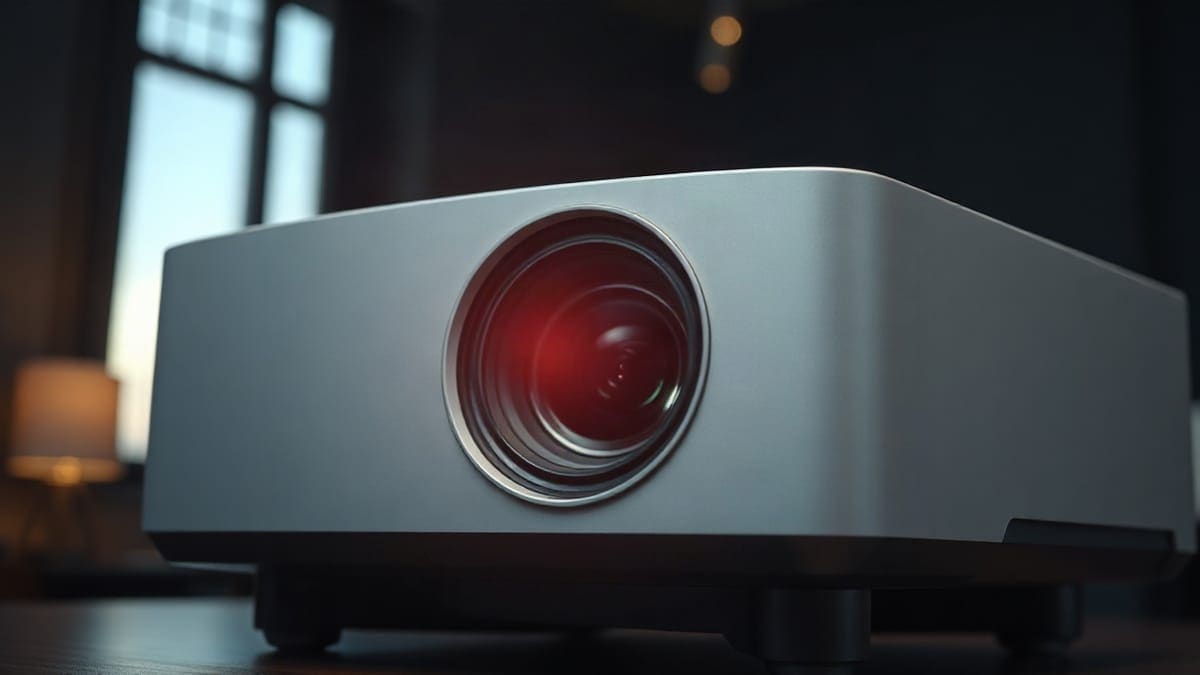
A projector makes light, shapes it into a picture with a small imager, and throws that picture through a lens onto a surface. The light comes from a lamp, an LED or a laser; the imager is a DLP mirror chip, three LCD panels (3LCD) or an LCoS chip. Each choice changes brightness, black level, rainbows, lifespan and price. We explain each part with published numbers.
Should you pick DLP, 3LCD or LCoS? Take this one, take that one
This block turns the technology into a buying choice.
- Take a single-chip DLP laser, such as the JMGO N1S Ultimate, if you want a small, bright projector and you have never seen rainbows on one.
- Take a 3LCD, such as the Epson Home Cinema 2350, if you are sensitive to rainbows or want white and color to be equally bright.
- Take an LCoS such as the Sony VPL-XW5000ES if the room goes fully dark and black level matters more than price.
- Take neither if you only need a picture for a few people on a couch. A 55 to 65 inch TV is simpler; see projector vs TV.
Quick answer: how a projector works in six points
- Light: a lamp (3,500 to 5,000 hours), an LED or a laser (20,000 to 30,000 hours on the models we list) makes white or colored light.
- Imager: DLP uses a chip with millions of tiny mirrors, 3LCD uses three liquid crystal panels, LCoS bounces light off liquid crystal on silicon.
- Lens: it focuses the picture. A 1.2:1 throw ratio needs 8.7 feet for a 100 inch image, a 0.22:1 ultra short throw needs 1.6 feet.
- Screen: a white wall reflects the light back to you. It cannot add black, so the room sets the darkest level.
- Rainbow effect: only single-chip DLP can show it, and only some viewers see it. 3LCD and three-chip designs do not.
- We have not tested any projector here. We read maker pages, Texas Instruments, Epson and JVC material, and independent lab data, and we say where they disagree.
What path does the light take through a projector?
Light goes from the source to the imager, through the lens, and lands on the screen. Every home projector follows the same four stages, and what differs is the part used at each one.
| Stage | What happens | Part | Choices |
|---|---|---|---|
| 1. Make light | A source produces bright light | Lamp, LED, laser | Lamp 3,500 to 5,000 h; laser 20,000 to 30,000 h |
| 2. Add color | White light is split or colors are made in turn | Color wheel, prism, RGB laser | Wheel, prism or three lasers |
| 3. Make the picture | Pixels are switched on or off | DMD chip, LCD panels, LCoS chip | DLP, 3LCD, LCoS |
| 4. Throw it | A lens focuses and sizes the picture | Zoom lens, lens shift | Throw ratio 0.22:1 to 1.2:1 |
Think of a flashlight shining through a slide: the flashlight is the source, the slide is the imager, and the lens is what sizes it. For kids: a projector shines a small, very bright picture through a magnifying lens onto the wall, so it grows to 100 inches or more.
The picture is not drawn all at once on the older single-chip designs. A single-chip DLP shows red, green and blue one after another, so at 60 frames per second it must produce at least 180 color flashes every second. Your eye blends them. That fact is the origin of the rainbow effect, covered below.
How does a projector work as a TV?
A projector works as a TV when you feed it a TV signal, usually from a streaming stick, a cable box or the apps built into it. Most models have no TV tuner. Many home models run Google TV or Android TV, so the apps sit inside them, and you still need a signal and sound.
The same goes for watching TV, movies or streaming at home: plug the source into HDMI, size the picture and dim the room. See how to use and set up a projector and projector vs TV. A laser TV is an ultra short throw projector 1.6 feet from the wall; see the Hisense laser TV guide.
How does a projector work with a laptop, phone, iPhone or iPad?
A wired link is the safest: HDMI from a laptop, or a USB-C to HDMI cable from a phone or tablet that supports video out. Wireless casting works on models with screen mirroring or Chromecast built in, with a small delay that matters for games.
- Laptop: HDMI is the standard. Windows and macOS treat the projector as a second display. See how to connect a projector to a laptop.
- Android phone: screen mirroring or a USB-C video cable. See how to connect a phone to a projector.
- iPhone and iPad: a Lightning or USB-C digital AV adapter, or AirPlay on projectors that support it. Not every projector does.
- Phone projectors: small projectors built for a phone's picture; see best phone projector.
How does a projector work with Netflix, Roku or a streaming stick?
Netflix works if the projector runs a certified Netflix app, or if you plug in a stick that does. Some projectors on Android TV have no certified Netflix app, which is why the Roku, Fire Stick and Chromecast route is common. The Nebula Capsule 3 Laser is an example: the 2023 version runs Android TV without Netflix and the August 2024 version runs Google TV with it, according to Notebookcheck.
How does projector sound work?
Most projectors have a small speaker, from 2 x 5 W to 50 W on the ten models in our best projector guide, and sound leaves them like it does from a TV speaker. Sound can also go to a Bluetooth speaker or a soundbar on the eARC port. The Hisense L9Q carries a 116 W Devialet system, but it is the exception.
What light sources do projectors use?
Projectors use a lamp, an LED, a laser with a phosphor wheel, or a three-color RGB laser, and the source sets brightness, color and lifespan. The source feeds light to the imager, and the imager never makes light on its own.
| Source | How it makes light | Rated life | On our models |
|---|---|---|---|
| UHP lamp | Arc in a high-pressure mercury bulb | 3,500 to 5,000 h | Epson Home Cinema 2350 (4,500 h), Optoma UHD38x (4,000 h, 15,000 h Eco) |
| LED | Red, green and blue LEDs, or white LED with filter | 25,000 to 30,000 h | Nebula Mars 3 |
| Blue laser + phosphor | Blue laser hits a phosphor wheel, which gives yellow and white | 20,000 to 30,000 h | Nebula Capsule 3 Laser (14 W blue laser) |
| RGB laser | Separate red, green and blue lasers | 20,000 to 30,000 h | JMGO N1S Ultimate, Valerion VisionMaster Max, Hisense PX3-Pro |
At 4 hours a night, 4,500 lamp hours last about 3.1 years (4,500 / 4 / 365), and a 20,000 hour laser lasts about 13.7 years. Brightness ratings follow ISO 21118, the stricter test, or the ANSI method, and the two are not interchangeable (Sound & Vision on ISO 21118). Lamps and lasers both dim with age; each maker defines the rated hours.
How does a projector lamp work?
A projector lamp, also called a bulb, is a bright arc lamp that heats until it glows white and then needs a cooldown. Cinema projectors often use xenon arc lamps, a related design. Because a hot lamp can break if it is cut cold, the fan runs a minute or two after you turn the projector off. Lamps are cheap to replace but fade with use; the rated-life answer below gives the hours.
How does a laser projector work?
A laser projector uses blue lasers hitting a phosphor wheel, or three lasers in red, green and blue, instead of a lamp. The phosphor design is cheaper and the RGB design shows a wider color range. JMGO says its dynamic speckle reducer cuts laser speckle (a faint shimmer on flat surfaces) by 97% on the N1S family, and that is the maker's figure. For the models, see best laser projector.
How does an LED projector work?
An LED projector uses small, cool LEDs, so the engine is compact and the unit can run on a battery, but it is dimmer than a lamp or laser at the same price. A mini LED projector is small, light and often under 1,000 lumens; the Nebula Mars 3 is rated 1,000 ANSI lumens with a 9.9 lb body. Brightness is covered in how many lumens you need, and the models in best LED projector.
When does a lamp or laser reach the end of its rated life?
A projector lasts as long as its light source is rated for, which is 3,500 to 5,000 hours for a lamp and 20,000 to 30,000 hours for a laser or LED. The projector does not stop on that day, it dims. Rated life is not a limit on one sitting; check the manual for a continuous-use note.
How does a DLP projector work?
A DLP projector uses a Texas Instruments chip, the DMD, made of millions of tiny mirrors; each mirror is one pixel and tilts toward the lens (on) or away from it (off). Texas Instruments describes the DMD as microscopic mirrors with a controller and driver on the chipset. A mirror that is on longer looks brighter, so gray comes from timing.
Most home DLP projectors use one chip. To make color, red, green and blue light reach the chip one after another, in time with the mirrors. A lamp projector does this with a spinning color wheel with red, green, blue and often a clear segment. A laser or LED model switches its colors on and off instead, so it needs no wheel. High-end and cinema designs use a prism to split the light and three chips, one per color, and show all colors at once.
Models and buying advice for this technology live on best DLP projector. A DLP chip is small, so the engine is small, which is why DLP leads in portable and short throw models.
How does a 3LCD projector work?
A 3LCD projector splits white light into red, green and blue, passes each through its own LCD panel, and joins them again with a prism before the lens. Epson says its 3LCD projectors process each primary color continuously with three liquid crystal panels, and describes the result as images with no rainbow effect distortion. Epson also claims up to 3 times brighter colors than comparable designs, which is a maker claim.
Because all three colors reach the screen at once, a 3LCD projector's color brightness matches its white brightness. The Epson Home Cinema 2350 is rated 2,800 lumens in both white and color, and the Epson EpiqVision Ultra LS650 is rated 3,600 ISO lumens, with ProjectorCentral measuring 3,485. The costs are size, since three panels and a prism take room, and a lower native contrast on most models than LCoS. See Epson projectors for the family.
How do LCoS, SXRD and D-ILA projectors work?
LCoS (liquid crystal on silicon) projectors bounce light off a reflective liquid crystal chip instead of passing it through, and Sony calls its version SXRD while JVC calls its version D-ILA. The mirror-like backplane lets the pixel gaps shrink and the black level fall, so they are the choice for dark home theaters.
JVCKENWOOD says it lowers black level with a wire-grid polarizer, a polarization compensation plate and stray-light control of the lens path. JVC lists its flagship DLA-NZ900 at 150,000:1 native contrast, which is JVC's own figure; a Sound & Vision measurement of the older DLA-X35 found 35,875:1. For Sony, Sound & Vision measured about 6,000:1 native on the VPL-VW665ES, with a dynamic iris lifting it toward 70,000:1. The Sony VPL-XW5000ES is rated 2,000 ISO lumens and has a native 3,840 x 2,160 0.61 inch SXRD, a 20,000 hour laser and a weight of 28.0 lb.
| Technology | Light path | Rainbows | Strengths | Weak spots |
|---|---|---|---|---|
| Single-chip DLP | Mirrors, color in sequence | Possible | Small, bright, long laser life | Some viewers see rainbows |
| Three-chip DLP | Prism, three mirror chips | No | Cinema color | Rare and costly at home |
| 3LCD | Three panels, prism | No | Equal white and color brightness | Larger, modest native contrast |
| LCoS (SXRD, D-ILA) | Reflective chip, prism | No | Deepest blacks | Heavy and expensive |
What is the rainbow effect, and who notices it?
The rainbow effect is a brief flash of red, green and blue edges that some viewers see on a single-chip DLP projector when a bright object moves against a dark background or when they move their eyes quickly. It happens because the chip shows one color at a time, and a fast eye movement can separate the colors before the brain blends them. 3LCD, LCoS and three-chip designs show all colors together, so they do not make it.
No reliable study gives a percentage that we could confirm, so we give none. Faster wheels, more segments and RGB laser engines reduce it. A reviewer noted a visible rainbow effect for sensitive viewers on the Valerion VisionMaster Pro 2, and ProjectorCentral notes that the Epson LS650's 3LCD design avoids rainbow artifacts.
If you see rainbows easily, test a single-chip projector at home within the return window.
What does the lens do to size and sharpness?
The lens enlarges the small image and focuses it on the screen; its zoom range and throw ratio decide how far back the projector can sit. Throw ratio is the distance divided by the image width. A 100 inch 16:9 image is 87.2 inches (7.27 feet) wide, so a 1.2:1 lens needs 8.7 feet and a 0.22:1 ultra short throw needs 1.6 feet. The throw distance calculator does the math, and best short throw projector and best ultra short throw projector list the models.
How does projector zoom, keystone and autofocus work?
Zoom changes the image size without moving the projector; keystone straightens a tilted picture; autofocus sets sharpness with a sensor. Optical zoom moves lens elements, and a 1.2x zoom means the image can grow by 20% at the same distance. Keystone correction warps the picture in software to square it up, and since it works on the image, a strong correction costs sharpness. Lens shift moves the lens itself and avoids that loss, which is why it appears on better projectors. Autofocus uses a distance sensor or a camera, depending on the model. Setting these is in how to use and set up a projector.
Can a projector work upside down?
Yes: a menu setting flips the picture so the projector can hang from a ceiling mount upside down. See best ceiling mounted projector.
Why does a white wall stay white and black look gray?
A projector can only add light, so a white wall shows the picture and black is simply the wall with little light on it. Black in a projected picture is the leak of light from the projector plus any light in the room. That is why contrast ratio, the white level divided by the black level, matters so much.
Here is our calculation. A 3,000 lumen projector on a 100 inch screen (29.68 square feet) gives about 101 foot-lamberts of white. At a 4,000:1 native contrast, black is 0.025 foot-lamberts. Add 1 foot-lambert of light from a window or lamp, which raises both levels, and you get 101 / 1.025, about 99:1. The room cut the contrast by a factor of 40. ProjectorCentral measured 3,900:1 on the Hisense L9Q against 5,000:1 rated, and our projector vs TV guide lists home models from 1,420:1 to 4,143:1 native.
Does a projector work better on a white or black wall?
A white or light gray, flat wall works best; a dark wall absorbs light and dims and dulls the picture. A black wall or a black fabric does not create a deeper black, it reflects less of everything, so a bright picture turns dim. A curtain adds shadows from its folds. A white projector screen is a smooth, even surface, and ALR (ambient light rejecting) screens and paints work by reflecting light from the projector's angle while rejecting light from the sides. See best projector screens and projector on a wall.
Does a projector work in daylight or outside?
It works if the picture is bright enough, which means more lumens for more light. For lumen numbers, units and room by room targets, see how many lumens you need, best projector for daylight, and for the yard, best outdoor projector. An inflatable movie screen is a blow-up screen, not a projector, and it is the usual outdoor surface.
How does pixel shifting make a 4K picture?
Pixel shifting moves a 1080p image by a half pixel several times per frame so the eye sees more detail than the chip has pixels. A 0.47 inch DLP chip with a 1,920 x 1,080 mirror array shifted 4 times per frame fills 8.3 million pixel positions. Whether that counts as native 4K is a debate we leave to best 4K projector and native 4K vs pixel shifting.
Why do projectors have fans and get hot?
A lamp, laser or LED makes far more heat than light, and the imager sits right next to it, so fans move that heat out. Lamp projectors run hottest, and laser engines run cooler but still need cooling for the lasers and the chip. Eco mode lowers the lamp power, which is why the Optoma UHD38x lamp is rated 4,000 hours in full mode and 15,000 hours in Eco. Keep the vents clear and let the fan finish before you unplug. Many spec sheets print fan noise in decibels, so compare it before you buy.
Which projector fits each technology?
Pick the technology for your eyes and your room, then the model. The table says what each choice changes for you.
| Your situation | Technology to look at | Why |
|---|---|---|
| Small room, easy carry | Single-chip DLP, LED or laser | Compact engine |
| You see rainbows | 3LCD or LCoS | Colors shown together |
| Room with some light | RGB laser or 3LCD with high color brightness | Bright colors |
| Dark home theater | LCoS or a good DLP laser | Black level |
| Wall space is tight | Ultra short throw laser | 1.6 feet from the wall for 100 inches |
| Lowest cost for a big picture | 3LCD or DLP lamp | Cheap light source |
JMGO N1S Ultimate (single-chip DLP, RGB laser). Best for living rooms with some light that want 4K by pixel shifting, a 30,000 hour laser and two HDMI ports; rated 3,500 ANSI lumens, with 2,608 ANSI measured in Standard mode by ProjectorCentral, and 9.9 lb. Not for viewers sensitive to rainbows who cannot return it. Check price. Read the JMGO N1S Ultimate review.
XGIMI Horizon 20 Max (RGB laser). Best for gaming and bright 4K: 5,700 ISO lumens rated, 3,312 ANSI measured in Movie mode by ProjectorCentral, 11.9 lb. Not for small bags or tight budgets. Check price. See XGIMI projectors.
Epson Home Cinema 2350 (3LCD lamp). Best for the lowest cost with equal white and color brightness: 2,800 ISO lumens rated (one outside lab measured about 2,000 ANSI), a 4,500 hour lamp, 9.0 lb. Not for anyone who wants a lamp-free projector. Check price.
Epson EpiqVision Ultra LS650 (3LCD laser, ultra short throw). Best for no rainbows and a 0.28:1 lens in a living room; 3,600 ISO lumens. Not for ceilings or tiny rooms. Check price.
Sony VPL-XW5000ES (native 4K SXRD, laser). Best for a dark room and the deepest blacks: native 3,840 x 2,160, 2,000 ISO lumens. Not for bright rooms or a small budget; at 28.0 lb it is also heavy. Check price.
Hisense PX3-Pro (RGB laser, ultra short throw). Best for a TV-like setup 1.6 feet from the wall: 3,000 ANSI lumens, 0.22:1, 19.8 lb. Not for anyone who moves a projector nightly. Check price.
Nebula Capsule 3 Laser (0.23 inch DLP, 14 W blue laser). Best for a 2.1 lb projector you can take anywhere; 300 ANSI lumens rated and 302 measured on the 2023 version. Not for daylight. Check price. See Nebula Capsule projectors.
For the complete shortlist, go to the best projector guide.
What else is called a projector, and how does it work?
The word projector covers anything that throws an image, and the rest use the same idea of light, picture and lens. A few common ones:
- Movie theater and film projectors: a film projector passes white light through moving film and a lens. A digital cinema projector uses DMD chips, three for the three colors in the high-end designs. See cinema projector: what theaters use.
- Overhead and slide projectors: a lamp shines through a transparency or slide, and a lens focuses it; a carousel holds a tray of slides.
- Pinhole projectors: a small hole forms an upside down image, the same principle as a camera obscura. People use one to view a solar eclipse indirectly.
- Galaxy, star and gobo projectors: a light shines through a patterned disc or stencil (a gobo), and a lens focuses the pattern, so these show a fixed design.
- Car projector headlights: a lens focuses the beam from the bulb and a shield makes the cut-off line.
- Planetarium projectors: older ones are a ball of lamps and star plates; modern ones are digital projectors on a dome.
- Tracing projectors: a lamp or LED throws a sketch or photo onto paper so you can trace it.
- CRT and rear projectors: old CRT projectors use three small tubes, one per color, each with its own lens. A rear projector sits behind a translucent screen, as in a projection TV.
- Homemade projectors: a magnifying lens, a box and a phone make a dim one; a lens enlarges the picture but never brightens it.
FAQ
How do the parts of a projector fit together?
A lamp, LED or laser makes light, an imager (DLP, 3LCD or LCoS) turns it into a picture, and a lens focuses that picture on a wall or screen. The six points at the top of the page give the numbers.
What does a projector need to work in daylight?
Many more lumens and a screen that rejects ambient light. The lumen targets are in how many lumens you need.
How do you make a projector work?
Plug in power, connect a source to HDMI, aim at a wall, focus, set the size and dim the room. Full steps are in how to use and set up a projector.
How does a projector color wheel work?
A single-chip lamp projector spins a disc with red, green and blue segments in front of the chip, and the chip shows each color image in step. Laser and LED models switch colors instead of using a wheel.
How does a projector work with a TV box or cable?
Through HDMI: the projector shows the box's picture in place of a TV panel.
Can an iPhone or iPad use a projector?
Yes, with a digital AV adapter, or AirPlay where the projector supports it.
Does a projector work for gaming?
Yes. Makers rate the best models at 1 to 3 ms of input lag, which are claims. ProjectorCentral measured 2 to 8 ms on the XGIMI Horizon 20 Max (2 ms at 1080p and 240 Hz, 8 ms at 4K and 60 Hz) and 18 to 26 ms on the Epson Home Cinema 2350. See best gaming projector.
How does a movie theater projector work?
It shines white light through film, or through DMD chips on a digital cinema projector. See the list of other projectors above.
How does a mini projector work?
The same as a full-size one, with an LED or laser engine and a small chip. It trades brightness for size: 300 ANSI lumens on the 2.1 lb Capsule 3 Laser.
What does a projector screen do for the picture?
A screen is a flat surface that reflects light toward you with an even color. A black or gray ALR screen reflects light from the projector's direction and rejects light from the sides.
How does a laser projector work differently from a lamp one?
The laser or phosphor replaces the lamp, turns on at full brightness and lasts 20,000 to 30,000 hours instead of 3,500 to 5,000.
Sources
- Texas Instruments, DLP chip overview: DMD micromirrors, controller and driver.
- Epson, 3LCD technology: three panels, continuous color, no rainbow effect claim.
- JVCKENWOOD, ultra-high contrast optical technology: D-ILA wire-grid polarizer and compensation plate.
- Sound & Vision, Sony VPL-VW665ES review and JVC DLA-X35 comparison: measured native contrast.
- ProjectorCentral, spec and review pages for the Epson EpiqVision Ultra LS650, Hisense L9Q and Nebula Capsule 3 Laser.
- Projector Reviews, rainbow effect guide: wheel speed and visibility.
- Notebookcheck, Nebula Capsule 3 Laser review: Google TV and Netflix on the 2024 version.
Keep comparing
 Black Friday Projector Deals 2026Black Friday is November 27, 2026
 Projector No SignalProjector says no signal? Work through input, cable, power order, resolution, HDCP and adapter checks
 ProjectorWe compare 10 home projectors for 2026, from budget to 4K laser, with real brightness, throw distance
 Portable Projector 2026Nine real models compared on weight, rated and measured lumens, battery life and ports, with picks for travel