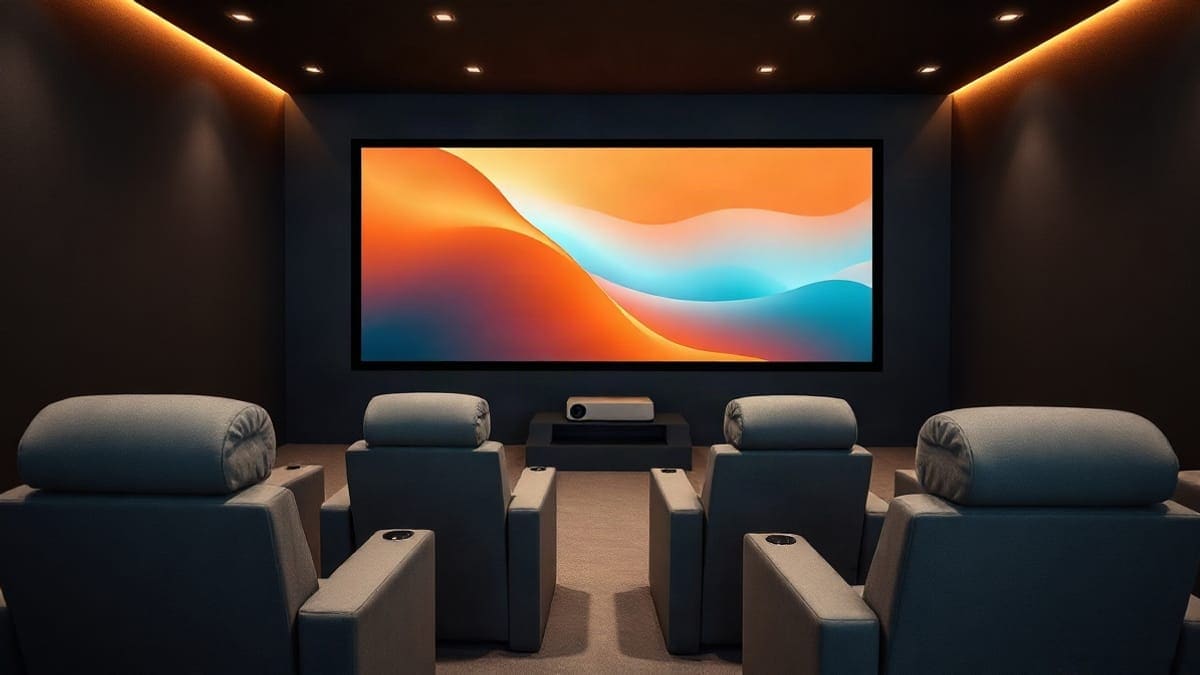
For a dedicated dark room, buy the Valerion VisionMaster Max: 5,000:1 native contrast, Dolby Vision, a 1.67x zoom and plus or minus 55 percent vertical lens shift. For native 4K chips, look at the Sony VPL-XW5000ES; for the lowest cost, the Epson Home Cinema 3800. We compared eight projectors on the numbers that decide a home theater, with the measured figure beside the rated one wherever a published review has it.
Which projector fits your room? Get this one, get that one
This block changes the question from "which is best" to "which is best for the room you have".
- Get the Valerion projectors if the room can be dark, the screen is 100 to 150 inches, and you want Dolby Vision plus a lens you can zoom and shift. It spans a 0.9 to 1.5:1 throw ratio, so a 120 inch picture fits anywhere from 7.8 to 13.1 feet back.
- Get the Sony VPL-XW5000ES or the Epson Pro Cinema LS12000 if the budget runs to a premium projector and you will calibrate it. Sony brings native 3840 x 2160 chips and 20,000 laser hours; Epson brings a 2.1x powered zoom with lens memory.
- Get the Epson Home Cinema 3800 if you want a proven 4K-enhanced projector at the lowest cost and accept a lamp rated for 3,500 hours.
- Get the XGIMI Horizon 20 Max if you watch with a lamp on or the curtains half open: 5,700 ISO lumens rated (3,312 ANSI measured) is the most light in this group. XGIMI's newer Horizon 30 Pro, Max and Ultra Max add 4K at 120 Hz.
- Get the Hisense PX3-Pro or PX4-Pro if the projector must sit under the screen, 1.6 feet from the wall for the PX3-Pro.
- None of these if the room is small and you want no mount at all. Then take the JMGO N1S Ultimate: a gimbal head, 9.9 lb, and enough light with a lamp on.
Our picks at a glance
- 1Valerion VisionMaster Maxa dedicated room, 100 to 150 inch screens, owners who want a ceiling or shelf mount with room to adjustCheck price
- 2Epson Pro Cinema LS12000a dark room, a ceiling mount, a viewer who wants powered zoom, focus and memoryCheck price
- 3Sony VPL-XW5000ESa dark room, viewers who want native chips and strong video processingCheck price
Quick answer: what to know before you buy
- In a dark room, contrast matters more than brightness. A 120 inch screen needs only about 683 lumens to reach 16 foot-lamberts. Every projector below has more light than that. What you will see is how dark the dark scenes get.
- Read the contrast figure carefully. The VisionMaster Max lists 5,000:1 native and 50,000:1 dynamic. ProjectorCentral measured 4,143:1 native and 28,660:1 dynamic. Dynamic numbers depend on an iris or laser dimming.
- 4K comes two ways. The Sony VPL-XW5000ES uses native 3840 x 2160 chips. The Epson Pro Cinema LS12000 and Home Cinema 3800 use 1080p chips with pixel shifting to a 4K image.
- Rated lumens are a ceiling. ProjectorCentral measured 2,533 ANSI lumens on the VisionMaster Max (rated 3,500 ISO) with its green-tinted Brightness Enhancer off, and 1,602 on the Sony (rated 2,000) in its default Bright Cinema mode.
- The light source sets the running cost. The Epson 3800 lamp is rated for 3,500 hours (5,000 in Eco). The laser models are rated for 20,000 to 25,000 hours, about 18 to 23 years at 3 hours a day.
- Pick the lens before the chip. Zoom and lens shift decide whether the projector fits your room on a shelf or a ceiling mount.
- We have not tested any of these. We read manufacturer specifications, ProjectorCentral measurements and other published reviews, and we say where they disagree.
What is the best home theater projector?
The best home theater projector depends on how dark your room gets: the Valerion VisionMaster Max for a dark room, the XGIMI Horizon 20 Max for a room with light, the Hisense PX3-Pro for a short wall. No single model wins every room. The table puts the eight on one screen.
| Model | Pick for | Rated brightness | 4K method | Light source | Weight |
|---|---|---|---|---|---|
| Valerion VisionMaster Max | Top pick, dark room | 3,500 ISO lm | 4K, pixel shifted from a 1080p chip | RGB laser, 25,000 h | 16.5 lb |
| Epson Pro Cinema LS12000 | Black level, lens control | 2,700 ISO lm | 4K by pixel shift | Laser, 20,000 h | 28.0 lb |
| Sony VPL-XW5000ES | Native 4K, premium | 2,000 ISO lm | Native 3840 x 2160 | Laser, 20,000 h | 28.0 lb |
| Epson Home Cinema 3800 | Lowest cost | 3,000 ISO lm | 4K Pro-UHD pixel shift | Lamp, 3,500 h | 15.2 lb |
| XGIMI Horizon 20 Max | Bright room, gaming | 5,700 ISO lm rated | 4K, pixel shifting | RGB laser | 11.9 lb |
| JMGO N1S Ultimate | Living room, no mount | 3,500 ANSI lm (rated) | 4K by pixel shift | RGB laser, 30,000 h | 9.9 lb |
| Hisense PX3-Pro | Ultra short throw | 3,000 ANSI lm | 4K, method not stated | RGB laser, 25,000 h | 19.8 lb |
| Hisense PX4-Pro | Ultra short throw, newest | 3,500 ANSI lm rated | 4K, method not stated | RGB triple laser | not published |
The order follows the questions of a home theater: how dark is the room, how big is the screen, where can the projector sit. The sections below take each one in turn. For every model that handles 4K, our 4K projector guide covers the wider field.
Which home theater projector is the top pick for a dark room?
The Valerion VisionMaster Max is the top pick for a dedicated dark room because it pairs the deepest native contrast in this group with a lens that adjusts. ProjectorCentral lists 5,000:1 native contrast, HDR10+ and Dolby Vision, a 0.9 to 1.5:1 throw ratio and plus or minus 55 percent vertical lens shift. Next in line are the Epson LS12000 for black level (the ProjectorCentral reviewer measured about 249,000:1 on its fastest iris setting) and the Sony for native 4K.
What is the best 4K home theater projector?
For native 4K chips, the Sony VPL-XW5000ES; for the best 4K image per dollar, the Epson Home Cinema 3800 or the VisionMaster Max, depending on how much contrast you need. The Sony is the only one here with native 3840 x 2160 chips (0.61 inch SXRD). The 4K question has its own page: see the best 4K projector guide.
What is the best home theater projector for the money?
The Epson Home Cinema 3800 is the value pick: 3,000 lumens, a 1.62x zoom and plus or minus 60 percent vertical lens shift, from a 3LCD lamp engine. ProjectorCentral measured 2,912 ANSI lumens in Dynamic mode and 2,176 in Natural at High lamp, and gave it a Highly Recommended award. Our budget home theater projector page and the cheap projector guide cover lower costs.
What is the brightest home theater projector?
The XGIMI Horizon 20 Max, rated at 5,700 ISO lumens, is the brightest of the eight, and the one that copes best with a lamp on. For brightness in depth, see the lumens guide and our bright room projector page.
What is a home theater projector, and how does it work?
A home theater projector is built to show films in a controlled room: it trades portability for contrast, a better lens and color control. A light source (laser or lamp) lights an imaging chip or three panels, the chip forms the picture, and a lens enlarges it onto a screen. What separates a home theater model from a portable one is not the principle but the parts.
In practice that means four things. The lens has zoom, and often shift, and on the LS12000 it is powered. Contrast is far higher: 4,143:1 native measured on the VisionMaster Max against 1,420:1 measured on the portable-style JMGO N1S Ultimate. The body is heavier, 15 to 28 lb for most of the eight (the Horizon 20 Max is 11.9 lb). And it lives on a shelf or a ceiling mount rather than on a table or a gimbal.
You will see the difference mostly in dark scenes. At 1,420:1 a dark scene shows a dark gray; at 4,143:1 it sits nearer black. Our contrast ratio guide and how a projector works go through the basics.
How does a laser projector differ from a lamp projector?
A laser is rated for five to seven times the hours of a lamp and reaches full brightness at once; a lamp costs less upfront. Rated life runs from 3,500 hours on the Epson 3800 lamp to 25,000 hours on the VisionMaster Max laser. Read laser vs DLP vs LCD for the trade-off.
DLP, 3LCD or SXRD: does the chip type matter?
It matters for rainbow effect and for contrast. DLP uses one chip and a color wheel or laser sequence, and a few viewers see brief rainbows. 3LCD (Epson) uses three panels and shows equal color and white brightness. SXRD is Sony's reflective liquid-crystal chip, used here in native 4K. See our DLP projector page for the DLP side.
Choosing a projector for a movie room: which six checks come first?
Choose in this order: room light, screen size, contrast and black level, lens, then HDR and ports. Most buyers start with resolution, and then discover that a 4K projector in a bright room has a washed out picture.
Step 1: how dark can the room get?
If you can block the windows, you need only a few hundred lumens; the money should go to contrast. If you cannot, plan on about three times the light and a gray ambient-light-rejecting screen. The VisionMaster Max, Epson LS12000 and Sony are dark room models. The Horizon 20 Max and N1S Ultimate suit rooms with light.
Step 2: how big is the screen?
Screen size sets how much light you need and how far back you sit. A 100 inch picture is 87.2 inches wide, 49.0 inches high and 29.7 square feet; a 150 inch picture is 130.8 x 73.6 inches and 66.7 square feet, or 2.25 times the area. Our screen size calculator and movie theater screen size pages give seating distances.
Step 3: how much contrast do you need?
For a dedicated room, look for native contrast of 3,000:1 or more, or an iris and laser dimming that a reviewer has measured. The native figures in this group are the VisionMaster Max (4,143:1 measured), the XGIMI Horizon 20 Max (1,400 to 1,640:1 measured) and the Hisense PX3-Pro (3,000:1 listed). The Sony and both Epsons list no native figure on ProjectorCentral.
Step 4: what lens do you need?
A zoom lens sets the image size without moving the projector. Lens shift moves the image up, down and sideways without tilting it. Together they let you install on a shelf or ceiling and still land the picture on the screen. The LS12000 has 2.1x powered zoom with lens memory. See what lens shift is.
Step 5: which HDR formats do you need?
HDR10 is universal. Dolby Vision and HDR10+ adjust scene by scene. Dolby Vision is on the VisionMaster Max, Horizon 20 Max, Hisense PX3-Pro and Hisense PX4-Pro. The Epson LS12000 supports HDR10+, and the Sony does not. See Dolby Vision projectors.
Step 6: which inputs does your gear need?
Two HDMI 2.1 ports cover a console and a streaming box. The Sony review says its two ports are HDMI 2.0b, so no 4K at 120 Hz. The VisionMaster Max and PX3-Pro have three ports (one HDMI 2.0, two HDMI 2.1). Check eARC if you plan to run a soundbar or an AV receiver.
| Your situation | Screen | Get | Why |
|---|---|---|---|
| Dedicated dark room, 4K, Dolby Vision | 100 to 150 in | Valerion VisionMaster Max | 5,000:1 native, zoom, shift |
| Dark room, you will calibrate, premium | 100 to 150 in | Epson Pro Cinema LS12000 | 2.1x powered zoom, lens memory |
| Dark room, native 4K chips | 100 to 130 in | Sony VPL-XW5000ES | Native 3840 x 2160, 20,000 h laser |
| Lowest cost for a real cinema projector | 90 to 120 in | Epson Home Cinema 3800 | 1.62x zoom, plus or minus 60% shift |
| Living room with a lamp on | 100 to 150 in | XGIMI Horizon 20 Max | 5,700 ISO lm, 4K |
| Living room, no mount, small footprint | 100 to 150 in | JMGO N1S Ultimate | 9.9 lb, gimbal, 2 HDMI |
| Shallow room, projector under the screen | 100 to 150 in | Hisense PX3-Pro | 0.22:1, 1.6 ft from the wall |
| Shallow room, newest Hisense | 100 to 150 in | Hisense PX4-Pro | 3,500 ANSI lm rated, Dolby Vision |
The eight projectors in detail
Each entry gives the maker rating, the measured figure where a published review has one, what the projector does well, and who should skip it. No price is printed on this page, since prices move too fast.
Valerion VisionMaster Max: top pick overall
The VisionMaster Max is the all-round home theater pick: 3,500 ISO lumens rated, 5,000:1 native contrast, a 25,000 hour RGB laser, Dolby Vision and HDR10+. ProjectorCentral lists a 3840 x 2160 image from a single 0.47 inch DLP chip, pixel shifted from 1080p, a 0.90 to 1.50:1 throw ratio, a 1.67x manual zoom with powered focus, plus or minus 55 percent vertical lens shift, three HDMI inputs (one HDMI 2.0, two HDMI 2.1), a 28 dB fan, 16.5 lb and a November 2025 release. The ProjectorCentral review says the chip is a native 1080p DMD pixel shifted to 4K, so it is pixel-shifted 4K, not native.
The brightness figure needs a caveat. ProjectorCentral measured 3,421 ANSI lumens only with the Brightness Enhancer on High, which adds a strong green bias, and 2,533 lumens with it off, about 28 percent under the rating (72 percent of it). Projector Reviews measured 3,230 lumens in Vivid with the enhancer off. Measured contrast also lands under the claim: ProjectorCentral got 28,660:1 dynamic and 4,143:1 native, Projector Reviews 28,586:1 and 3,419:1. The spec page lists 15 ms at 4K/60; the review measured 18 ms at 1080p/60, 11 ms at 1080p/120 and 5 ms at 1080p/240, which we treat as the safer figures.
Best for: a dedicated room, 100 to 150 inch screens, owners who want a ceiling or shelf mount with room to adjust. Skip it if you want a built-in battery or a 10 lb body: at 16.5 lb it stays put. See the Valerion guide.
Epson Pro Cinema LS12000: for black level and lens control
The LS12000 is rated at 2,700 ISO lumens in white and in color, with a laser rated for 20,000 hours, a 2.1x powered zoom, lens memory and HDR10+ support. ProjectorCentral lists a 3840 x 2160 image made by four-phase, dual-axis pixel shifting from 1080p chips, a 1.35 to 2.84:1 throw ratio, lens shift of plus or minus 47 percent horizontal and plus or minus 96 percent vertical, two HDMI 2.1 ports, a 30 dB fan (22 dB in Eco), 28.0 lb and a February 2022 release. Its measured gamut is 93.1 percent of DCI-P3.
In the ProjectorCentral review, Dynamic mode at full light output measured 2,575 ANSI lumens (95.3 percent of the rating), Natural at 100 percent 1,919 and Cinema at 50 percent 957. The reviewer's contrast readings ranged from about 4,960:1 with the iris off to about 35,429:1 on Normal and about 249,000:1 on High Speed. Input lag is 19.5 ms at 4K/60 in Fast mode and 60.5 ms in Fine. The review lists no 3D and no dynamic tone mapping for HDR10 as the cons, and notes that zoom costs 34.8 percent of the light between wide and telephoto.
Best for: a dark room, a ceiling mount, a viewer who wants powered zoom, focus and memory. Skip it if your room has light and you need every lumen at the long end of the zoom. See the Epson projector page.
Sony VPL-XW5000ES: native 4K chips
The Sony is rated at 2,000 ISO lumens with native 3840 x 2160 SXRD chips (0.61 inch), a 20,000 hour laser and a 1.6x manual zoom. ProjectorCentral lists a 1.38 to 2.21:1 throw ratio, lens shift of plus or minus 25 percent horizontal and plus or minus 71 percent vertical, 28.0 lb and an August 2022 release. It has no mechanical iris: Sony's Dynamic Control stands in, and the reviewer judged the Limited setting the usable compromise and Full unusable on slow fades.
Measured brightness in the review runs from 1,454 lumens in TV mode to 2,146 in Bright Cinema with a custom color temperature, with 1,602 in the default Bright Cinema setting. Uncalibrated gamut measured 80.9 to 84.3 percent of DCI-P3, short of Sony's 95 percent claim, which Sony calls theoretical. Input lag is 19.6 ms at 4K/60 with the reduction on, and 71.9 ms with it off. The review measured 27.6 to 32.3 dBA against a 27.6 dBA room floor.
Ports are the catch: the ProjectorCentral spec page lists two HDMI 2.1 ports, but its review says they are HDMI 2.0b, so no 4K at 120 Hz. We treat the review as the safer reading and flag it as unresolved. There is no HDR10+ and no 3D.
Best for: a dark room, viewers who want native chips and strong video processing. Skip it if you game at 4K/120 or want a powered lens: the lens is manual with no memory. See also our high-end home theater projector page.
Epson Home Cinema 3800: lowest cost for a real cinema projector
The Epson Home Cinema 3800 gives 3,000 lumens in white and in color, a 1.62x manual zoom and plus or minus 60 percent vertical shift, from a 3LCD lamp engine. ProjectorCentral lists a 1080p panel with 4K Pro-UHD pixel shifting, a 1.32 to 2.15:1 throw ratio, horizontal shift of plus or minus 24 percent, two HDMI 2.0 ports, a lamp rated 3,500 hours (5,000 in Eco), a 35 dB fan (24 dB in Eco), 15.2 lb, Full HD 3D and an October 2019 release.
The review measured 2,912 ANSI lumens in Dynamic mode at High lamp, 2,176 in Natural and 1,623 in Cinema, and a 6 percent light loss across the zoom range. Calibrated Natural mode on a 90 inch screen reached 24 foot-lamberts in Eco, above the 22 foot-lambert SMPTE level it cites. Input lag measured 20.6 ms at 4K. The reviewer gave 10 memory positions per color mode and a 16-step HDR brightness slider, and noted that the 3800 does not cover the full DCI-P3 gamut of the 4010 and 5050UB: 75.5 percent of DCI-P3 in calibrated HDR.
Best for: a first cinema projector, 90 to 120 inch screens, a family room you can darken. Skip it if you want a laser that runs for decades or the deepest blacks: it lists 100,000:1 dynamic contrast and no native figure. It is an older model, and Epson's own page showed it out of stock in November 2026, so confirm it is still sold. See the Epson Home Cinema 3800 page.
XGIMI Horizon 20 Max: bright room and gaming
The Horizon 20 Max is the brightest of the eight at 5,700 ISO lumens rated (3,312 ANSI measured in Movie mode), an RGB laser projector with 4K, HDR10+ and Dolby Vision, a 1.25x optical zoom and plus or minus 120 percent vertical lens shift. ProjectorCentral lists a 1.20 to 1.50:1 throw ratio, plus or minus 45 percent horizontal shift, two HDMI ports, a 28 dB fan, 11.9 lb, an October 2025 release and 20,000:1 dynamic contrast. ProjectorCentral measured input lag of 8 ms at 4K/60, 6 ms at 1080p/120 and 2 ms at 1080p/240, and it does not show 4K at 120 Hz.
The trade is contrast. ProjectorCentral measured 1,400 to 1,640:1 native, close to the JMGO N1S Ultimate and well under the Valerion's 4,143:1, so do not buy it for a light-free theater. What it does well is hold a picture with a lamp on. XGIMI's Titan Noir line, rated up to 7,000 ISO lumens, is brighter still, but no lab has measured it yet.
Best for: a bright living room, a 120 to 200 inch screen, gamers who care about 2 ms lag. Skip it if your room goes fully dark and the price gap matters. See the XGIMI projector guide and the gaming projector page.
JMGO N1S Ultimate: living room, no mount
The JMGO N1S Ultimate is rated at 3,500 ANSI lumens, with a 4K image made by pixel shifting, a 30,000 hour RGB laser, two HDMI 2.1 ports and a gimbal head that turns 360 degrees sideways. Published measurements land lower: ProjectorCentral measured 2,608 ANSI lumens in Vivid, Standard and Movie, and Projector Reviews 2,792 in Vivid and 1,934 in Movie. Measured contrast is 1,420:1 against the 1,600:1 claim, so blacks are only fair. HDR is HDR10 and HLG, with no Dolby Vision, and the throw ratio is a fixed 1.2:1. ProjectorCentral measured 99.14 percent of DCI-P3 and 96.45 percent of BT.2020 against the 110 percent BT.2020 claim.
Best for: a living room with some light, a 100 to 150 inch picture, owners who want no ceiling mount. Skip it if you need deep blacks or a zoom lens. See our JMGO N1S Ultimate review.
Hisense PX3-Pro: ultra short throw
The PX3-Pro is a 3,000 ANSI lumen RGB laser model with a 0.22:1 throw ratio, which puts a 100 inch image 1.6 feet from the wall. ProjectorCentral lists a 4K picture (the page does not say how it is built), 3,000:1 native contrast, a 25,000 hour laser, an image from 50.07 to 150.20 inches at 0.8 to 2.4 feet, HDR10, HDR10+, Dolby Vision and HLG, one HDMI 2.0 and two HDMI 2.1 ports, 19.8 lb, an August 2024 release and a 50 W Harman Kardon system with Dolby Atmos support. Input lag is not listed, only an Auto Low Latency Mode and 240 Hz at 1080p. The PX4-Pro below succeeds it.
Best for: a living room where the projector sits on a media console, a 100 to 150 inch screen with an ambient-light-rejecting surface. Skip it if you want to place it on a ceiling mount. See our ultra short throw guide and the Hisense laser TV page.
Hisense PX4-Pro: ultra short throw, newest
The PX4-Pro is a 4K triple laser ultra short throw projector rated at 3,500 ANSI lumens, with 6,500:1 contrast and a 7-level adjustable iris, sold from July 21, 2026. Hisense's release lists an 80 to 200 inch picture, up to 118 percent of the BT.2020 gamut, VIDAA OS, a Devialet-tuned sound system, Dolby Vision, IMAX Enhanced and FreeSync Premium. It gives no throw ratio, port count, weight or speaker wattage, and we found no lab measurement, so every figure here is a rating and the ports are the question to ask before you buy.
Best for: a short wall and a laser TV look with the current Hisense. Skip it if you need Google TV or a confirmed HDMI 2.1 count. See the Hisense laser TV page for the PX4-Pro, PX3-Pro and L9Q side by side.
How much contrast do these projectors really have?
Contrast decides how a dark scene looks, and makers quote two different things. Native (full on/off) contrast compares a full white screen with a full black one. Dynamic contrast counts the effect of an iris or laser dimming, which is why it runs into the hundreds of thousands. Use native for ranking and dynamic as a hint about black level in dark scenes.
| Model | Native contrast | Dynamic contrast | Measured by a reviewer |
|---|---|---|---|
| Valerion VisionMaster Max | 5,000:1 | 50,000:1 | 4,143:1 native, 28,660:1 dynamic (ProjectorCentral); 3,419:1 and 28,586:1 (Projector Reviews) |
| Epson Pro Cinema LS12000 | not listed | 2,500,000:1 | about 4,960:1 iris off, 35,429:1 normal, 249,000:1 high speed (ProjectorCentral reviewer) |
| Sony VPL-XW5000ES | not listed | not listed | no figure; blacks described as elevated before calibration |
| Epson Home Cinema 3800 | not listed | 100,000:1 | no figure in the review |
| XGIMI Horizon 20 Max | 1,400 to 1,640:1 | 20,000:1 | 20,877 to 25,401:1 dynamic (ProjectorCentral) |
| JMGO N1S Ultimate | 1,600:1 | not listed | 1,420:1 (ProjectorCentral) |
| Hisense PX3-Pro | 3,000:1 | not listed | none read |
| Hisense PX4-Pro | not listed | 6,500:1 (type not stated) | none read |
Two things stand out. The VisionMaster Max has the highest native figure we can verify, and it holds about 83 percent of its rating (4,143 of 5,000). The Epson LS12000 shows how far an iris can push a number: 4,960:1 with it off, about 249,000:1 on its fastest setting, a 50 times spread on one projector. Neither is a promise of how a real film looks, but a high native figure plus a good iris is the combination that keeps dark rooms dark. Our contrast guide explains why a bright room cancels most of the difference.
Does an iris or laser dimming help?
Yes, on dark scenes, and it can hurt on fades. Epson's auto iris gives the LS12000 its dynamic range. Sony has no iris, and the reviewer found its Dynamic Control worth using only on the Limited setting, because Full shut the laser down on slow fades. If you watch a lot of dark films, the way the iris behaves matters as much as the headline number.
Why does black level look gray in a "dark" room?
Because any light in the room, including light bounced back from pale walls and ceiling, adds to the black. A projector with 5,000:1 native contrast projecting 475 lumens onto a 100 inch screen puts about 0.003 foot-lamberts on a black screen, and a lit wall can add more than that. Dark walls, a dark ceiling and a gray screen help more than another 1,000:1 of contrast.
How bright is a home theater projector in practice?
Brightness needs two numbers: the rated lumens and the lumens in the mode you will use for movies. A foot-lambert is lumens divided by screen area in square feet on a 1.0 gain screen. We use 16 foot-lamberts as the dark-room target, the same cinema reference level as on our best projector guide. The ProjectorCentral reviewer of the Epson 3800 cites a 22 foot-lambert SMPTE level for calibrated SDR, so the target can run higher. Lumens ratings come in two kinds, ISO (ISO 21118) and ANSI, and the two are not interchangeable: a maker that quotes ISO lumens and one that quotes ANSI are not describing the same measurement, and ISO 21118 is the stricter test.
Here is the light you need for a 16 foot-lambert picture, by screen size, before any loss from picture modes or laser aging:
| Screen | Area | Lumens for 16 fL |
|---|---|---|
| 100 in | 29.7 sq ft | 475 lm |
| 120 in | 42.7 sq ft | 683 lm |
| 130 in | 50.1 sq ft | 802 lm |
| 150 in | 66.7 sq ft | 1,067 lm |
| 200 in | 118.7 sq ft | 1,899 lm |
Rated lumens are a ceiling, and the figure that counts is the one in the mode you will watch films in. The next table sets the rated and the measured numbers side by side, with the foot-lamberts our calculation gives from each measured figure. Where no reviewer published a measurement, we show the rated figure instead and mark it as rated, so no row hides a gap.
| Model | Rated | Measured, movie-friendly mode | fL at 120 in | fL at 150 in | fL at 200 in |
|---|---|---|---|---|---|
| Valerion VisionMaster Max | 3,500 ISO | 2,533 ANSI (enhancer off) | 59.3 | 38.0 | 21.3 |
| Epson Pro Cinema LS12000 | 2,700 ISO | 1,919 ANSI (Natural, 100%) | 44.9 | 28.8 | 16.2 |
| Sony VPL-XW5000ES | 2,000 ISO | 1,602 ANSI (Bright Cinema) | 37.5 | 24.0 | 13.5 |
| Epson Home Cinema 3800 | 3,000 ISO | 2,176 ANSI (Natural, High) | 51.0 | 32.6 | 18.3 |
| JMGO N1S Ultimate | 3,500 ANSI | 2,608 ANSI (Standard) | 61.1 | 39.1 | 22.0 |
| XGIMI Horizon 20 Max | 5,700 ISO | 3,312 ANSI (Movie, boost on) | 77.6 | 49.7 | 27.9 |
| Hisense PX3-Pro | 3,000 ANSI | none read | 70.3 rated | 45.0 rated | 25.3 rated |
| Hisense PX4-Pro | 3,500 ANSI | none read | 82.0 rated | 52.5 rated | 29.5 rated |
On a 1.0 gain screen, every projector with a measurement clears 16 foot-lamberts at 150 inches. At 200 inches the Sony falls to about 13.5 and the LS12000 sits right at 16.2, so a 200 inch dark room needs the brighter models or a higher gain screen. The calibrated HDR picture is the other reason to want headroom: the ProjectorCentral reviewer measured 72.8 foot-lamberts of HDR peak on the Sony with a 1.3 gain screen at 100 inches, compared with 31.6 for calibrated SDR.
The takeaway for a dark room is that brightness is rarely the limit; screen size and HDR are. For the light in a room with windows, see our lumens guide.
How far back does each projector sit?
Multiply the throw ratio by the width of the picture. A 100 inch 16:9 picture is 87.2 inches wide and a 120 inch picture is 104.6 inches wide. The ranges below come from the ProjectorCentral throw ratios for each model:
| Model | Throw ratio | Distance for 100 in | Distance for 120 in |
|---|---|---|---|
| Valerion VisionMaster Max | 0.90 to 1.50:1 | 6.5 to 10.9 ft | 7.8 to 13.1 ft |
| Epson Pro Cinema LS12000 | 1.35 to 2.84:1 | 9.8 to 20.6 ft | 11.8 to 24.8 ft |
| Sony VPL-XW5000ES | 1.38 to 2.21:1 | 10.0 to 16.1 ft | 12.0 to 19.3 ft |
| Epson Home Cinema 3800 | 1.32 to 2.15:1 | 9.6 to 15.6 ft | 11.5 to 18.7 ft |
| XGIMI Horizon 20 Max | 1.20 to 1.50:1 | 8.7 to 10.9 ft | 10.5 to 13.1 ft |
| JMGO N1S Ultimate | 1.2:1 fixed | 8.7 ft | 10.5 ft |
| Hisense PX3-Pro | 0.22:1 | 1.6 ft | 1.9 ft |
| Hisense PX4-Pro | not published | not published | not published |
The Epson and Sony models need the longest room: a 120 inch picture from the Sony needs 12 feet at the wide end of the zoom. The VisionMaster Max reaches the same picture from 7.8 feet, which makes it the only one of the three premium models that fits a short living room. For a size not in the table, the throw distance calculator does the sum, and the short throw projector for home theater page when the room is shallow.
| Lens feature | VisionMaster Max | LS12000 | Sony XW5000ES | Epson 3800 | Horizon 20 Max |
|---|---|---|---|---|---|
| Zoom | 1.67x manual | 2.1x powered | 1.6x manual | 1.62x manual | 1.25x optical |
| Vertical shift | plus or minus 55% | plus or minus 96% | plus or minus 71% | plus or minus 60% | plus or minus 120% |
| Horizontal shift | none listed | plus or minus 47% | plus or minus 25% | plus or minus 24% | plus or minus 45% |
| Lens memory | not listed | yes | not listed | not listed | not listed |
The more shift you have, the less you need to compromise on where the projector sits. A ceiling mount above the back row, a shelf behind the seats, and a table in front all work if the shift is wide. See what lens shift is and our ceiling mounted projector guide.
HDR, color and 4K: what the numbers mean
HDR on a projector behaves differently from HDR on a TV. A projector cannot reach TV-level peak brightness, so it maps the HDR signal down to what it can show, a step called tone mapping. How well it does that matters more than the logos on the box.
| Model | HDR formats listed | Gamut figure | 4K image |
|---|---|---|---|
| Valerion VisionMaster Max | HDR10+, Dolby Vision | 110% Rec.2020 (maker claim) | pixel shift from 1080p |
| Epson Pro Cinema LS12000 | HDR10, HDR10+, HLG | 93.1% DCI-P3 (measured) | pixel shift from 1080p |
| Sony VPL-XW5000ES | HDR, dynamic tone mapping; no HDR10+ | 80.9 to 84.3% DCI-P3 uncalibrated (measured); 95% claimed | native 3840 x 2160 |
| Epson Home Cinema 3800 | HDR10, HLG per Epson | 75.5% DCI-P3 calibrated HDR (measured) | pixel shift from 1080p |
| XGIMI Horizon 20 Max | HDR10+, Dolby Vision | 98.78% DCI-P3 (measured) | pixel shift from 1080p |
| JMGO N1S Ultimate | HDR10, HLG | 99.14% DCI-P3 (measured) | pixel shift from 1080p |
| Hisense PX3-Pro | HDR10, HDR10+, Dolby Vision, HLG | not listed | 4K, method not stated |
| Hisense PX4-Pro | Dolby Vision, IMAX Enhanced | up to 118% BT.2020 (maker) | 4K, method not stated |
Three points follow. First, the JMGO measures the widest gamut in this group, but contrast is its limit, so wide color does not rescue a dark scene. Second, the Sony measures lower than its claim on gamut; plan to calibrate it. Third, the Epson LS12000 has no dynamic tone mapping for HDR10, so it uses a 16-point HDR slider that you set per film (the reviewer used settings from 4 to 11 across three films). See Dolby Vision projectors and the 4K projector guide.
Is native 4K better than pixel shifting?
On the spec sheet, yes; on screen, the gap depends on the content and the screen size, and we have no measured comparison between native and shifted 4K to quote. Native chips show every pixel of a 4K signal. Pixel shifting moves a 1080p chip several times a frame to fill a 4K grid. The Sony is the only native 4K option in this guide, and its reviewer called its lens soft until Reality Creation, which is on by default, is applied. In a dark room, contrast is the larger difference between these projectors.
How loud are they, and how fast do they respond?
Noise matters in a theater because you sit near the projector, and input lag matters if you game. The table gives the maker rating and the measured figure where a reviewer has one.
| Model | Fan, rated | Fan, measured | Input lag at 4K/60 |
|---|---|---|---|
| Valerion VisionMaster Max | 28 dB | none read | 18 ms at 1080p/60 (review); 15 ms at 4K/60 (spec page) |
| Epson Pro Cinema LS12000 | 30 dB, 22 dB Eco | 32.4 to 34.5 dBA (room floor 31 dBA) | 19.5 ms Fast, 60.5 ms Fine |
| Sony VPL-XW5000ES | 24 dBA | 27.6 to 32.3 dBA (room floor 27.6 dBA) | 19.6 ms reduction on, 71.9 ms off |
| Epson Home Cinema 3800 | 35 dB, 24 dB Eco | none read | 20.6 ms |
| XGIMI Horizon 20 Max | 28 dB | none read | 8 ms (measured); 3 ms rated |
| JMGO N1S Ultimate | 26 dB | 33.6 to 36.8 dBA (room floor 33.3 dBA) | 19 to 20 ms ultra low latency |
| Hisense PX3-Pro | not listed | none read | not listed |
| Hisense PX4-Pro | not listed | none read | not listed |
Fan figures are not comparable across rows: the reviewers measured at different distances and in rooms with different noise floors. Within a model, the Eco or low light output setting is the quiet one. If you also game, the Horizon 20 Max (8 ms at 4K/60 and 2 ms at 1080p/240, measured) is the fast one here, and our gaming projector page goes further. For film, 20 ms is fine.
What does it cost to keep a home theater projector running?
The light source is the running cost. A lamp is a purchase every few years. A laser is rated for decades of normal use. Our calculation at 3 hours a day (1,095 hours a year) and at 5 hours a day (1,825 hours a year):
| Light source | Rated hours | Years at 3 h a day | Years at 5 h a day |
|---|---|---|---|
| Epson 3800 lamp, normal | 3,500 | 3.2 | 1.9 |
| Epson 3800 lamp, Eco | 5,000 | 4.6 | 2.7 |
| Sony and Epson LS12000 laser | 20,000 | 18.3 | 11.0 |
| Valerion, Hisense laser | 25,000 | 22.8 | 13.7 |
| JMGO laser | 30,000 | 27.4 | 16.4 |
Laser hours are usually rated to half brightness (the LS12000 review says so), so the picture dims before the light source ends. A lamp costs money again at the end; a laser costs nothing, but you buy it up front. For heavy use, the laser pays back over time. See laser vs DLP vs LCD.
Which screen should you pair with a home theater projector?
A screen raises contrast and brightness control compared with a wall, and a gray or ambient-light-rejecting one helps in a room with light. White matte gives the most brightness in a dark room. Gray gives deeper blacks when the room is not fully dark. A 1.0 gain screen is the reference and our brightness math assumes it. See our best projector screens guide, the home theater projector screen page and screen types explained. For ultra short throw models like the PX3-Pro and PX4-Pro, the screen is not optional: they need an ALR surface made for them.
In a fully dark room with a black ceiling, a white matte screen at 1.0 gain gives the most light and true colors. With pale walls, a gray screen at 0.8 to 1.0 gain gives deeper blacks and less glare. With windows or lamps on, choose an ALR screen. For ultra short throw, use an ALR screen made for that angle, which rejects light from above.
How do you set up a home theater projector?
Set it up in five steps: place the screen, measure the distance, mount or shelf the projector, connect and then calibrate. Doing it in that order saves you from moving a ceiling mount twice.
- Place the screen first. Choose the width from the wall space: a 120 inch picture needs 104.6 inches. Put the middle of the screen near eye level when seated.
- Measure the throw distance. Use the table above: a 120 inch picture from a 1.35 to 2.84:1 lens like the LS12000 needs 11.8 to 24.8 feet.
- Fix the projector. Pick a mount height inside the lens shift range, so you never need digital keystone, which softens the picture and costs light.
- Connect the sources. Run HDMI to the projector, or to an AV receiver, and set the projector to a signal that matches your player.
- Calibrate. Start with the Cinema, Natural or Reference mode. Measured accuracy improves a lot with calibration: the Sony's reviewer got average grayscale error to 1.0 after calibration, and the LS12000's from 3.7 to 1.6 with minor tweaks.
For the basic steps of any projector, see how to use and set up a projector and the projector on wall guide.
Do you need a dedicated room?
No, but the closer you get to one, the better the picture. Dark walls, a dark ceiling, no windows and no light bounce are worth more than a more expensive projector. A basement or a bedroom with blackout curtains works for the dark room models. A living room needs a bright projector or an ALR screen.
How do you use a home theater projector day to day?
Switch it on, wait for the laser or lamp to reach full output, choose your picture mode, and pick the source. Laser models reach full brightness in seconds. Lamp models, like the Epson 3800, take longer. Let the fan finish before you cut the power.
How do you connect a home theater projector?
Use HDMI for picture and sound. Send the picture to the projector, and use eARC or an optical output to feed an AV receiver or soundbar. The Hisense PX3-Pro lists two HDMI 2.1 ports and one HDMI 2.0, so a console, a streaming box and a soundbar fit. To mirror a laptop or phone, see how to connect a projector to a laptop and how to connect a phone to a projector.
What about sound?
A built-in speaker is a backup. The Hisense PX3-Pro lists a 50 W Harman Kardon system with Dolby Atmos support and the PX4-Pro is Devialet tuned with no wattage published, but most home theaters add a soundbar or a speaker system. See our home theater system with projector guide.
Does a home theater projector beat a TV for movie night?
A projector wins on size per dollar and loses on brightness. A 120 inch picture is 42.7 square feet. A TV beats it in a bright room and for casual daytime viewing. A projector wins for a film night in a darkened room. See home theater projector vs TV and our projector vs TV comparison.
Which buying mistakes cost the most in a dark room?
- Buying 4K before contrast. In a dark room, contrast and black level are what you see first.
- Trusting a dynamic contrast number. The Epson LS12000 shows a 50 times spread between the iris off and on.
- Ignoring the lens. A fixed lens can cost you a ceiling mount. Zoom and shift are what make a room work.
- Using rated lumens as truth. Measured output was 72 percent of the rating on the VisionMaster Max with its enhancer off.
- Forgetting the lamp. The Epson 3800 lamp is rated for 3,500 hours; plan for the replacement.
- Skipping the screen. A pale wall costs you contrast, and a gray screen can win it back.
- Skipping HDMI checks. The Sony's ports are disputed between pages (HDMI 2.1 on the spec page, HDMI 2.0b in the review), and Hisense publishes no port count for the PX4-Pro.
How did we compare these projectors?
We compared eight projectors that cover the main home theater rooms, and we did not test any of them ourselves. Every specification comes from the ProjectorCentral spec page for that model, read on the day of writing. Measured numbers come from the ProjectorCentral reviews of the Sony VPL-XW5000ES, Epson Pro Cinema LS12000, Epson Home Cinema 3800 and Valerion VisionMaster Max, and from Projector Reviews for the VisionMaster Max and JMGO N1S Ultimate. Where a measurement was not published, the table says "none read". The foot-lambert, distance and hour calculations are ours and use the formulas stated on the page. Where two sources disagree, as with the Sony's HDMI ports, we say so. We did not use Amazon ratings or reviews.
FAQ: more questions about home theater projectors
How much does a home theater projector cost?
Prices run from an entry cinema projector like the Epson Home Cinema 3800 class up to premium models like the Sony VPL-XW5000ES and the Epson Pro Cinema LS12000. We do not print prices here because they move too fast. Use the Check price buttons for the current price, and weigh it against the measured contrast and lens, not the resolution alone. For a lower-cost start, see our cheap projector guide.
How much is a good home theater projector?
A good one is the one that matches your room. A dark-room model costs more than a bright-room model of the same size, because contrast and lens quality cost money. The Epson 3800 is the entry point we recommend for a real cinema picture, and the VisionMaster Max, LS12000 and Sony step up from there. Check the current price on each before you decide.
How much is a home movie projector?
A basic home movie projector for casual viewing costs far less than a home theater model, and it is also dimmer and lower in contrast. The reason is the parts: lens, light source and imaging chip. Our budget home theater projector page shows where the step up is worth it.
How much is an RCA home theater projector?
RCA sells low-cost projectors in the entry class. We do not print prices; check the seller. Retailer listings describe the RPJ107 as 480p (800 x 480 native) with 33 lumens, and the RPJ133 as 720p (1280 x 720) with 60 ANSI lumens; the listings disagree with each other, so confirm the model against the RCA page or manual.
Does an RCA home theater projector have Bluetooth?
Some do. Retailer listings give the RPJ107 built-in Bluetooth 4.2 and the RPJ133 Bluetooth 5.0, and one listing of the RPJ181 shows no Bluetooth. Because listings conflict, check the RCA product page or the manual for the exact model.
How do you connect an RCA home theater projector?
Through HDMI, as the listings describe. Retailer listings say the 480p models accept a 1080p signal over HDMI but their native image is 800 x 480. For a laptop or phone, our laptop connection guide covers cables and adapters.
How do you use an RCA home theater projector?
Place it facing a white wall or screen, focus it, connect the source and choose the input. Because the listed brightness is 33 to 120 lumens, it needs a dark room: 33 lumens on a 60 inch picture gives about 3.1 foot-lamberts against the 16 we aim for in a cinema.
How do you set up an RCA home theater projector?
The same way as any projector: screen first, distance second, focus last. On a 60 inch picture, 33 lumens gives 3.1 foot-lamberts and 120 lumens gives 11.2, so keep the picture small and the room dark. For bigger pictures, move to the models in this guide.
Are RCA projectors worth it for a home theater?
Not as a main home theater. The listings describe 800 x 480 or 1280 x 720 native images and 33 to 120 lumens, far under the 683 lumens a 120 inch dark room needs. They suit a child's room or an occasional film on a small picture.
Where do you buy a home theater projector?
Buy from the maker's store or an authorized retailer, so the warranty and the return window are clear. The Check price buttons above lead to the current seller of each model.
Are home theater projectors worth it?
Yes, if you watch films in a darkened room and want a picture of 100 inches or more. A 120 inch picture is 42.7 square feet of screen. They are not worth it if the room stays bright all day and you need a TV that works at noon. Read the projector vs TV comparison before you decide.
Can a home theater projector replace a TV?
In a room you can darken, yes. In a room with light all day, an ALR screen and a bright model like the Horizon 20 Max narrow the gap, but a TV stays easier. See our projector and screen for TV replacement guide.
How many years of movies is a laser rated for?
Rated hours run from 20,000 to 30,000 for the laser models here, which is about 18 to 27 years at 3 hours a day. The rating is to half brightness, so the picture dims gradually before it ends.
Is a gray screen better than a white one?
For a room that is not fully dark, yes: gray gives deeper blacks. For a fully dark room, a white 1.0 gain screen gives the most light. See our gray vs white screen guide.
Sources
- ProjectorCentral: Valerion VisionMaster Max specifications
- ProjectorCentral: Valerion VisionMaster Max review
- Projector Reviews: Valerion VisionMaster Max review
- ProjectorCentral: Epson Pro Cinema LS12000 specifications
- ProjectorCentral: Epson Pro Cinema LS12000 review
- ProjectorCentral: Sony VPL-XW5000ES-B specifications
- ProjectorCentral: Sony VPL-XW5000ES review
- ProjectorCentral: Epson Home Cinema 3800 specifications
- ProjectorCentral: Epson Home Cinema 3800 review
- ProjectorCentral: XGIMI Horizon 20 Max
- ProjectorCentral: Hisense PX3 PRO
- ProjectorCentral: Valerion VisionMaster Max review (pixel shifting, measured lag)
- ProjectorCentral: JMGO N1S Ultimate
- RCA: 480p home theater projector
Keep comparing
 Portable Projector 2026Nine real models compared on weight, rated and measured lumens, battery life and ports, with picks for travel
 Mini Projectors for 2026Nine real pocket models compared on weight, ANSI lumens, battery, ports and picture size
 Phone ProjectorsEight real models checked for AirPlay, Google Cast, USB-C video, Netflix, weight and lumens
 Outdoor Projectors in 2026The outdoor projectors for backyards, patios and campsites, with real brightness numbers, screen sizes