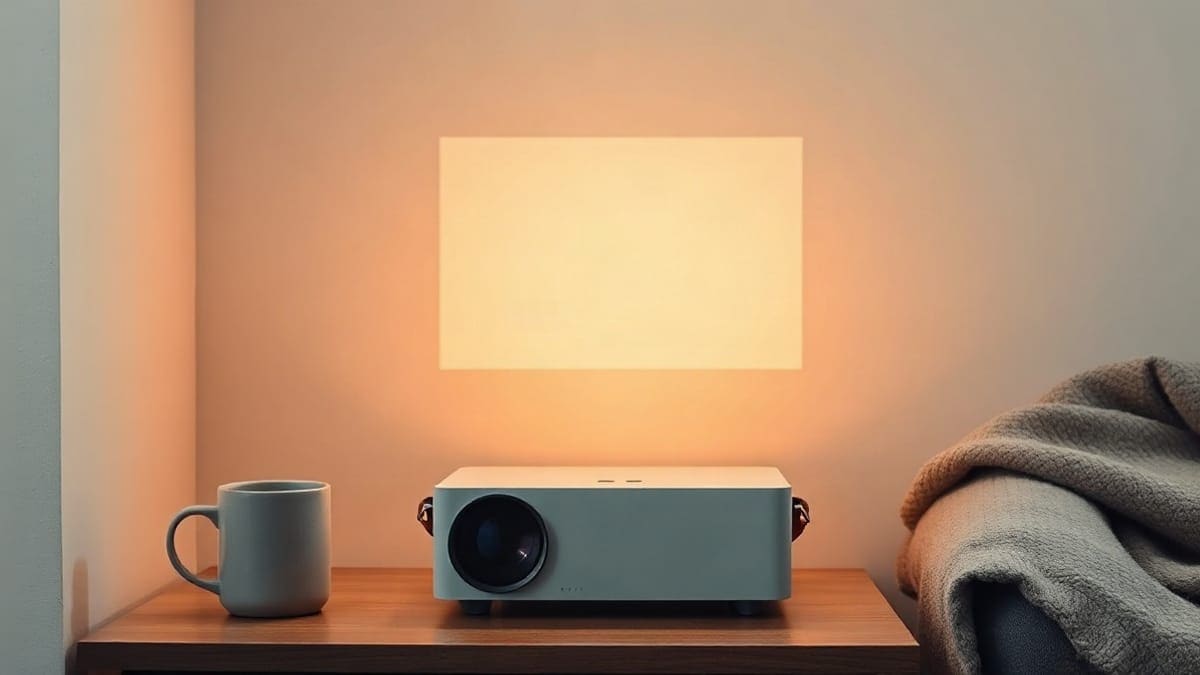
The Samsung Freestyle 2nd Gen is the mini projector for most people: 1.8 lb, 1080p, 230 ANSI lumens, 30,000 hours of LED life. Under 100 ANSI lumens a mini projector is a 30 to 40 inch toy for a dark room. Our sources are maker sheets and ProjectorCentral data for nine models from 0.3 to 2.4 lb; we ran no tests.
Take the Freestyle 2nd Gen for a shelf or desk with an outlet. Take the Nebula Capsule 3 Laser for two hours off the wall (2.1 lb, 52 Wh). Skip both above 100 inches or in a lit room: see the best projector guide or the JMGO range.
Quick answer: what a mini projector gives you
- Brightness is the limit. The nine models here are rated from 50 to 450 lumens, and only one (the Capsule 3 Laser) has a published lab measurement. That is a 30 to 80 inch picture in a dark room, not a living room TV.
- Weight sets the class. Under 1 lb (0.3 to 0.7 lb) is a micro projector with a 480p or 720p picture. From 1.4 to 2.4 lb you get 1080p and, on some, a battery.
- Battery runs about 2 hours. Every model with a battery listed here gives 1 to 2.5 hours. A full film at full brightness needs an outlet or a power bank.
- Resolution and brightness are linked. The sharpest models (1080p) are also the brightest. A 480p projector rated at 50 or 60 ANSI lumens is a toy for a ceiling or a 30 inch wall.
- Read the unit. ANSI and ISO lumens are measured tests. "LED lumens" has no standard test and reads far higher.
- We did not test these. We read maker pages and ProjectorCentral's database, and we flag every spot where sources disagree.
Our picks at a glance
- 1Samsung Freestyle 2nd Gena shelf, a bedroom ceiling or a hotel desk with an outlet, 40 to 80 inchesCheck price
- 2Nebula Capsule 3 Lasera dorm, a tent, a trip, 40 to 80 inches in a dark roomCheck price
- 3Nebula Capsule 3a bedroom or a camping trip with a battery, 40 to 80 inchesCheck price
Which mini projectors compare side by side?
Nine models cover the whole mini category, from a 0.3 lb card-sized unit to a 2.4 lb 1080p box. The table puts the numbers that decide a purchase in one place. Brightness shows the unit used, because 450 ISO lumens and 450 ANSI lumens are not equal. Sources are ProjectorCentral and the maker pages listed at the end.
| Model | Weight | Brightness | Resolution | Image size | Power |
|---|---|---|---|---|---|
| Samsung Freestyle 2nd Gen | 1.8 lb | 230 ANSI | 1080p | 29.6 to 100.4 in | 50 W plug |
| Nebula Capsule 3 | 1.9 lb | 200 ANSI | 1080p | 40 to 120 in | 2 h battery |
| Nebula Capsule 3 Laser | 2.1 lb | 300 ANSI rated, 302 to 341 measured | 1080p | 40 to 100 in | 52 Wh battery |
| Nebula Capsule Air (discontinued, reference) | 1.4 lb | 150 ANSI | 720p | up to 100 in | 34 Wh battery |
| XGIMI MoGo 3 Pro | 2.4 lb | 450 ISO | 1080p | 39.9 to 200.1 in | Plug-in |
| ViewSonic M1 Mini Plus (discontinued, reference) | 0.7 lb | 50 ANSI | 480p | 24.1 to 100.1 in | 2 h battery |
| Kodak Luma 150 | 0.3 lb | 60 ANSI | 480p | 5 to 80 in | 2 h battery |
| Aurzen ZIP Cyber Edition | 0.6 lb | 100 ANSI | 720p | 25 to 80 in | 1 h battery |
| Samsung Freestyle 1st gen (discontinued, reference) | 1.8 lb | 550 "LED lumens", no ANSI rating | 1080p | 30 to 100 in | 65 W plug |
The order follows one idea: the more you want a sharp picture, the more weight and power you carry. The 1080p models sit at the top of the weight range and the 480p models at the bottom, and no model gives both a pocket body and a bright picture. The next table turns that trade-off into a choice by situation, so you can find your row and go straight to that model.
| Your situation | Picture size | Buy | Why |
|---|---|---|---|
| One mini projector for a desk or shelf | 40 to 80 in | Samsung Freestyle 2nd Gen | 1.8 lb, 1080p, 230 ANSI lm |
| Run it off a wall for a film | 40 to 80 in | Nebula Capsule 3 Laser | 52 Wh, 2 h 4 min, 302 lm measured |
| Brightest mini box | 60 to 120 in | XGIMI MoGo 3 Pro | 450 ISO lm, 2 x 5 W speakers |
| Smallest 1080p with a battery | 40 to 100 in | Nebula Capsule 3 | 1.9 lb, 200 ANSI lm |
| Pocket-size toy for a kid's room | 25 to 40 in | Kodak Luma 150 | 0.3 lb, 60 ANSI lm, SD card slot |
| Tiny picture, tiny object (crafts, cookies) | 5 to 20 in | Kodak Luma 150 | image size starts at 5 in |
The nine mini projectors in detail
Each entry gives the numbers, what the projector does well, where it falls short and who should skip it. Prices move too fast to print, so each Check price button opens the live offer.
Samsung Freestyle 2nd Gen: top pick for most people
The Freestyle 2nd Gen weighs 1.8 lb, is rated at 230 ANSI lumens and shows a 1080p picture from 29.6 to 100.4 inches. ProjectorCentral lists a single DLP chip, a 30,000 hour LED, a 1.20:1 throw ratio (2.6 to 8.8 feet), 30 dB of noise, a 5 W mono speaker and a 50 W power supply. The body is 6.8 inches tall, 4.0 wide and 3.7 deep. Release date: August 2023.
The limit is simple. There is no battery, and one HDMI port is the only port on the connection panel. We found no lab measurement of its lumens, so 230 ANSI is the listed figure. On a 60 inch picture that gives about 21.5 foot-lamberts in a fully dark room, which is bright enough for a film (calculation below).
Best for: a shelf, a bedroom ceiling or a hotel desk with an outlet, 40 to 80 inches. Skip it if you want a battery or a picture above 100 inches. Read the Samsung Freestyle page and the Freestyle 2nd Gen page.
Nebula Capsule 3 Laser: top pick with a battery
The Capsule 3 Laser is a 2.1 lb cylinder with a 52 Wh battery and a laser engine rated at 300 ANSI lumens. ProjectorCentral measured 341 ANSI lumens in Custom mode, 302 in Standard, 236 in Movie and 123 in Game on AC power. On battery the same modes give 217, 192, 150 and 78. Battery life was 2 hours 4 minutes in Standard mode, against 2.5 hours in the maker highlights.
Two versions share the name. The 2023 model that ProjectorCentral measured runs Android TV 11 with no authorized Netflix app, and the version announced in August 2024 runs Google TV with Netflix (per Notebookcheck and Anker Japan). The figures here come from the 2023 model. It is 1080p, with a 1.2:1 throw ratio and an 8 W speaker. ProjectorCentral measured fan noise at 38.6 dBA in Standard mode at 36 inches, against the 28 dB Anker quotes. ProjectorCentral measured input lag of 22.4 ms in Game mode at 4K/60 and 129.6 ms in Standard mode.
Best for: a dorm, a tent, a trip, 40 to 80 inches in a dark room. Skip it if you want a bright picture on battery: 192 lumens is under half of what the MoGo 3 Pro rates. See the Nebula Capsule 3 Laser page and the Nebula family.
Nebula Capsule 3: the cheaper cylinder
The Capsule 3 weighs 1.9 lb, is rated at 200 ANSI lumens and shows 1080p from 40 to 120 inches at 3.5 to 10.4 feet. ProjectorCentral lists a single DLP chip, an LED, a 1.20:1 throw ratio, an 8 W mono speaker, one HDMI port, two USB-A ports and a 3.5 mm audio output. The body is 6.3 inches tall and 3.1 wide. It shipped in January 2024.
Battery life is listed at 2 hours in the spec table and 2.5 hours in the highlights, so plan on 2. The light source life is not listed. At 200 ANSI lumens a 60 inch picture gives about 18.7 foot-lamberts, a little under the Freestyle.
Best for: a bedroom or a camping trip with a battery, 40 to 80 inches. Skip it if you want a laser engine or measured brightness. We found no lab number for it. See the Nebula Capsule 3 page.
Nebula Capsule Air: a discontinued reference point
The Capsule Air weighs 1.4 lb, is rated at 150 ANSI lumens, shows 720p and has a 34 Wh battery listed at 2 hours. ProjectorCentral lists a 0.16 inch DLP chip, a 30,000 hour LED, a 5 W mono speaker, HDMI 2.1, USB-A and Bluetooth 5.1. The body is 5.5 inches tall and 2.7 wide. The maximum picture is 100 inches. It launched in August 2024 and ProjectorCentral shows it as discontinued in November 2025, so it is a reference point and not one of our picks.
Call it 720p, not 1080p: the picture is less sharp than the Capsule 3 on a large wall. At 150 ANSI lumens, a 40 inch picture gives about 31.6 foot-lamberts and an 80 inch picture 7.9, so stay small. Only used or leftover stock remains.
Useful as a comparison: a nightstand, a 40 to 60 inch picture in the dark. Not a pick, because it is discontinued: if you want its size, look at the Capsule 3 above. See the Nebula Capsule Air page.
XGIMI MoGo 3 Pro: the brightest mini box
The MoGo 3 Pro is a 2.4 lb 1080p LED projector rated at 450 ISO lumens, with two 5 W speakers and a 39.9 to 200.1 inch picture range. ProjectorCentral lists a 0.23 inch DLP chip, a 1.20:1 throw ratio (3.5 to 17.4 feet), a 25,000 hour light source and HDMI, USB-A and USB-C ports. The body is 8.07 inches tall and 3.74 wide. It was released in September 2024.
The rating is ISO, not ANSI. Anker's explainer says ISO 21118 is the stricter test, so a projector usually scores lower in ISO lumens than in ANSI lumens, and 450 ISO should not be read against the 300 ANSI of the Capsule 3 Laser as if the two were the same unit. The page lists no battery, so plan on an outlet. We found no lab measurement. A newer model is on the XGIMI MoGo 4 page and the brand page is XGIMI projectors.
Best for: a 60 to 120 inch picture in a dim room from a small box. Skip it if you need a battery, or need the weight under 2 lb.
ViewSonic M1 Mini Plus: a micro projector with a battery
The M1 Mini Plus weighs 0.7 lb, is rated at 50 ANSI lumens, shows 854 x 480 pixels and runs about 2 hours on its built-in battery. ProjectorCentral lists a 1.20:1 throw ratio, a 24.1 to 100.1 inch picture, a 2 W mono speaker, HDMI 1.4, USB-A and a 30,000 hour LED. The body is 1.1 inches thick. The page also lists 120 LED lumens, which is a different, non-standard measure. Release date: June 2020. ProjectorCentral shows it as discontinued in January 2025, so it is a reference point and not one of our picks.
Fifty ANSI lumens on a 40 inch picture gives about 10.5 foot-lamberts, which is dim and needs full darkness. It works as a tiny travel projector for a hotel wall or a tablet.
Useful as a comparison: a 30 to 40 inch picture in the dark, a bag with no spare room. Not a pick, because it is discontinued and hard to find now.
Kodak Luma 150: the smallest and lightest
The Luma 150 weighs 0.3 lb, is rated at 60 ANSI lumens by Kodak and shows 854 x 480 pixels from 5 to 80 inches. ProjectorCentral lists a single DLP chip, a 2.20:1 throw ratio (0.8 to 12.8 feet), a 2 W mono speaker, HDMI, USB-A, a memory card reader, an audio output and Miracast. Battery life is 2 hours in the spec table and up to 2.5 hours in the highlights. The body is 0.87 inches thick and 3.9 inches square.
The 2.20:1 ratio is the longest here, so it needs 6.4 feet for a 40 inch picture and 12.8 feet for 80 inches. It is the only one that can make a picture as small as 5 inches. A 60 ANSI lumen picture at 60 inches gives 5.6 foot-lamberts: a screen that cannot be seen with a lamp on.
Best for: a kid's bedroom, a ceiling, a small hobby project. Skip it if you want to watch a film on a big wall in anything other than total darkness.
Aurzen ZIP Cyber Edition: the 0.6 lb toy
The ZIP Cyber Edition weighs 0.6 lb, is rated at 100 ANSI lumens and shows 1280 x 720 pixels from 25 to 80 inches with two 1 W speakers. ProjectorCentral lists a single DLP chip, an LED, a 1.09:1 throw ratio (2.0 to 6.3 feet) and a single USB-A connection. Battery life is 1 hour on the listing and 1.5 hours in the product description, so the listing disagrees with the maker. Release date: September 2025.
No HDMI port is listed, which limits it to content on a drive. At 100 ANSI lumens a 40 inch picture gives about 21 foot-lamberts and a 60 inch picture 9.4. The light source life is not listed.
Best for: a child's room, a short trip, a 25 to 40 inch picture. Skip it if you need HDMI, a long battery or a sharp picture.
Samsung Freestyle (1st gen): the "LED lumens" warning
The first Freestyle weighs 1.8 lb and shows 1080p from 30 to 100 inches, but it has no ANSI rating. Samsung quotes 550 LED lumens, a figure that ProjectorCentral flags as non-standard. The page lists a 1.22:1 throw ratio, a 20,000 hour LED, a 5 W mono speaker, HDMI, USB-A and a 65 W power supply. Release date: February 2022. ProjectorCentral shows it discontinued in July 2024.
We include it because it shows how an honest maker can still publish a number that cannot be compared. The 2nd Gen next to it lists 230 ANSI lumens, so the gap between "550" and "230" is probably a gap in tests more than in light, though Samsung does not say. Do not assume the 1st gen is twice as bright.
Useful as a comparison only. It is discontinued, and if you find a used or leftover unit its brightness is unknown: choose the 2nd Gen.
What can a mini projector really do?
A mini projector makes a dark-room picture of 25 to 100 inches, with a speaker good enough for a bedroom and a battery that covers one film at best. These sections give the numbers behind that sentence.
How does the picture of a mini projector get made?
A mini projector is a projector small enough to carry in a bag, 0.3 to 2.4 lb in this guide. It works like a big one: an LED or laser lights a chip, a lens focuses the picture on a wall, and a small board handles apps and Wi-Fi. The chip in most is a 0.16 or 0.23 inch DLP. "Pico" and "pocket" are other names for the same class, and a "mini LED projector" is one with an LED light source. Read how any projector works in our how a projector works guide, the chip trade-off in DLP projectors, and bigger travel models in the best portable projector guide.
Is 200 ANSI lumens enough for a mini projector?
Yes for a 40 to 60 inch picture in a dark room, and no for 80 inches or any room with a lamp on. The target is at least 15 foot-lamberts on the screen. The 16 fL figure is the cinema reference level in SMPTE summaries, explained in a foot-lambert calculation guide. Divide the lumens by the screen area in square feet to get foot-lamberts on a plain 1.0 gain screen. A 40 inch 16:9 picture is 4.75 sq ft, a 60 inch picture is 10.7 sq ft and an 80 inch picture is 19.0 sq ft. Our calculation:
| Model and rating used | 40 in | 60 in | 80 in |
|---|---|---|---|
| Kodak Luma 150, 60 ANSI | 12.6 fL | 5.6 fL | 3.2 fL |
| ViewSonic M1 Mini Plus, 50 ANSI | 10.5 fL | 4.7 fL | 2.6 fL |
| Aurzen ZIP, 100 ANSI | 21.1 fL | 9.4 fL | 5.3 fL |
| Nebula Capsule Air, 150 ANSI | 31.6 fL | 14.0 fL | 7.9 fL |
| Nebula Capsule 3, 200 ANSI | 42.1 fL | 18.7 fL | 10.5 fL |
| Samsung Freestyle 2nd Gen, 230 ANSI | 48.4 fL | 21.5 fL | 12.1 fL |
| Capsule 3 Laser, 192 ANSI on battery (measured) | 40.4 fL | 18.0 fL | 10.1 fL |
| Capsule 3 Laser, 302 ANSI on AC (measured) | 63.6 fL | 28.3 fL | 15.9 fL |
| XGIMI MoGo 3 Pro, 450 ISO | 94.8 fL | 42.1 fL | 23.7 fL |
Read this as a ceiling, and a cautious one for the ISO row, since ISO is the stricter test. It ignores light lost in picture modes (the Capsule 3 Laser falls from 341 to 236 lumens between Custom and Movie, a 31 percent drop) and it mixes ANSI and ISO. The rule that follows: under 100 ANSI lumens, stay near 30 to 40 inches; 150 to 300 lumens carry 60 inches; only the 450 lumen box keeps 80 inches lively. For the maths in full, see how many lumens you need for a projector in our lumens guide.
Why do ANSI and ISO lumens differ on a mini projector?
Both are measured tests, and they are not the same test. ANSI lumens follow ANSI IT7.228: brightness is read at nine evenly spaced points on the picture and averaged. ISO lumens follow ISO 21118, which Anker describes as the stricter method, so one projector usually scores lower in ISO. Anker's own illustration is a projector rated 1,000 ANSI lumens that may read about 850 ISO. Compare ANSI with ANSI, ISO with ISO, and treat a lab figure as better than a box figure.
How big a picture can a mini projector make, and from how far?
Distance equals the throw ratio times the picture width, and for a 16:9 picture the width is 87.2 percent of the diagonal. Five of the nine models list a 1.20:1 ratio or close to it; the Aurzen ZIP is 1.09:1 and the Kodak Luma 150 is 2.20:1. Our calculation:
| Picture size | At 1.09:1 (Aurzen ZIP) | At 1.20:1 (most models) | At 2.20:1 (Kodak Luma 150) |
|---|---|---|---|
| 30 in | 2.4 ft | 2.6 ft | 4.8 ft |
| 40 in | 3.2 ft | 3.5 ft | 6.4 ft |
| 60 in | 4.8 ft | 5.2 ft | 9.6 ft |
| 80 in | 6.3 ft | 7.0 ft | 12.8 ft |
| 100 in | 7.9 ft | 8.7 ft | 16.0 ft |
The Luma 150 page tops out at 80 inches and 12.8 feet, which matches the table. The throw distance calculator handles any other ratio. Note the pocket models have no optical zoom, so the distance sets the size. If the room is shorter than the distance in the table, pick the next size down or move the projector, because a mini projector cannot shrink the picture from a long way off. A shelf behind the sofa and a desk in front of the bed are the two layouts that fit most rooms.
What do the built-in speakers give you?
Mini projector speakers are a stopgap, from 2 W mono to two 5 W drivers. They are loud enough for one person in a bedroom, and thin on bass. Sound adds weight to a pocket model, so the lightest units have the weakest speakers. Noise from the fan is the other half: ProjectorCentral measured 38.6 dBA on the Capsule 3 Laser at 36 inches, against 28 dB claimed. Samsung quotes 30 dB for the Freestyle 2nd Gen.
| Model | Speaker | Fan noise listed |
|---|---|---|
| Samsung Freestyle 2nd Gen | 5 W mono | 30 dB (maker) |
| Nebula Capsule 3 | 8 W mono | not listed |
| Nebula Capsule 3 Laser | 8 W mono | 38.6 dBA measured, 28 dB claimed |
| Nebula Capsule Air | 5 W mono | not listed |
| XGIMI MoGo 3 Pro | 2 x 5 W | not listed |
| ViewSonic M1 Mini Plus | 2 W mono | not listed |
| Kodak Luma 150 | 2 W mono | not listed |
| Aurzen ZIP Cyber Edition | 2 x 1 W | not listed |
| Samsung Freestyle (1st gen) | 5 W mono | not listed |
Speaker power in watts says little about quality, and mono means one driver, so a 2 W mono speaker in a 0.3 lb body will sound thin at any volume. For a larger room or any film where dialogue matters, pair a Bluetooth speaker. Models with a 3.5 mm output (Capsule 3, Capsule 3 Laser, Kodak Luma 150) can use a wired one.
Which ports does each mini projector have?
Count your devices before you buy, because a mini projector often has one HDMI input and nothing else. HDMI takes a console, a laptop or a streaming stick, and USB-A lets you play a drive or power a stick.
| Model | Video in | Other ports |
|---|---|---|
| Samsung Freestyle 2nd Gen | Micro HDMI | none listed |
| Nebula Capsule 3 | HDMI | 2 x USB-A, 3.5 mm out |
| Nebula Capsule 3 Laser | HDMI 2.0 with eARC | USB-C, 3.5 mm out |
| Nebula Capsule Air | HDMI 2.1 | USB-A, Bluetooth 5.1 |
| XGIMI MoGo 3 Pro | HDMI | USB-A, USB-C |
| ViewSonic M1 Mini Plus | HDMI 1.4 | USB-A |
| Kodak Luma 150 | HDMI | USB-A, card reader, 3.5 mm out, Miracast |
| Aurzen ZIP Cyber Edition | none listed | USB-A |
| Samsung Freestyle (1st gen) | HDMI | USB-A |
A micro projector with no HDMI port, such as the ZIP, can only play from a drive or a phone app, which is a real limit if you own a console. The right cable is a short HDMI lead, covered in our mini projector HDMI cable guide. A USB-C to HDMI adapter links a phone or laptop where there is no wireless option.
How long does a mini projector run on a charge?
Plan on 1 to 2.5 hours, and read the mode. The table shows what we found; the measured numbers are the only ones that come from a lab.
| Model | Capacity | Runtime found | Source |
|---|---|---|---|
| Nebula Capsule 3 Laser | 52 Wh | 2 h 4 min in Standard, 192 lm | measured by ProjectorCentral |
| Nebula Capsule 3 Laser | 52 Wh | 2.5 h | maker highlight |
| Nebula Capsule 3 | not listed | 2 h (spec), 2.5 h (highlight) | ProjectorCentral |
| Nebula Capsule Air | 34 Wh | 2 h in Eco mode | ProjectorCentral |
| ViewSonic M1 Mini Plus | not listed | about 2 h | ProjectorCentral |
| Kodak Luma 150 | not listed | 2 h (spec), 2.5 h (highlight) | ProjectorCentral |
| Aurzen ZIP Cyber Edition | not listed | 1 h (listing), 1.5 h (description) | ProjectorCentral |
| Samsung Freestyle 2nd Gen | none | plug-in only | ProjectorCentral |
The pattern is the same everywhere: the long figures come from highlights text and the short ones from spec tables. Use the short one. A battery also shrinks with age and cold, so a unit that lasts 2 hours on day one will give less after a year of daily charging, and a power bank adds hours at the cost of a cable on the table. For a long film, plug in or use a USB-C power bank on the models that take one. For bigger packs see battery powered projectors.
What weight class of mini projector suits you?
Buy by weight class, then by room. A micro projector under 1 lb is for a small, very dark space; a 1.4 to 2.1 lb model is the all-round pocket class; the 2.4 lb MoGo 3 Pro is the one that can handle some ambient light. The older XGIMI MoGo 2 Pro has no battery, so it sits a step below. The table shows the three classes side by side.
| Class | Models here | Weight | Brightness | Resolution | Picture it carries |
|---|---|---|---|---|---|
| Micro | Kodak Luma 150, Aurzen ZIP, ViewSonic M1 Mini Plus | 0.3 to 0.7 lb | 50 to 100 ANSI | 480p or 720p | 25 to 40 in |
| Capsule Air, Freestyle 2nd Gen, Capsule 3, Capsule 3 Laser | 1.4 to 2.1 lb | 150 to 300 ANSI | 720p or 1080p | 40 to 80 in | |
| Compact | XGIMI MoGo 3 Pro | 2.4 lb | 450 ISO | 1080p | 60 to 120 in |
Wall, bed and desk matter as much as the class. A bedroom ceiling needs no throw distance at all and suits the micro models, while a shelf across a 9 foot room suits the pocket class at 60 to 80 inches. The sweet spot is the pocket class: it is the only one that has 1080p and a battery at a weight a bag will take. If you would rather have a bigger picture and less travel, read the best portable projector guide and the best pocket projector guide. For a model built around a phone, see phone projectors.
Which traps do no-name mini projectors set?
The mini projector market is full of unbranded models with brightness numbers that no lab can reproduce. A listing for 9,500 lumens is not a fault of arithmetic. It is the lack of a standard test. ProjectorCentral compared three cheap Amazon models with their ads in a 2014 test and found the real output at 5 to 10 percent of the claim: 137 lumens against 2,800, 87 against 1,500 and 190 against 2,000.
The pattern has not gone away. In February 2024 a US court ordered the seller AuKing to pay more than half a million US dollars in damages in a suit brought by Epson over false brightness claims for low-priced mini projectors sold on Amazon, with a claim of 9,500 lumens against a measured output of under 1 percent of that, as ChannelNews reported. That is why we list no no-name model in this guide.
- "9,000 lumens" or any figure over 1,000 on a model under 2 lb. A bare "lumens" figure with no test. Ask for: an ANSI or ISO rating.
- "LED lumens", "lux", "lamp brightness". a figure with no standard test. Ask for: the ANSI figure, or skip.
- "Native 1080p" with a price far below the Freestyle. Often a 480p or 720p chip with a 1080p input. Ask for: the chip resolution on the spec sheet.
- "4K support". The projector accepts a 4K signal and shows a lower resolution. Ask for: native resolution.
- "300 inch screen". A claim, not a usable size. Ask for: the throw ratio and the lumens.
- No brand and no manual page. No place to get firmware or support. Ask for: a brand with a US support page.
Compare with the modest numbers in our table: the Kodak Luma 150 at 60 ANSI lumens and the Aurzen ZIP at 100. A rule that holds in every case above: the smaller the projector, the lower its true brightness, and the louder the claim, the less it can be trusted.
What if you already own a no-name mini projector like the Z1 or a Temu model?
Start with the model number on the box or the underside, then find the manual from the seller. We list no figures for models like the Z1 or a Temu listing, because no maker page or lab data backs them. Treat any brightness claim as unverified and expect 50 to 150 real ANSI lumens. For that class, a 30 to 40 inch picture in the dark is a fair target.
Use the same setup steps as for any mini projector, shown below. If there is no HDMI port, mirroring an iPhone or Android phone usually needs the seller's own app. If it does not work, return it and buy a model with an ANSI rating, such as the Kodak Luma 150 or the Freestyle 2nd Gen, or compare our cheap projector picks.
How do you set up a mini projector and fix problems?
Put it on a flat surface at the right distance, focus, then connect a source. For most models in this guide, the distance is 5.2 feet for a 60 inch picture and 7.0 feet for 80 inches.
How do you set up a mini projector for the first time?
Follow five steps. They take about ten minutes.
- Choose the wall. A flat, pale surface that faces away from windows.
- Set the distance. Use the throw table above: 3.5 feet for 40 inches at 1.2:1, 6.4 feet at 2.2:1.
- Focus first, keystone last. Digital keystone softens the picture and loses light.
- Connect the source. HDMI for a console or laptop; a USB drive on models with USB-A.
- Darken the room. Switch off lights and close the blinds, since a 150 lumen picture is lost in daylight.
Our projector setup guide goes further, and the projector and screen combos page covers a matched screen.
What do you check when a mini projector shows nothing?
Most failures are a cable, a source setting or a power limit. Work down the table.
- No picture. Likely cause: wrong input, loose HDMI. Fix: switch input, reseat the cable; see the no signal fix.
- Picture is dim. Likely cause: room too bright, mode set to Eco. Fix: darken the room, use Standard or Custom mode.
- Picture is blurry. Likely cause: out of focus, wrong distance. Fix: refocus, move to the throw distance for your size.
- Shuts off after minutes. Likely cause: battery empty or a weak USB power source. Fix: plug in the wall adapter that came with it.
- No sound. Likely cause: speaker muted, audio sent to Bluetooth. Fix: check the audio output setting.
- Won't charge. Likely cause: wrong cable or a low-power port. Fix: use the supplied USB-C or barrel plug.
Phones and laptops have their own guides: connect a phone with the phone connection guide, connect a laptop with the laptop connection guide, and for lens care, battery care and general upkeep read the portable projector guide. To build a projector from a box and a lens, see how to make a projector at home; it will not match any model here. For an iPhone model, see projectors for iPhone, and for where to buy, where to buy a projector.
Which buying mistakes cost the most with a pocket model?
- Trusting the lumen number. A bare "lumens" figure means nothing. Ask for ANSI or ISO.
- Expecting a big picture from 100 lumens. At 80 inches a 100 ANSI projector gives 5.3 foot-lamberts.
- Planning a long film on battery. 2 hours is one short film, and Eco mode cuts the light.
- Buying 1080p on the box and getting 480p. Check the chip resolution, not the input.
- Ignoring the wall. A textured or colored wall costs more light than any spec.
- Using heavy keystone. It softens the picture and loses light.
- Forgetting HDMI. The ZIP Cyber Edition lists none, so a console will not plug in.
- Counting on the speaker. Pair a Bluetooth speaker for dialogue.
How we chose these projectors
We built this page from maker pages and ProjectorCentral's spec database and reviews, read on 17 November 2026. We chose nine models to cover three weight classes (micro, pocket, compact) and the main brightness claims. We did not test any projector ourselves. We left out unbranded models, because no maker page or lab data backs their numbers.
Three choices are worth saying aloud. Three of the nine are discontinued (the Capsule Air, the M1 Mini Plus and the Freestyle 1st gen). We keep them as reference points, without a buy button, because they show the weight and the "LED lumens" trade-offs, and we do not count them among our picks. We counted the MoGo 3 Pro at 2.4 lb as a mini projector because it fits a daypack and is the brightest of the group.
What we could not confirm: a lab measurement of lumens for the Freestyle 2nd Gen, Capsule 3, Capsule Air, MoGo 3 Pro and the three micro models; charge times for any model; the battery capacity of five of the nine; and which Capsule 3 Laser version a store ships (see the FAQ). The Capsule Air's measured brightness is reported by CNET but we could not open that page, so we list the rated 150 ANSI only.
FAQ
Are mini projectors cheap or expensive?
It ranges from entry level to premium, and the order matches the table: micro models cost least, the 1080p battery models more. We print no prices because they move faster than a page can be updated, so use the Check price buttons. See how much a projector costs and best projector under 200.
Is a mini projector worth buying?
Yes, for a dark-room picture of 40 to 80 inches that fits in a bag, and no if you watch in daylight. A 230 lumen projector gives 21.5 foot-lamberts at 60 inches, a good film picture, but loses to a TV in a lit room. See projector vs TV. Models like the Freestyle 2nd Gen and the Capsule 3 Laser do work well within these limits.
Can a mini projector beat a sunny window?
No. Sunlight on a white wall overwhelms a few hundred lumens. The brightest model here, the MoGo 3 Pro at 450 ISO lumens, gives 23.7 foot-lamberts at 80 inches in a dark room and far less with the lights on. For lit rooms, see daylight projectors.
Can a mini projector stream Netflix?
Some can, and one model comes in two versions. The 2023 Nebula Capsule 3 Laser runs Android TV 11 with no authorized Netflix app, and the August 2024 version runs Google TV with Netflix built in. Check which version you are buying, or add a streaming stick through HDMI.
Can mini projectors handle gaming?
Only a few. Input lag decides it: the Capsule 3 Laser measured 22.4 ms in Game mode at 4K/60 but 129.6 ms in Standard mode, and the 450 lumen MoGo 3 Pro is listed by ProjectorCentral at 27 ms at 1080p/60, read on 17 November 2026 (the mode is not named). Pocket brightness also falls in Game mode (123 lumens on AC for the Capsule 3 Laser). For fast games, see gaming projectors.
Do mini projectors have sound?
Yes, every model here has a speaker: 2 W mono on the micro models, 5 W mono on the Freestyle and Capsule Air, 8 W mono on the Capsules and 2 x 5 W on the MoGo 3 Pro. It is enough for a bedroom, and a Bluetooth speaker is better for a film.
Do mini projectors have HDMI ports?
Eight of the nine do, usually one. The exception is the Aurzen ZIP Cyber Edition, which lists only USB-A. The Capsule 3 Laser has HDMI 2.0 with eARC and the Capsule Air has HDMI 2.1.
Do mini projectors need Wi-Fi or Bluetooth?
No. Wi-Fi is needed only for built-in apps, and HDMI works with no network. Bluetooth is only for a speaker or headphones, and the Capsule Air lists Bluetooth 5.1. Pocket models with built-in apps use the network, so check the model.
Do mini projectors need a screen?
No. A white or light gray flat wall works in a dark room. A screen adds contrast, and our do you need a screen for a projector guide shows when. For a portable one, see portable projector screens and projector screens.
Do mini projectors use a lot of electricity?
No. The Freestyle 2nd Gen ships with a 50 W supply, so two hours is at most 0.1 kWh, and the first Freestyle 65 W, so at most 0.13 kWh.
How long does a mini projector run on a charge?
About 2 hours. The Capsule 3 Laser lasted 2 hours 4 minutes in Standard mode in ProjectorCentral's test, and the Capsule Air lists 2 hours in Eco mode. The ZIP Cyber Edition lists 1 hour. The built-in packs are rechargeable, and the maker pages give their capacity in watt-hours, the usual unit for lithium-ion packs: 34 Wh on the Capsule Air and 52 Wh on the Capsule 3 Laser.
How many years does a mini projector last?
The light source lasts 20,000 to 30,000 hours on the LED models here (30,000 on the Freestyle 2nd Gen and Capsule Air, 25,000 on the MoGo 3 Pro). At 2 hours a day that is 730 hours a year, so the light source outlasts the product by decades. The built-in battery and the electronics wear out first.
Can you use a mini projector for cookie decorating?
Yes, with a model that makes a very small picture. The Kodak Luma 150 lists an image from 5 inches, so it can project an outline onto a cookie or a cake top if you hold it pointing down at 0.8 feet. The others start at 24 to 40 inches and cannot make a picture that small.
Is it safe to buy a mini projector on Amazon?
It is safe to buy a known brand there, and risky to buy an unknown brand on a brightness claim. Buy a model with an ANSI or ISO rating and a maker page, such as the ones listed above. See the table of traps above and our cheap projector picks.
Sources
- ProjectorCentral: Samsung Freestyle 2nd Gen
- ProjectorCentral: Samsung Freestyle
- ProjectorCentral: Anker Nebula Capsule 3
- ProjectorCentral: Anker Nebula Capsule 3 Laser review
- ProjectorCentral: Anker Nebula Capsule 3 Laser
- ProjectorCentral: Anker Nebula Capsule Air
- ProjectorCentral: XGIMI MoGo 3 Pro
- ProjectorCentral: ViewSonic M1 Mini Plus
- ProjectorCentral: Kodak Luma 150
- ProjectorCentral: Aurzen ZIP Cyber Edition
- ProjectorCentral: Cheap Projectors, how bad are they? (2014)
- ChannelNews: AuKing and deceptive projector brightness claims (February 2024)
- Anker: ISO lumens vs ANSI lumens
- Acoustic Frontiers, calculating foot-lamberts from lumens
Keep comparing
 Home Theater ProjectorEight home theater projectors compared for 2026 by contrast, black level, HDR, lens, noise and screen size
 4K ProjectorNine 4K projectors compared for 2026 by how the 4K is made, brightness, HDR formats and HDMI ports
 Outdoor Projectors in 2026The outdoor projectors for backyards, patios and campsites, with real brightness numbers, screen sizes
 Short Throw ProjectorEight short throw projectors on sale in the US compared by throw ratio, feet from a 100 inch screen