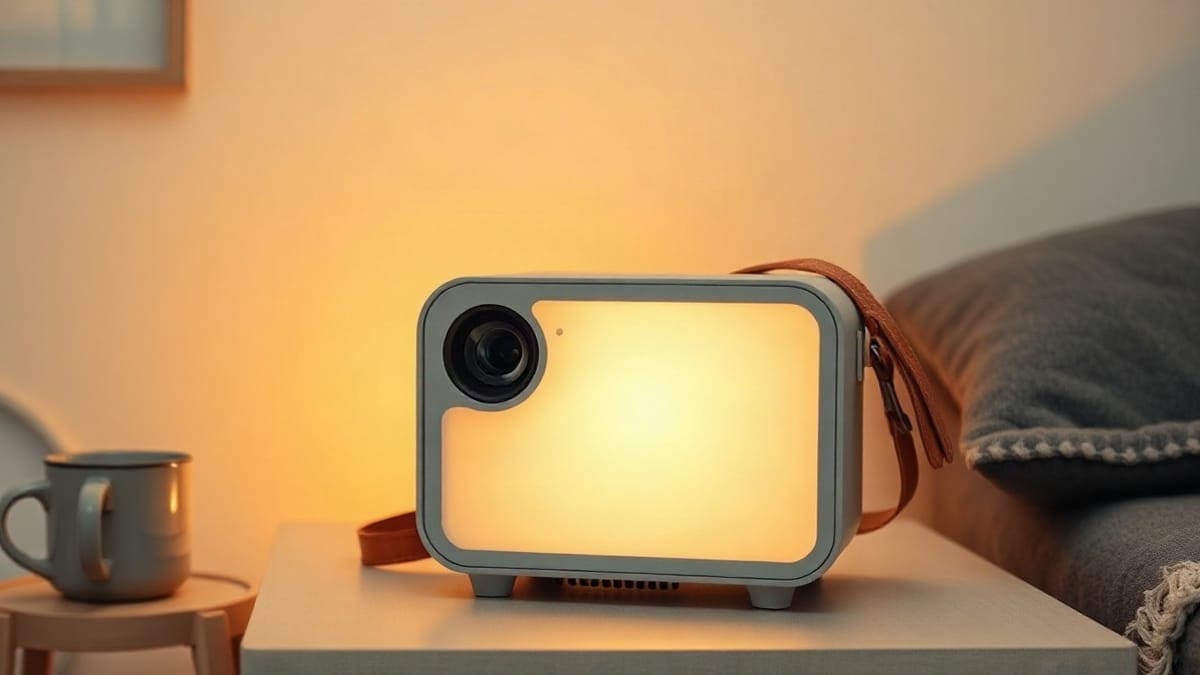
Our pick for most people is the Nebula Mars 3 Air: a 52 Wh battery, Google TV with Netflix and a measured 372 to 399 ANSI lumens against 400 rated. It weighs 3.7 lb. We read maker sheets and lab data on nine portables, from a 1.8 lb pocket model to a 9.9 lb box.
Choose the XGIMI MoGo 4 if the projector rides in a bag every day (2.9 lb, 20 ms input lag).
Choose the JMGO N1S 4K if you want 4K and always have an outlet (4.4 lb).
Choose neither for a sunny room. No battery model here passes 959 measured lumens, so look at daylight projectors.
Quick answer: what to know before you buy
- Lumens are the first limit. The battery models in this guide give 145 to 959 ANSI lumens in the modes ProjectorCentral measured. That is a dark-room picture of 40 to 100 inches. A pocket projector is not a TV replacement.
- Weight splits the category in three. 1.8 to 2.9 lb is a pocket or bag-side model. 3.3 to 4.4 lb is a backpack model. 9.9 lb is a carry-out box with a handle.
- Battery life is short. Measured and rated runtimes run from about 2 hours (Nebula Capsule 3 Laser, XGIMI MoGo 4) to about 4.5 hours (JMGO PicoFlix). A long film needs the outlet or a power bank. The older MoGo 2 Pro has no battery at all, so it needs a wall socket.
- Ratings are not the same unit. ISO 21118 is the strictest of the lumen tests, and a figure on a box is a "rated" claim from the maker. Compare the same unit, and prefer a published lab measurement over a rating.
- Sound is a stopgap. Built-in speakers run from 5 W mono to 8 W and 2 x 6 W. A Bluetooth speaker beats any of them outdoors.
- We did not test these. We read maker specifications and published lab measurements, and we say where they disagree.
Our picks at a glance
- 1Nebula Mars 3 Aira bedroom wall, a dorm, a tent or a hotel, at 30 to 100 inches in a dark roomCheck price
- 2XGIMI MoGo 4a desk, a nightstand and a backpack, 40 to 80 inches, gaming over HDMICheck price
- 3JMGO PicoFlixlong movies off the grid at 60 to 100 inches, kids' rooms, campingCheck price
Which portable projectors compare best, side by side?
Nine projectors cover almost every portable question. The table puts weight, brightness and power in one view. Brightness shows the maker rating first and the published measurement where one exists. Sources are ProjectorCentral and the maker pages listed at the end.
| Model | Right for | Brightness | Resolution | Weight | Power |
|---|---|---|---|---|---|
| Nebula Mars 3 Air | Best overall | 400 ANSI rated, 372 to 399 measured | 1080p | 3.7 lb | 52 Wh battery |
| XGIMI MoGo 4 | Pocket size, speakers | 450 ISO rated | 1080p | 2.9 lb | 71.28 Wh, 2 to 2.5 h |
| JMGO PicoFlix | Battery life | 450 ANSI rated | 1080p | 3.3 lb | About 4 h battery |
| Nebula Capsule 3 Laser | Travel, laser life | 300 ANSI rated, 302 to 341 measured | 1080p | 2.1 lb | 52 Wh battery |
| Samsung Freestyle 2nd Gen | Lightest | 230 ANSI | 1080p | 1.8 lb | 50 W plug, no battery |
| JMGO N1S 4K | 4K, small body | 1,700 ISO (JMGO), 1,100 ISO (ProjectorCentral) | 4K | 4.4 lb | Plug-in |
| XGIMI MoGo 4 Laser | Pocket laser, more light | 550 ISO rated | 1080p | 2.9 lb | 71.28 Wh, up to 2.5 h |
| Nebula Mars 3 | Outdoors, big battery | 1,000 ANSI rated, 959 measured | 1080p | 9.9 lb | 185 Wh battery |
| JMGO N1S Ultimate | Brightest | 3,500 ANSI rated, about 2,600 to 2,800 measured | 4K | 9.9 lb | Plug-in |
The order follows the questions you must answer: how far will it travel, how dark is the room, and how big is the picture. The sections below take each in turn.
What is the best portable projector to buy?
Buy the Nebula Mars 3 Air if you want one all-round battery projector. It is the only model here that combines a measured brightness near its rating (383 ANSI lumens in Standard mode), a 52 Wh battery, Google TV with Netflix and a body of 3.7 lb. Buy the XGIMI MoGo 4 if you carry the projector daily and want 2.9 lb with stereo speakers. Buy the JMGO N1S 4K if 4K and a gimbal stand matter more than a battery. Our projector guide covers the full-size models.
Which portable projector fits each need??
Pick the row that describes your use. This is the whole decision on one screen.
| Your situation | Screen size | Buy | Why |
|---|---|---|---|
| One projector for most uses | 60 to 100 in | Nebula Mars 3 Air | 383 ANSI lm measured, Netflix, 52 Wh |
| Daily carry, hotel, desk | 40 to 80 in | XGIMI MoGo 4 | 2.9 lb, 2 x 6 W, 20 ms lag |
| Longest battery in a small body | 60 to 100 in | JMGO PicoFlix | about 4 to 4.5 h, 450 ANSI lm |
| Travel with a laser engine | 40 to 80 in | Nebula Capsule 3 Laser | 2.1 lb, 30,000 h laser |
| Lightest possible, outlet in the room | 30 to 100 in | Samsung Freestyle 2nd Gen | 1.8 lb |
| 4K picture, wall outlet | 100 to 150 in | JMGO N1S 4K | 4.4 lb, 4K, gimbal |
| Pocket laser, a little more light | 40 to 80 in | XGIMI MoGo 4 Laser | 550 ISO rated, 71.28 Wh, 20 ms lag |
| Backyard movie night | 80 to 110 in | Nebula Mars 3 | 959 ANSI lm, 185 Wh, IPX3 |
| Brightest portable of all | 100 to 150 in | JMGO N1S Ultimate | 3,500 ANSI lm rated |
The nine portable projectors in detail
Each entry gives the main numbers, what it does well, where it falls short, and who should skip it. Prices change too quickly to print, so each Check price button opens the live offer instead.
Nebula Mars 3 Air: top pick overall
The Mars 3 Air is a 1080p RGB LED projector rated at 400 ANSI lumens, with a 52 Wh battery, Google TV and a 3.7 lb body. ProjectorCentral lists a 0.23 inch DLP chip, 30,000 hours of light source life, a 1.2:1 throw ratio with no optical zoom, two 8 W speakers, HDMI 2.0, USB-A, a 3.5 mm audio out, Wi-Fi and Bluetooth 5.1. The body is 7 x 4.8 x 5.2 inches. Google TV brings Netflix, Prime Video, Disney+, Hulu, HBO Max and Apple TV+.
The measurements are the honest part. ProjectorCentral recorded 399 ANSI lumens in Conference mode, 383 in Standard, 382 in Game and 372 in Movie, so the 400 rating is real, with 88 percent brightness uniformity. The catch is the battery: in Eco mode it falls to 145 lumens and runs about 3 hours 10 minutes, against 2.5 hours rated. At full brightness expect a shorter runtime. ProjectorCentral measured 40.3 dBA of fan noise at 36 inches in Conference mode (Nebula quotes 28 dB) and input lag of 44.1 ms.
Right for: a bedroom wall, a dorm, a tent or a hotel, at 30 to 100 inches in a dark room. Skip it if you watch above 100 inches or with lights on: ProjectorCentral notes the image washes out past about 80 inches. See also the Nebula guide and the battery projector page.
XGIMI MoGo 4: top pick for a pocket
The MoGo 4 is a 2.9 lb, 8.2 inch tall 1080p LED projector rated at 450 ISO lumens, with two 6 W Harman Kardon speakers and 20 ms of input lag at 1080p/60. ProjectorCentral lists a 0.23 inch DLP chip, Google TV with Google Assistant and Google Cast, auto focus, auto keystone, obstacle avoidance, HDR10 and a 360 degree tilt stand. It takes power by USB-C at 65 W, so a power bank can run it. XGIMI lists a 71.28 Wh battery with up to 2.5 hours of video in Eco mode, and ProjectorCentral lists 2 hours. Noise is 28 dB by the maker. Ports are HDMI and USB-A. It was released in June 2025.
The limits are the rating unit and the missing numbers. 450 ISO lumens is a rating from the maker, and we found no lab measurement of it. ISO 21118 is the strictest of the lumen tests, so the figure is a fair claim, but it is not a measurement. ProjectorCentral lists no throw distance and does not mention Netflix for this model, while XGIMI's own page lists Google TV with licensed Netflix, so Netflix is built in on the maker's word.
Right for: a desk, a nightstand and a backpack, 40 to 80 inches, gaming over HDMI. Skip it if you want a measured brightness figure or more than 2.5 hours on battery. The model before it is covered on XGIMI MoGo 3 Pro and XGIMI MoGo 4; the brand page is XGIMI projectors.
JMGO PicoFlix: longest battery in a small body
The PicoFlix weighs 3.3 lb and gives a maker rating of 450 ANSI lumens from an LED engine, with about 4 hours of runtime and up to 4.5 hours on the maker highlights. ProjectorCentral lists 1080p, a 1.2:1 throw ratio, a 25,000 hour light source, two 5 W speakers, HDMI 2.1, USB-C and USB-A, and a body of 3.15 x 9.45 x 3.15 inches (a bottle shape). Google TV is listed as a feature. It was released in October 2024.
That is the longest battery runtime on this page for a model that small. Sources disagree on the exact weight, with 3.3 lb on ProjectorCentral and 1.3 to 1.5 kg (2.9 to 3.3 lb) on retailer sheets, so treat it as about 3 lb. We found no independent lab measurement of its lumens, so 450 ANSI is the maker figure. See the JMGO range for how it sits beside the N1S models.
Right for: long movies off the grid at 60 to 100 inches, kids' rooms, camping. Skip it if you want a measured brightness or 4K.
Nebula Capsule 3 Laser: the travel pick with a laser engine
The Capsule 3 Laser is a 2.1 lb cylinder, 3.3 inches wide and 6.7 inches tall, with a 52 Wh battery and a laser engine rated at 300 ANSI lumens. ProjectorCentral measured 341 ANSI lumens in Custom mode, 302 in Standard, 236 in Movie and 123 in Game on AC power. On battery the numbers drop: 217 in Custom, 192 in Standard, 150 in Movie and 78 in Game. Battery life was about 2 hours 4 minutes in Standard mode.
It is 1080p on a 0.23 inch DLP chip, with a 1.2:1 throw ratio, HDMI 2.0 with eARC, USB-C, a 3.5 mm output, an 8 W speaker and Bluetooth 5.0. Two versions share the name: the 2023 model that ProjectorCentral measured runs Android TV 11.0 with no authorized Netflix app, and the version announced in August 2024 runs Google TV with Netflix (per Notebookcheck and Anker Japan). Check which one you buy. ProjectorCentral measured fan noise at 38.6 dBA in Standard mode (Nebula quotes 28 dB). Input lag in Game mode is 22.4 ms at 4K/60 but 129.6 ms in Standard. All the figures above come from the 2023 version.
Right for: a dorm, a tent, travel, 40 to 80 inches, a dark room. Skip it if you want a bright picture on battery: 192 measured lumens is the lowest on this page except the Freestyle. See the Nebula Capsule family and Capsule 3 Laser.
Freestyle 2nd Gen from Samsung, the lightest to carry
The Freestyle 2nd Gen weighs 1.8 lb, is rated at 230 ANSI lumens, and has no battery. ProjectorCentral lists 1920 x 1080, a 1.20:1 throw ratio for a 29.6 to 100.4 inch image from 2.6 to 8.8 feet, a 30,000 hour LED, a 5 W mono speaker, a Micro HDMI port and a 50 W power supply. The body is 6.8 x 4.0 x 3.7 inches and the OS is Samsung Tizen. It was released in August 2023. Retailer pages quote 550 LED lumens for the same unit. "LED lumens" has no standard test, so it is not comparable with ANSI and is not another model.
The honest limit is the lowest brightness of the nine. 230 ANSI lumens on a 60 inch screen gives about 21.5 foot-lamberts in a fully dark room, and 12.1 at 80 inches. Input lag is not listed on ProjectorCentral. For a hotel desk it is the easiest thing to pack.
Right for: a shelf, a bedroom ceiling, a short trip with an outlet. Skip it if you want battery power or a picture above 80 inches. Read the Samsung Freestyle page and the Freestyle 2nd Gen page.
JMGO N1S 4K: the 4K portable for a wall outlet
The N1S 4K weighs 4.4 lb and is announced by JMGO at 1,700 ISO lumens, though ProjectorCentral lists 1,100 ISO lumens for the same model. We found no explanation for the gap, so the realistic output is the lower end. It is a triple laser projector on a gimbal stand, 4K input, a 1.2:1 throw ratio (5.2 to 17.4 feet for 60 to 200 inches), one HDMI 2.1 port and one USB-A port, Google TV with Netflix, and a body of 7.5 x 6.5 x 7.3 inches. It has no battery listed.
On the 1,100 ISO figure, 100 inches gives about 37 foot-lamberts and 120 inches about 26. On the 1,700 figure it is about 57 and 40. In a dim room both work.
Right for: a bedroom or living room where the projector comes out of a cabinet, 80 to 120 inches, 4K sources. Skip it if you need a battery or two HDMI ports. See the JMGO N1S 4K review and the 4K portable guide.
XGIMI MoGo 4 Laser: the same pocket body with a laser engine
The MoGo 4 Laser is the 2.9 lb MoGo 4 body with an RGB laser engine rated at 550 ISO lumens, a 71.28 Wh battery and 20 ms of input lag at 1080p/60. ProjectorCentral lists 1080p, a 1.20:1 throw ratio (3.5 to 17.4 feet), two 6 W speakers, HDMI and USB-A, Google TV, and a body of 8.2 x 3.8 x 3.8 inches. It was released in June 2025 and is listed as shipping. XGIMI says the battery gives up to 2.5 hours of video in Eco mode and up to 6 hours of music, and that Netflix is built in. ProjectorCentral lists 2 hours of battery.
The limit is the missing measurement. 550 ISO lumens is a maker rating, and we found no lab figure for it, so treat it as a little brighter than the 450 ISO MoGo 4 rather than a different class. XGIMI quotes 56 ms of lag with auto keystone on, against 20 ms with it off, so switch auto keystone off for games.
Right for: a desk, a tent or a hotel, 40 to 80 inches in a dark room, with a bank or the outlet. Skip it if you want a lab brightness figure, or a bigger picture than 80 inches. The brand page is XGIMI projectors.
Nebula Mars 3: the outdoor battery pick
The Mars 3 is a 9.9 lb, 1,000 ANSI lumen LED projector with a 185 Wh battery rated at up to 5 hours, an IPX3 splash rating and a 40 W speaker. ProjectorCentral measured 959 ANSI lumens in Bright mode at full power, 785 in Standard and 686 in Movie, and the same review notes 442 lumens in Eco mode. It is 1080p, 1.2:1, 25,000 hours, with HDMI and two USB-A ports, 10.2 x 6.3 x 9.8 inches, released in July 2023. It can charge a phone as a power bank.
A 100 inch image needs 8.7 feet and gives about 32 foot-lamberts at 959 lumens. Its two-hour life at standard power is the cost of the brightness.
Right for: a backyard or campsite at 80 to 110 inches after dark. Skip it if you fly with it: 185 Wh is above the 160 Wh airline limit (see the plane section below). Our outdoor projector guide has the full outdoor comparison.
JMGO N1S Ultimate: the brightest portable
The N1S Ultimate is rated at 3,500 ANSI lumens (3,300 ISO on some retailer sheets) in a 4K RGB laser body with two HDMI ports and a 30,000 hour light source. ProjectorCentral lists a 1.2:1 throw ratio, a 9.9 lb weight and 1,600:1 contrast. Another review lists 14.3 lb, so the weight source matters. Measurements are lower than the rating: about 2,600 to 2,800 ANSI lumens in normal modes, and 3,524 only with "Ultra Brightness" on, which has a strong green bias.
At a real 2,700 lumens it gives about 91 foot-lamberts at 100 inches and 40 at 150 inches. It has no battery. We would call it portable only in the sense of moving between rooms.
Right for: a lit living room, 100 to 150 inches, one device you carry between a living room and a patio. Skip it if you need a battery. See the N1S Ultimate review and the brightest portable projector page.
What should you check before buying a portable projector?
Choose in this order: where you will use it, how big the picture must be, brightness, power, then ports and apps. Most people start from resolution and end up with a dim 4K picture or a bright one that cannot be carried.
How bright does a portable projector need to be?
For a dark room, aim for at least 15 to 20 foot-lamberts on the screen, and for a pocket projector that means a smaller picture. The 16 fL figure is the cinema reference level in SMPTE 196M summaries on Acoustic Frontiers. Divide lumens by the screen area in square feet and you get foot-lamberts, on a plain 1.0 gain screen. Our calculation:
| Model and rating used | 60 in (10.7 sq ft) | 80 in (19.0 sq ft) | 100 in (29.7 sq ft) |
|---|---|---|---|
| Samsung Freestyle, 230 ANSI | 21.5 fL | 12.1 fL | 7.7 fL |
| Capsule 3 Laser, 302 ANSI measured | 28.3 fL | 15.9 fL | 10.2 fL |
| Mars 3 Air, 383 ANSI measured | 35.9 fL | 20.2 fL | 12.9 fL |
| Mars 3 Air, Eco mode, 145 ANSI | 13.6 fL | 7.6 fL | 4.9 fL |
| MoGo 4 or PicoFlix, 450 rated | 42.1 fL | 23.7 fL | 15.2 fL |
| MoGo 4 Laser, 550 ISO rated | 51.5 fL | 29.0 fL | 18.5 fL |
| Mars 3, 959 ANSI measured | 89.8 fL | 50.5 fL | 32.3 fL |
| N1S 4K, 1,100 ISO (ProjectorCentral) | 103 fL | 57.9 fL | 37.0 fL |
| N1S Ultimate, 2,700 ANSI measured | 253 fL | 142 fL | 90.9 fL |
Read the table as a ceiling. It mixes ANSI and ISO figures and ignores the loss in picture modes, which was 28 percent from Bright to Movie on the Mars 3 (959 to 686 lumens). Add 30 percent to your target. On this math the Freestyle and the Capsule 3 Laser belong at 60 to 80 inches, the 450 lumen models at 80 to 100, and only the Mars 3 and above keep a 100 inch picture lively. See the how many lumens guide and brightness explained.
Why do two projectors rated at 450 lumens look different?
A rating is the maker's number, and a measurement is a lab's. ISO 21118 is the strictest of the lumen tests, so an ISO rating is not a flattering figure, but it is still the maker's own claim, while a lab measures an ANSI figure on the actual unit. Two projectors with a 450 lumen rating, like the MoGo 4 (450 ISO rated) and the PicoFlix (450 ANSI rated), are therefore not an even match on paper. Anker explains the difference, and Sound & Vision reported on the ISO standard. When a lab number exists, use it: the Mars 3 Air measured 372 to 399 against a 400 rating, and the N1S Ultimate measured about 20 to 25 percent under its 3,500.
Is 1080p sharp at 40 to 100 inches?
1080p is enough for a portable. Seven of the nine models here are native 1080p, and the picture is small, 40 to 100 inches. The two 4K models (JMGO N1S 4K and N1S Ultimate) output 4K and need a wall outlet. A 4K signal into a 1080p projector, like the 4K/60 input of the Capsule 3 Laser, is downscaled to 1080p.
How much weight is too much?
For a bag, stay under 5 lb. The 1.8 to 3.7 lb models fit a daypack, the 4.4 lb model fits a carry-on with room to spare, and the 9.9 lb models need a handle or a case. The weight table below puts them in order.
| Model | Weight | Height or length | Battery |
|---|---|---|---|
| Samsung Freestyle 2nd Gen | 1.8 lb | 6.8 in | None, 50 W plug |
| Nebula Capsule 3 Laser | 2.1 lb | 6.7 in | 52 Wh, about 2 h 4 min |
| XGIMI MoGo 4 | 2.9 lb | 8.2 in | 71.28 Wh, 2 to 2.5 h |
| XGIMI MoGo 4 Laser | 2.9 lb | 8.2 in | 71.28 Wh, up to 2.5 h |
| JMGO PicoFlix | 3.3 lb | 9.45 in | about 4 to 4.5 h |
| Nebula Mars 3 Air | 3.7 lb | 7 in | 52 Wh, 3 h 10 min in Eco |
| JMGO N1S 4K | 4.4 lb | 7.5 in | None listed |
| Nebula Mars 3 | 9.9 lb | 10.2 in | 185 Wh, up to 5 h Eco |
| JMGO N1S Ultimate | 9.9 lb | 9.5 in | None listed |
Do you need apps built in?
If you hate sticks and cables, pick Google TV. The Mars 3 Air and the N1S 4K list Netflix. The 2023 Android TV version of the Capsule 3 Laser has no authorized Netflix app, while the 2024 Google TV version has it. XGIMI lists licensed Netflix on the MoGo 4 and MoGo 4 Laser, though ProjectorCentral does not mention it. A stick fixes this for a modest cost, as covered in Netflix on a projector and projector apps.
What about ports and inputs?
Count your devices. Most pocket models have one HDMI. The N1S Ultimate has two HDMI 2.1, and the Capsule 3 Laser has HDMI 2.0 with eARC. A HDMI projector guide and a short cable guide help with the cable.
| If you will... | Look at | Avoid |
|---|---|---|
| Carry it daily | Freestyle, Capsule 3 Laser, MoGo 4, MoGo 4 Laser | N1S Ultimate, Mars 3 |
| Watch off the grid | PicoFlix, Mars 3, Mars 3 Air | Freestyle, N1S 4K |
| Use it in a lit room | N1S Ultimate, N1S 4K | Freestyle, Capsule 3 Laser |
| Stream without a stick | Mars 3 Air, MoGo 4, N1S 4K | Capsule 3 Laser (2023 version) |
| Game on it | MoGo 4 and MoGo 4 Laser (20 ms) | Capsule 3 Laser in Standard (129.6 ms) |
| Hook up two devices | N1S Ultimate | Most pocket models |
How far back must a portable projector sit?
Distance is the throw ratio times the picture width, and for a 16:9 image the width is 87.2 percent of the diagonal. Eight of the nine models list a 1.2:1 ratio. ProjectorCentral lists none for the MoGo 4, though the MoGo 4 Laser in the same body lists 1.20:1, so use the maker's sheet for the MoGo 4. Our math for the 1.2:1 lens:
| Picture size | Width | Distance at 1.2:1 |
|---|---|---|
| 60 in | 52.3 in | 5.2 ft |
| 80 in | 69.7 in | 7.0 ft |
| 100 in | 87.2 in | 8.7 ft |
| 120 in | 104.6 in | 10.5 ft |
The throw distance calculator handles other sizes.
How long does a portable projector run on battery?
Runtime depends on brightness, so read the mode, not only the hours. The table lists what we found, and the mode matters more than the headline number.
| Model | Capacity | Runtime found | Condition |
|---|---|---|---|
| Nebula Capsule 3 Laser | 52 Wh | about 2 h 4 min | Standard mode, 192 lm on battery |
| Nebula Mars 3 Air | 52 Wh | 2.5 h rated, 3 h 10 min measured | Eco mode, 145 lm |
| XGIMI MoGo 4 | 71.28 Wh | 2 h (ProjectorCentral), up to 2.5 h (XGIMI) | Eco mode, video |
| XGIMI MoGo 4 Laser | 71.28 Wh | up to 2.5 h (XGIMI) | Eco mode, video |
| JMGO PicoFlix | about 10,000 mAh (retailer) | about 4 h, up to 4.5 h | maker figure |
| Nebula Mars 3 | 185 Wh | up to 5 h | Eco mode, 442 lm |
The pattern is simple: the long runtimes come from dimmer modes. If you plan a three hour film at full brightness, bring a USB-C power bank for the models that accept one (the MoGo 4 does, at 65 W) or an outlet.
What types of portable projector are there?
There are three: pocket projectors under 3 lb, backpack projectors from 3 to 5 lb, and carry-out projectors near 10 lb. Each type trades weight for lumens and for battery.
| Type | Examples here | Weight | Typical brightness | Battery |
|---|---|---|---|---|
| Freestyle, Capsule 3 Laser, MoGo 4, MoGo 4 Laser | 1.8 to 2.9 lb | 230 to 550 lumens | 0 to about 2.5 h | |
| Backpack | PicoFlix, Mars 3 Air, N1S 4K | 3.3 to 4.4 lb | 400 to 1,700 lumens | 0 to 4.5 h |
| Carry-out | Mars 3, N1S Ultimate | 9.9 lb | 1,000 to 3,500 lumens | 5 h or none |
The light source matters too. LED and RGB LED are small and cool, with 25,000 to 30,000 hours of life on the models here. Laser (Capsule 3 Laser, MoGo 4 Laser, N1S 4K, N1S Ultimate) gives more light for its size, and ProjectorCentral lists 30,000 hours where it gives a figure. None here uses a lamp. Read DLP vs LCD for the chip trade-off and portable laser projectors for laser picks.
What makes a projector portable?
A portable projector is a small projector built to move: light, usually with a battery or a USB-C power input, and with a stand or gimbal. It works the same way as a large one. A light source (LED or laser) lights a chip, usually a 0.23 inch DLP chip in this group. A lens focuses the picture onto a wall or screen, and a processor handles Wi-Fi, apps and autofocus. Our how a projector works guide shows the parts.
Is a mini, mobile or pocket projector the same thing?
Mostly yes: these are names for the same kind of small projector, and the dividing line is weight and brightness, not a standard. For the smallest models, with tiny batteries and a few hundred lumens at best, read our mini projector guide and pocket projector guide.
How much does a portable projector cost?
It costs from an entry level to a premium level, and the order matches the table: pocket models cost less than the 4K and 1,000 lumen models. We show no prices here because they move faster than a page can be updated, and the Check price buttons open the current offer. For a price overview by budget, see how much does a projector cost, cheap projectors and projector under 200.
Are portable projectors worth it?
Yes, if you watch in a dark room and accept a smaller, softer picture than a TV in daylight. The 1080p picture is sharp at 60 to 100 inches. The trade-offs are brightness (145 to 959 lumens on battery), battery life (about 2 to 4.5 hours) and fan noise (28 dB claimed, 35 to 40 dBA measured on some). A TV wins in daylight; see projector vs TV.
Do portable projectors work?
Yes, they work well in the right room. In a dark bedroom a 400 lumen projector gives about 20 foot-lamberts at 80 inches, which is a cinema-level brightness. In a sunny room they fail: sunlight on a white wall overwhelms 1,000 lumens.
Are portable projectors any good?
They are good for what they do, and not a replacement for a TV. Check the numbers that matter: measured lumens, throw distance and input lag. A projector with 22.4 ms lag in game mode is fine for gaming, and one with 129.6 ms is not.
How do you set up and use a portable projector?
Set it on a flat surface about 8.7 feet from a 100 inch screen, run focus and keystone, then connect a source. At the 1.2:1 throw ratio found on most models here, the distance is 5.2 feet for 60 inches, 7.0 feet for 80 inches and 8.7 feet for 100 inches.
- Pick the wall. White or light gray, flat, with no window opposite.
- Place the projector. Square to the wall, near the center, at the distance for your size.
- Run autofocus and keystone. Use as little digital keystone as you can, since it softens the picture.
- Connect the source. HDMI for a console or laptop, Wi-Fi for apps.
- Darken the room. Switch the lights off and close the blinds.
- Add sound. Pair a Bluetooth speaker.
Our setup guide, focus guide and throw distance calculator go deeper.
Can a portable projector connect to a phone?
Yes, in most cases, by cable or wirelessly. Google Cast on the XGIMI MoGo 4 and Google TV on the Mars 3 Air and the N1S 4K can receive a cast from an Android phone, and an iPhone 15, 16 or 17 (not the 16e or 17e, which have no USB-C video output) can send video over a USB-C to HDMI adapter, as 9to5Mac reported. Step-by-step instructions are on our phone connection guide and the phone projector page.
Which cable links a portable projector to a laptop?
Yes, over HDMI or USB-C. Our laptop connection guide lists the cables, adapters and settings.
Is Wi-Fi required on a portable projector?
No. Wi-Fi is needed only for built-in apps like Netflix. Over HDMI from a console or laptop, they work with no network. The Mars 3 Air lists Wi-Fi and Bluetooth 5.1, the Capsule 3 Laser lists Bluetooth 5.0, and the Samsung Freestyle runs Samsung Tizen, an app platform that uses a network. For connected models see Wi-Fi and Bluetooth projectors.
Do portable projectors have Bluetooth?
Many do. The Mars 3 Air (Bluetooth 5.1) and the Capsule 3 Laser (Bluetooth 5.0) list it, and the MoGo 4 lists Bluetooth as a feature. One review of the Mars 3 reports Bluetooth audio sync issues, so test the lag with your speaker. See Bluetooth projectors.
Do portable projectors have speakers?
Yes, all nine do: 5 W mono on the Freestyle, two 5 W on the PicoFlix, an 8 W speaker on the Capsule 3 Laser, two 8 W on the Mars 3 Air, two 6 W speakers on the MoGo 4 and MoGo 4 Laser, and 40 W on the Mars 3. They are fine in a bedroom. Outdoors, add a speaker; see projectors with speakers.
Do portable projectors need to be plugged in?
Not always. Six of the nine run on a built-in battery (Mars 3 Air, Capsule 3 Laser, PicoFlix, MoGo 4, MoGo 4 Laser, Mars 3), and the two MoGo models also take a USB-C power bank. The Freestyle, N1S 4K and N1S Ultimate list no battery and need an outlet or a large portable power station. A battery that lasts 2 hours covers one film at best.
Is a portable projector rechargeable?
The battery models are rechargeable. ProjectorCentral measured about 2 hours to recharge the Mars 3 Air. Run time depends on the mode: the Mars 3 Air lasted about 3 hours 10 minutes in Eco mode at 145 lumens, against 2.5 hours rated.
Where do portable projectors perform well?
They work best in a dark room, a tent, a dorm or a backyard after dusk, and they work worst in daylight. For each case the numbers decide.
Can you bring a portable projector on a plane?
Yes. TSA allows projectors in carry-on and checked bags, and the batteries are the issue. Under the FAA rule for spare lithium batteries, a battery up to 100 Wh is allowed, 101 to 160 Wh needs the airline's approval, and more than 160 Wh is not permitted, which rules out the 185 Wh Nebula Mars 3 as a spare battery. The 52 Wh models (Capsule 3 Laser, Mars 3 Air) and the 71.28 Wh MoGo 4 models are under 100 Wh. Check the airline policy before you fly, and keep the unit in your carry-on.
Which portable projector suits camping and travel??
For a tent, pick the Capsule 3 Laser or the Mars 3 Air (52 Wh each), or the PicoFlix for about 4 to 4.5 hours. For a hotel room with an outlet, the 1.8 lb Samsung Freestyle is the lightest. See projector for travel and camping and camping projectors.
Which portable projector suits outdoor movies??
The Nebula Mars 3: 959 ANSI lumens measured, a 185 Wh battery and an IPX3 splash rating. IPX3 covers splashes, not rain. For 80 to 110 inches after dark it is enough. Our outdoor projector guide has the details, and portable outdoor projector covers more models.
Is a portable projector good for presentations?
It can be, if the room can be darkened. For a meeting room with lights on you need about 1,000 lumens or more, and the JMGO N1S 4K at 1,100 ISO lumens (ProjectorCentral) is the nearest here; the N1S Ultimate is brighter but heavier. A 300 lumen pocket model suits a dim room of about 60 inches. See office projectors.
What is the brightest portable projector?
The JMGO N1S Ultimate: 3,500 ANSI lumens rated, about 2,600 to 2,800 ANSI measured in normal modes. It has no battery. Among battery models, the Mars 3 leads with 959 ANSI lumens measured. See brightest portable projectors.
What screen do you need for a portable projector?
A white wall works in a dark room, and a portable screen adds contrast. For screen sizes and prices see our portable projector screen guide and projector screens, and a stand or tripod for placement.
Where do you buy a portable projector?
From the maker's store, Best Buy or Amazon. Our where to buy a projector guide compares them, and Black Friday projector deals tracks sales.
How do you look after a portable projector?
Keep the lens clean, the vents clear, and never open the case. A dust blower and a lens cloth are enough for the outside of the lens. For dust inside the optics, ask the maker or a service center, because opening the housing voids most warranties.
How do you clean a portable projector lens?
Blow off dust, then wipe gently with a clean microfiber cloth. Dust inside the lens or the light engine is a service job, not something to open yourself.
What if you want to build one?
Building a projector from a box and a magnifier lens is a craft project, not a way to get a picture like these. Our how to make a projector at home guide covers the DIY version.
What mistakes should you avoid?
- Buying on the box number. A rating in ISO lumens is not an ANSI measurement.
- Expecting a big picture on a pocket model. At 100 inches a 300 lumen projector gives about 10 foot-lamberts.
- Planning a long film on battery. Two hours of battery is one movie, and Eco mode cuts the light by more than half on the Mars 3 Air.
- Forgetting the wall. A textured or colored wall costs more brightness than any spec.
- Using heavy keystone. It softens the picture and loses light.
- Counting on the speaker. Outdoors, a Bluetooth speaker is a better buy.
- Flying with a 185 Wh battery. It exceeds the 160 Wh limit.
- Skipping the stick. If the model has no Netflix, buy a streaming stick before you leave.
Keep reading: more portable projector guides
- By size: mini projectors, pocket projectors, phone projectors
- By power: battery powered projectors, 4K portable projectors, 1080p portable projectors
- By use: outdoor, camping, daylight
- Brands: JMGO, XGIMI, Nebula, Samsung Freestyle, Epson portable
- Basics: setup, lumens, throw distance
How we chose these projectors
We built this page from maker pages and ProjectorCentral's spec database and reviews, read on 17 November 2026. We chose nine models to cover six needs: best overall, pocket size, battery life, travel, 4K and brightness, plus one outdoor pick. We did not test any projector ourselves.
Three choices are worth saying aloud. We dropped the Epson EpiqVision Mini EF12, and the EF21 and EF22 that followed it, because ProjectorCentral lists them as discontinued: a buying guide should recommend what you can buy. We counted the Mars 3 and the N1S Ultimate as portable by carry weight, not by pocket size. We kept ratings and measurements in separate columns wherever a lab number exists.
What we could not confirm: a lab measurement of the lumens of the MoGo 4, the MoGo 4 Laser and the PicoFlix, the exact weight of the PicoFlix (3.3 lb against 2.9 lb on retailer sheets), the weight of the N1S Ultimate (9.9 lb on ProjectorCentral, 14.3 lb in one review), which version of the Capsule 3 Laser a given store ships, and why ProjectorCentral does not list Netflix for the MoGo 4 when XGIMI does.
FAQ
Which model should I look at first?
For most people, the Nebula Mars 3 Air: 3.7 lb, a 52 Wh battery and 383 ANSI lumens measured in Standard mode. For a pocket, the 2.9 lb XGIMI MoGo 4.
How much does a portable projector cost?
It ranges from entry level to premium. We list no prices because they change daily; use the Check price buttons, or see how much does a projector cost.
Is a portable projector bright enough for daytime?
No. Battery models measure 145 to 959 ANSI lumens, which is a dark-room picture. For daylight see daylight projectors.
How long does a portable projector battery last?
About 2 to 4.5 hours: 2 hours 4 minutes for the Capsule 3 Laser in Standard mode, about 4 to 4.5 hours for the PicoFlix, and up to 5 hours in Eco mode for the Mars 3.
How big a picture can a portable projector make?
About 40 to 100 inches for the pocket models, and 100 to 150 inches for the N1S 4K and the N1S Ultimate. ProjectorCentral notes the Mars 3 Air washes out past about 80 inches.
How far should a portable projector sit from the screen?
At a 1.2:1 throw ratio: 5.2 feet for 60 inches, 7.0 feet for 80 inches and 8.7 feet for 100 inches.
Do portable projectors work with a phone?
Yes, by cable or by casting. Details are on our phone connection guide.
Which portable projectors include Netflix?
On the Mars 3 Air, the JMGO N1S 4K and, per XGIMI, the MoGo 4 and MoGo 4 Laser. The Capsule 3 Laser depends on the version: the 2023 Android TV model has no authorized Netflix app, the 2024 Google TV model does. Add a stick if yours has none.
Can I take a portable projector on a plane?
Yes, in carry-on, if its battery is under 100 Wh, or under 160 Wh with airline approval. The 185 Wh Mars 3 is over the limit.
What is the lightest portable projector here?
The Samsung Freestyle 2nd Gen at 1.8 lb, followed by the Nebula Capsule 3 Laser at 2.1 lb.
Does a portable projector need 4K?
Yes, at 100 inches and below. 4K helps at larger sizes and needs more lumens.
Do portable projectors have good sound?
They have usable sound for a bedroom: 5 W to 40 W across these models. Add a Bluetooth speaker outdoors.
Which portable projector lasts longest on battery?
The JMGO PicoFlix, rated about 4 hours and up to 4.5 hours. The Mars 3 has the biggest battery at 185 Wh.
Sources
- ProjectorCentral: Anker Nebula Capsule 3 Laser review
- ProjectorCentral: Anker Nebula Mars 3 Air review
- ProjectorCentral: Anker Nebula Mars 3
- ProjectorCentral: XGIMI MoGo 4
- ProjectorCentral: JMGO PicoFlix
- ProjectorCentral: Samsung Freestyle 2nd Gen
- ProjectorCentral: XGIMI MoGo 4 Laser
- XGIMI: MoGo 4 Laser
- XGIMI: MoGo 4
- ProjectorCentral: JMGO N1S 4K
- ProjectorCentral: JMGO N1S Ultimate
- TSA: projectors
- TSA: lithium batteries over 100 watt hours
- FAA: airline passengers and batteries
- 9to5Mac: iPhone 15 USB-C external displays
- Acoustic Frontiers: image brightness targets and foot-lamberts
- Anker: ISO lumens vs ANSI lumens
- Sound & Vision: projector brightness standards (ISO 21118)
Keep comparing
 Home Theater ProjectorEight home theater projectors compared for 2026 by contrast, black level, HDR, lens, noise and screen size
 4K ProjectorNine 4K projectors compared for 2026 by how the 4K is made, brightness, HDR formats and HDMI ports
 Gaming ProjectorNine gaming projectors for 2026, compared by rated and lab-measured input lag at 1080p 60, 120
 Short Throw ProjectorEight short throw projectors on sale in the US compared by throw ratio, feet from a 100 inch screen