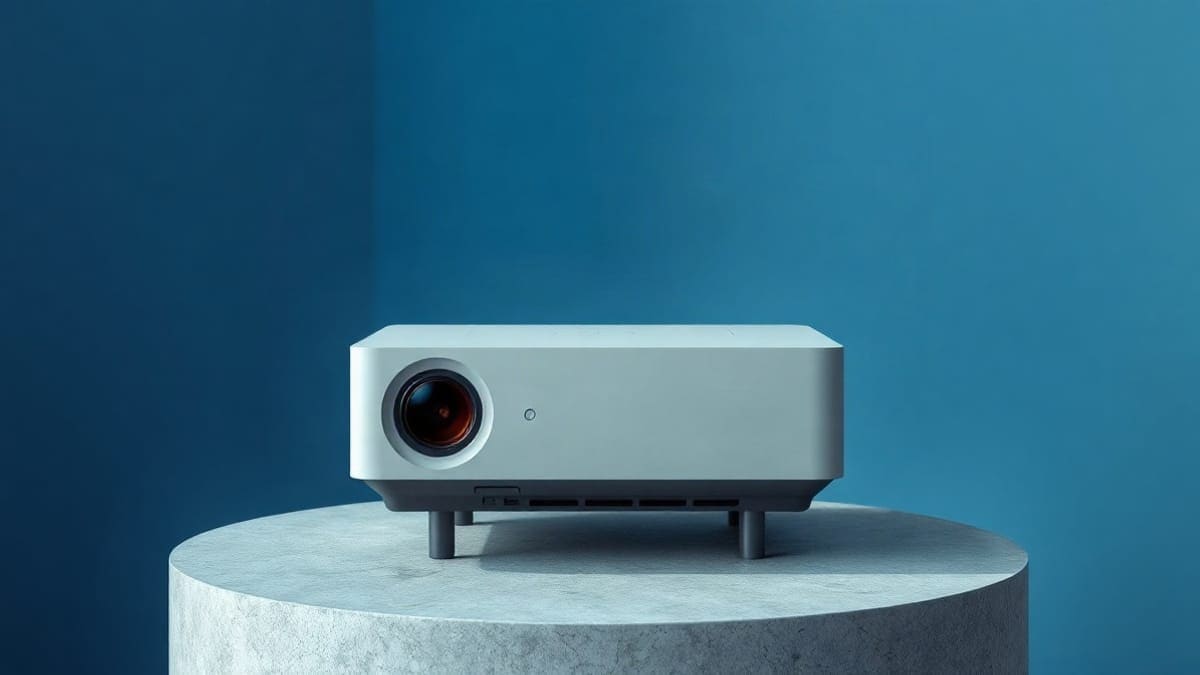
Buy a projector if you want 100 inches or more and can dim the room; buy a TV if you watch in daylight or want the simplest setup. A 100 inch image has 2.37 times the area of a 65 inch TV, while a good TV still wins on brightness and black levels in a lit room. We compare both on published numbers and our calculations, then give a verdict by room.
Should you buy a projector or a TV? Take this one, take that one
This block turns "which is better" into "which is better for your room".
- Take a projector, such as the JMGO N1S Ultimate, if the picture should be 100 to 150 inches, the room can be dim for movies, and you have a white wall or a screen.
- Take a TV if the room is bright all day, the viewing is mostly news, sport and shows, or you want it to work the moment you press the remote.
- Take a laser TV (an ultra short throw projector with a screen), such as the Hisense PX3-Pro, if you want 100 inches or more but the projector must sit on a media stand 1.6 feet from the wall.
- Take neither if the room is tiny and the viewing is solo. A 55 to 65 inch TV on a wall costs the least floor space, and a portable projector can come out only for movie night.
Our picks at a glance
- 1JMGO N1S Ultimatea living room where a TV used to be and the curtains can closeCheck price
- 2XGIMI Horizon 20 Maxa room with lamps on, and for consolesCheck price
- 3Valerion VisionMaster Maxa dedicated dark roomCheck price
Quick answer: projector vs TV in seven points
- Size. A projector gives 100 to 150 inches (29.68 to 66.76 square feet). A 65 inch TV gives 12.54 square feet.
- Brightness. A 3,000 lumen projector on a 100 inch screen gives about 101 foot-lamberts (346 nits) at best. RTINGS treats more than 500 nits as good SDR brightness for a TV.
- Contrast. OLED TVs switch pixels off. Home projectors measured from 1,420:1 to 4,143:1 native.
- Power. A laser projector draws 250 to 280 W; a 65 inch TV is estimated at 95 to 130 W. Per square foot of picture, they are close.
- Life. Laser light sources are rated 20,000 to 30,000 hours; a lamp 3,500 to 5,000. Most TVs in RTINGS's accelerated test survived 10,000 hours.
- Gaming. The best projectors list 1 to 3 ms of input lag; many measure 17 to 20 ms.
- We have not tested any of these. We use maker specifications, ProjectorCentral measurements and other published sources, and we say where we calculate.
What is a projector TV, and how do you project a TV?
A projector TV is a projector used in place of a television, usually a 4K model with built-in apps, speakers and a remote. The term also covers the laser TV, a projector sold with a special screen. The two terms mean the same job: show cable, streaming and games on a big wall or screen instead of a panel.
To project a TV signal, plug the source into the projector's HDMI port: a cable box, a streaming stick, a console or a laptop. Many models run Google TV or similar apps, so a stick is optional. The JMGO N1S 4K ships with Google TV and Netflix, per ProjectorCentral.
Phones mirror over Wi-Fi or a cable; see how to connect a phone to a projector. A laptop needs HDMI or USB-C: see how to connect a projector to a laptop. For models built for daily TV use, read our best projector guide.
What is the difference between a TV and a projector?
A TV makes light in the panel and sends it to you. A projector makes light, shapes it with a chip, and throws it at a surface that reflects it to you. That one difference explains almost everything below: size, brightness, contrast, noise and setup.
| Point | TV | Projector |
|---|---|---|
| Light path | Emitted by the panel | Reflected from a screen or wall |
| Typical size | 55 to 85 in | 80 to 150 in |
| Room light | Handles it | Needs a dim room or an ALR screen |
| Black level | OLED switches pixels off | Raised by room light and the chip |
| Fan noise | Rarely audible | 28 dB rated, 35 to 45 dBA measured |
| Light source life | Backlight or pixels | Lamp 3,500 h; laser 20,000 to 30,000 h |
| Setup | Stand or wall mount | Throw distance, screen, mount |
| Portability | Fixed | 2 to 20 lb models exist |
Fan figures come from ProjectorCentral measurements at about 3 feet; the other figures are typical ranges from the models we cite below.
Size is the headline and setup is the price of it. The next sections take each point in turn.
Which is better, a projector or a TV?
Neither wins everywhere. A projector is better for size and for a dark room; a TV is better for brightness, black levels in a lit room and convenience. If you ask "are projectors better than TVs", the honest reply is that they are better at one job: a very large picture that you watch with the lights low.
If you ask "which is best, a projector or a TV", count your hours. A family room used all day with the curtains open suits a TV. A room used mainly at night for films, sport or games suits a projector, because its main weakness (ambient light) is gone and its main strength (size) shows. Our home theater projector guide covers the dark-room case in depth, and the sibling comparison home theater projector vs TV narrows it to movies.
Why would you pick a projector over a TV?
Three reasons carry the argument: size, size per cost, and space. A projector turns a blank wall into a 100 to 150 inch screen. It can also vanish: a ceiling mount or a pull-down screen leaves the wall empty between uses. And a projector travels, which a wall-mounted TV cannot.
People who ask why a projector is better than a TV usually mean the first reason. The step from 65 to 100 inches is a change in how the room feels, not a small upgrade. The gap is the picture area, shown in the next section.
How big a picture does each give you?
A 100 inch picture has 2.37 times the area of a 65 inch TV, and a 150 inch picture has 5.32 times. Area, not the diagonal, is what you feel. Our calculation uses a 16:9 shape; width is the diagonal times 0.8716, height times 0.4903.
| Diagonal | Width x height | Area | Area vs 65 in | Seat distance for a 40 degree view |
|---|---|---|---|---|
| 65 in | 56.7 x 31.9 in | 12.54 sq ft | 1.00 | 6.5 ft |
| 75 in | 65.4 x 36.8 in | 16.69 sq ft | 1.33 | 7.5 ft |
| 85 in | 74.1 x 41.7 in | 21.44 sq ft | 1.71 | 8.5 ft |
| 100 in | 87.2 x 49.0 in | 29.68 sq ft | 2.37 | 9.9 ft |
| 120 in | 104.6 x 58.8 in | 42.73 sq ft | 3.41 | 11.9 ft |
| 150 in | 130.7 x 73.5 in | 66.76 sq ft | 5.32 | 14.9 ft |
Seat distance is our calculation: 1.37 times the image width fills a 40 degree field of view. Sit farther for a gentler angle.
The last column is the catch. A 120 inch image wants almost 12 feet of seating distance for a cinema-wide view, and your room may not have it. For a short room, ultra short throw projectors sit under the screen, and the throw distance calculator tells you where a given model must stand.
Large TV or 100 inch projector: where is the crossover?
Up to about 85 inches, a large TV is usually the easier answer. Past that size, the choice changes: a projector gives 100 to 150 inches in a space where a TV of that diagonal would be a very large panel. A TV can be wall-mounted flat; a projector needs a throw distance, which is 8.7 feet for a 100 inch image at a 1.2:1 ratio, or 1.6 feet from the wall at the 0.22:1 ratio of the Hisense PX3-Pro.
For a family that watches mostly in the evening, 100 inches from a projector beats 85 inches from a TV on feeling. For a family that watches in daylight, the TV still wins. The projector's advantage is size; it is not picture quality.
Which is cheaper, a projector or a TV?
It depends on the size you want, and we do not print prices because they move. The method is simple: divide the price of the whole setup by the area in the table above, not by the diagonal. A projector, a screen and a sound bar are three items; a TV is one. Add them all before you compare.
Here is how it plays out. A TV is a panel of one fixed size, so each step up in size is a new, bigger purchase. A projector is the same machine at 100 or 150 inches: only the screen grows. That is why the cost per square foot of picture tends to favor the projector as the image gets bigger, and the TV at 65 inches or below. Press Check price on the models below and compare on the day.
The first costs are only part of the bill. Add the lamp on a lamp projector (3,500 to 5,000 hours of life) and the power cost, which the electricity section works out. A laser projector rated 25,000 hours has no lamp to replace, so the answer for most laser models is that the projector costs more up front and less later.
"How much is a projector TV?" The range is wide, from budget models to premium laser models. Read the cheap projector guide for entry-level choices and the black friday projector deals page for sale timing.
Projector lumens vs TV nits: how bright is each?
A projector's brightness is measured in lumens and spread over the screen; a TV's is measured in nits at the panel. To compare them, convert. One foot-lambert is 3.426 nits, and foot-lamberts equal lumens divided by screen area in square feet for a 1.0 gain screen (our calculation).
For cinema, the reference level is 16 foot-lamberts (about 55 nits), as summarized in the SMPTE 196M figures on Acoustic Frontiers. With room light on, our own rule of thumb is 40 to 50 foot-lamberts (137 to 171 nits).
| Screen size | Lumens for 16 fL (dark room) | Lumens for 50 fL (room light) |
|---|---|---|
| 65 in | 201 | 627 |
| 75 in | 267 | 835 |
| 100 in | 475 | 1,484 |
| 120 in | 684 | 2,137 |
| 150 in | 1,068 | 3,338 |
Our calculation: lumens needed = foot-lamberts times area in square feet, gain 1.0.
The table shows why dark rooms are easy. Every projector in our guides clears 683 lumens, the number a 120 inch screen needs for 16 foot-lamberts. In a lit room, 120 inches asks for 2,137 lumens before the room's own light is subtracted.
Then compare with a TV. A 3,000 lumen projector gives about 101 foot-lamberts on a 100 inch screen, which is 346 nits (our calculation, white screen, no gain). RTINGS names more than 500 nits as good for its SDR real-scene test and more than 365 nits for a 2 percent window. Even a bright projector lands under what a good TV makes. And ambient light lifts the black on a projector screen, which a panel does not suffer. You can read the full method in how many lumens you need.
Which projector is bright enough to compete in a lit room?
Rated lumens are a ceiling, and ISO 21118 is the strictest of the lumen tests. The XGIMI Horizon 20 Max is rated at 5,700 ISO lumens, the highest in our guides. The JMGO N1S Ultimate is rated at 3,500 ANSI lumens, and a lab measured less in its normal modes. ProjectorCentral measured the Valerion VisionMaster Max at 2,533 ANSI lumens with its Brightness Enhancer off. For daylight rooms, see projectors for bright rooms.
Contrast: which makes a deeper black, a projector or a TV?
An OLED TV makes the deepest black because each pixel can switch fully off. Projectors cannot match that, and a room's light makes it worse, because a gray screen glows when the lamp is on. Measured projector contrast ranges from low to modest.
- JMGO N1S Ultimate: 1,420:1 measured, against 1,600:1 in ProjectorCentral's listing.
- Hisense PX3-Pro: 3,000:1 rated, and it needs an ALR screen in a lit room.
- Valerion VisionMaster Max: 4,143:1 native measured, 5,000:1 rated, 28,660:1 dynamic measured.
- Epson Pro Cinema LS12000: about 249,000:1, the reviewer's reading on its fastest iris, so a dynamic figure.
- OLED TV: pixels switch off, so black is limited only by the room.
At 1,420:1 a dark scene looks gray; at 4,143:1 it looks nearer black. For a family evening that is fine. For a film lover with a dark room, it is the key to the choice, and the reason that home theater models cost more. The contrast guide explains native and dynamic figures.
The first fix for a gray black is the surface. A gray or ALR screen improves contrast in a lit room more than extra lumens do. See projector screens and the projector and screen combos.
Sound: do projector speakers match a TV?
Neither fills a room, and a sound bar helps both. Projector speakers run from 2 x 5 W to 50 W across our guides. The Hisense PX3-Pro lists a 50 W Harman Kardon system with Dolby Atmos support, the XGIMI Horizon 20 Max has 12 W x 2 speakers, the Nebula Mars 3 has 40 W, and the Samsung Freestyle has a 5 W mono speaker.
We found no consistent published wattage for TV speakers, so we make no per-watt claim. What matters is the fan. A TV has no fan to hear. A projector's fan is rated near 28 dB but measured 34.7 to 45 dBA at 3 feet in labs we read. In a room with a 33.3 dBA noise floor, quiet scenes expose it. Put the projector behind the seat or run Eco mode.
How long does each last: lamp, laser, LED or panel?
A laser projector's light source is rated for 20,000 to 30,000 hours, about 14 to 21 years at 4 hours a day. A lamp is rated 3,500 to 5,000 hours. TVs are rated differently, and independent testing looks good: RTINGS's accelerated test reports show most TVs surviving 10,000 hours.
- Epson Home Cinema 2350 lamp: 4,500 hours, 3.1 years at 4 hours a day; 7,500 in Eco, 5.1 years.
- Sony VPL-XW5000ES laser: 20,000 hours, 13.7 years.
- Valerion VisionMaster Max and Hisense PX3-Pro lasers: 25,000 hours, 17.1 years.
- JMGO N1S Ultimate laser: 30,000 hours, 20.5 years.
- TV in RTINGS's accelerated test: 10,000 hours reached by most, 6.8 years. This is a test result, not a rating.
Years are our calculation: hours divided by 1,460 hours a year.
Hours are the maker's number for the light source; the rest of the machine can fail first. Per the Tom's Hardware report on RTINGS's three-year test, OLED failed less than edge-lit LCD TVs. If lifespan decides for you, a laser projector or a direct-lit TV is a safe pick, and a lamp projector is the shortest-lived choice. For more, read how long projectors last.
Does a projector or TV use more electricity?
A laser projector draws more watts than a 65 inch TV, but about the same per square foot of picture. The Hisense PX3-Pro lists 250 W maximum on its Hisense Canada page, and the XGIMI Horizon 20 Max draws 280 W. Published estimates for a 65 inch TV run 95 to 130 W, with EnergySage among the sources, though they vary by panel and brightness. ENERGY STAR certifies TVs with a sleep mode of 0.5 W or less and on-mode limits by screen area, and says certified models are on average about 34 percent more efficient than conventional ones.
| Display | Power | Area | Watts per sq ft | Energy a year, 4 h a day |
|---|---|---|---|---|
| 65 in TV, low estimate | 95 W | 12.54 sq ft | 7.6 | 139 kWh |
| 65 in TV, high estimate | 130 W | 12.54 sq ft | 10.4 | 190 kWh |
| Hisense PX3-Pro at 100 in | 250 W | 29.68 sq ft | 8.4 | 365 kWh |
| Horizon 20 Max at 100 in | 280 W | 29.68 sq ft | 9.4 | 409 kWh |
Our calculation: watts times 4 hours times 365 days. Multiply by your own rate per kWh for a cost. The projector figures are maximum draw, so a dimmer mode costs less.
The answer to "which uses more" is therefore: the projector, in watts; neither, in watts per square foot. The yearly gap is about 175 to 270 kWh for 4 hours a day, our estimate, which is small on most bills. It rarely decides the purchase. For more detail see projector power consumption.
Is a projector or TV more energy efficient? On those figures, a TV is at least as efficient per square foot of picture at 65 inches, and a laser projector gets closer as the image grows to 120 inches (5.9 W per square foot for the PX3-Pro). Use Eco mode on either.
Which screen type is easier on your eyes?
We found no source that shows one is healthier. The American Academy of Ophthalmology's advice on screen time says digital eye strain comes mostly from how people use screens, such as blinking less, rather than from blue light, and it suggests the 20-20-20 rule: every 20 minutes, look 20 feet away for 20 seconds.
That leaves a few real differences. Some people find a projector's reflected light softer in a dim room, and a big picture lets you sit farther back. Neither point is proof of benefit. The risks are shared: a very bright screen in a dark room, a seat too close, and long sessions without breaks. A dim room helps both: it cuts the contrast between a bright panel and a dark wall.
If you are asking because of an eye condition, ask an eye doctor. Our guide cannot answer that.
Is a projector or TV better for gaming?
For gaming, a TV is the safe choice; a projector is a good one if you pick a low-lag model. Input lag is the time between a frame leaving the console and its light leaving the screen. The best projectors list 1 to 3 ms in the maker's own rating, but labs measured 17 to 20 ms on several, and 2 to 8 ms on the XGIMI Horizon 20 Max. We did not source TV figures here; look them up on RTINGS for the exact TV.
- XGIMI Horizon 20 Max: XGIMI rates 3 ms at 4K/60; ProjectorCentral measured 8 ms at 4K/60 and 1080p/60, 6 ms at 1080p/120 and 2 ms at 1080p/240. It has no 4K at 120 Hz.
- BenQ X3100i: rated 16.7 ms at 4K/60, measured 17 ms.
- Valerion VisionMaster Max: 15 ms rated by Valerion, measured 18 ms at 4K/60.
- JMGO N1S Ultimate: 15 ms claimed, measured 19 to 20 ms in Ultra-Low Latency mode.
Rated and measured figures differ, so read which one you are looking at. A projector's gaming strength is size: a 100 inch picture makes racing, sports and co-op games feel different. Its weakness is brightness in a lit room and a fan you hear. Compare in the gaming projector guide and its HDMI 2.1 and 4K/120 notes.
Is a projector or TV better for a bedroom?
A TV is better for a bright bedroom, and a projector for a dark one where you want a big picture on the wall or ceiling. A bedroom is usually dim, so the projector's main weakness is small. The catch is a short throw: a bed rarely sits 8.7 feet from a wall. Many people choose a short throw model or a ceiling mount. See the bedroom projector guide and the ceiling mount guide.
Is a projector or TV better for a home theater?
A projector, for a dark dedicated room. A home theater is the case where projector strengths line up: a dark room, a seating distance of 10 to 15 feet, and a screen of 100 to 150 inches. The VisionMaster Max lists 5,000:1 native contrast and Dolby Vision, and ProjectorCentral measured 4,143:1. A premium OLED TV remains better for a lit living room that doubles as a theater. Read the home theater projector guide and the 4K projector guide.
Where does a laser TV fit between the two?
A laser TV is an ultra short throw projector sold with a screen that looks and acts like a TV on a stand. The Hisense PX3-Pro is the example: 3,000 ANSI lumens, a 0.22:1 throw ratio, an image of 50.07 to 150.2 inches from 0.8 to 2.4 feet, a 25,000 hour RGB laser, and a 4K picture whose build the sources do not state. It needs no ceiling mount and no long throw.
The trade is a screen. An ALR screen lifts contrast in a lit room, but it is another item to buy and mount. Read our Hisense laser TV page for the full detail, and the short throw guide for models that are not ultra short.
Which projectors should you look at instead of a TV?
These are the projectors we point people to when the answer is "projector". Each has a role, and each carries a "not for" line.
JMGO N1S Ultimate: for a living room with no mount
It is rated at 3,500 ANSI lumens, with 4K by pixel shifting, a 30,000 hour RGB laser, two HDMI ports and a gimbal head, in a 9.9 lb body. The measured figures are lower than the rating, as the N1S Ultimate review explains. Best for: a living room where a TV used to be and the curtains can close. Not for: a very bright room; the contrast measured 1,420:1.
XGIMI Horizon 20 Max: for a bright room and gaming
It is rated at 5,700 ISO lumens (ProjectorCentral measured 3,312 ANSI in Movie mode), an RGB laser, with 8 ms of measured input lag at 4K/60 and a 28 dB fan. It weighs 11.9 lb and draws 280 W. Best for: a room with lamps on, and for consoles. Not for: a small space; it needs 4.4 to 26.2 feet of throw. See the XGIMI projector guide.
Valerion VisionMaster Max: for a dark room and movies
It lists 5,000:1 native contrast, Dolby Vision and HDR10+, a 0.9 to 1.5:1 throw and plus or minus 55 percent vertical lens shift. ProjectorCentral measured 2,533 ANSI lumens with the Brightness Enhancer off. Best for: a dedicated dark room. Not for: daylight rooms. Read the Valerion guide.
Epson Home Cinema 2350: for the lowest cost with a lamp
It is rated 2,800 lumens, with a 1.62x zoom, plus or minus 60 percent vertical lens shift and a lamp rated 4,500 hours (7,500 in Eco). GearLab measured about 2,000 ANSI lumens, so plan on the lower figure. Best for: a first projector in a room you can darken. Not for: a viewer who wants no lamp to replace. See the Epson Home Cinema 2350 review and the Epson projector guide.
Nebula Mars 3: for a backyard
It lists 1,000 ANSI lumens, and ProjectorCentral measured 959 in Bright mode; it has a 185 Wh battery, 40 W speakers and an IPX3 rating. A 100 inch image needs 8.7 feet. Best for: a movie night outside. Not for: a daylight lawn. A TV outdoors needs weatherproofing and enough nits for the light, so for most yards a projector is the practical choice, as the outdoor projector guide shows.
Projector vs TV: what is the verdict by profile?
- A film fan with a dark room: a projector at 100 to 130 inches, for the size and the cinema feel.
- A family with a bright living room: a TV at 65 to 85 inches, for brightness and no setup.
- A gamer in a dim room: a low-lag projector, with 17 ms or less measured.
- A gamer in a bright room: a TV, with no dimming needed.
- A renter who cannot drill: a TV, or a no-mount projector such as the N1S Ultimate.
- Someone with a very short room: a laser TV or a TV.
- A backyard host: a portable projector.
Our verdict: if you can dim the room, go bigger with a projector. The step from 65 to 100 inches is the biggest upgrade in home viewing per dollar of any, and the reason this guide exists. If you cannot dim it, buy the TV and do not feel bad about it. A TV is a better product for a bright room, not a lesser one.
FAQ
How big should a projector screen be compared to a TV?
For the same seat, scale the width. A 65 inch TV is 56.7 inches wide and suits a seat 6.5 feet back for a 40 degree view. A 100 inch screen is 87.2 inches wide and suits about 9.9 feet. Pick the size from the seat distance, not from the largest screen you can afford.
Can a projector replace a TV completely?
Yes, if you accept a dimmer room by day and a little fan noise. Plug in a streaming stick or use the built-in apps, add a sound bar, and pick a model with enough lumens for the room. Many people keep a small TV for daytime news and use the projector for evenings.
Is a projector or TV better for an apartment?
A TV is easier in a small rented apartment: no throw distance and no screen. A projector suits an apartment if you have a blank wall 8 to 10 feet from a seat, or if you pick an ultra short throw model that sits on the media stand. A gimbal model such as the JMGO N1S Ultimate needs no mount.
Is a projector or TV better for movies?
A projector, in a dark room, for the size and the cinema feel. A TV, in a lit room, for the brightness and black level. For a dedicated room, read the home theater projector guide.
Can you use a projector in the daytime?
Yes, with enough lumens and the right screen. For a 100 inch picture with room light, aim near 1,484 lumens (50 foot-lamberts), and more for a sunny room. Closing blinds helps more than any spec. A TV needs none of this.
Do projectors have more input lag than TVs?
Some do and some do not. The best list 1 to 3 ms, and labs measured 17 to 20 ms on several. We did not source TV figures, so check the specific TV on RTINGS and compare it with the projector's measured lag, not its rating.
How often must a projector be maintained?
A laser projector needs dust control and a clear vent. A lamp projector needs a new lamp after 3,500 to 5,000 hours, about 2.4 to 3.4 years at 4 hours a day. A TV needs nothing. Check the filter notes in the manual.
Is a projector or TV better for D&D and tabletop games?
A projector, on a table or the ceiling, can show maps at a large scale, but needs a dim room. Our D&D projector page covers that use. A flat TV on the table also works.
Do projectors lose quality as they age?
The light source dims slowly with use, and a lamp fades faster than a laser. A TV panel ages too. Rated hours describe the light source's life, and independent tests found most TVs reached 10,000 hours.
What is better for sports, a projector or TV?
A TV, if the room is bright at game time. A projector, if the game is at night and you want a life-size picture. Sports use motion, so check the maker's motion settings and game mode.
Sources
- Hisense PX3-Pro, Hisense Canada specification page: 250 W maximum power, 80 to 150 in range.
- Hisense PX3-Pro, ProjectorCentral listing: throw ratio, lumens, contrast, laser life.
- ProjectorCentral: measured lumens, contrast, noise and input lag for the projectors named here.
- RTINGS TV brightness tests: SDR real scene and 2 percent window tests.
- Tom's Hardware on the RTINGS three-year TV longevity test.
- American Academy of Ophthalmology, screen time advice.
- ENERGY STAR, certified televisions: sleep and on-mode limits, the 34 percent average saving.
- EnergySage, how many watts a TV uses.
- Acoustic Frontiers, image brightness targets: the 16 foot-lambert reference.
Keep comparing
 Projector on a WallCan you project on a wall? Wall color, finish, paint, distance
 How to Use and Set Up a ProjectorWhere to put it, focus, keystone, zoom, picture and sound settings, sources, a Google TV first start, care
 How Does a Projector Work?Light source, DLP, 3LCD and LCoS imagers, lens, screen, rainbow effect, contrast and heat
 Projector No SignalProjector says no signal? Work through input, cable, power order, resolution, HDCP and adapter checks