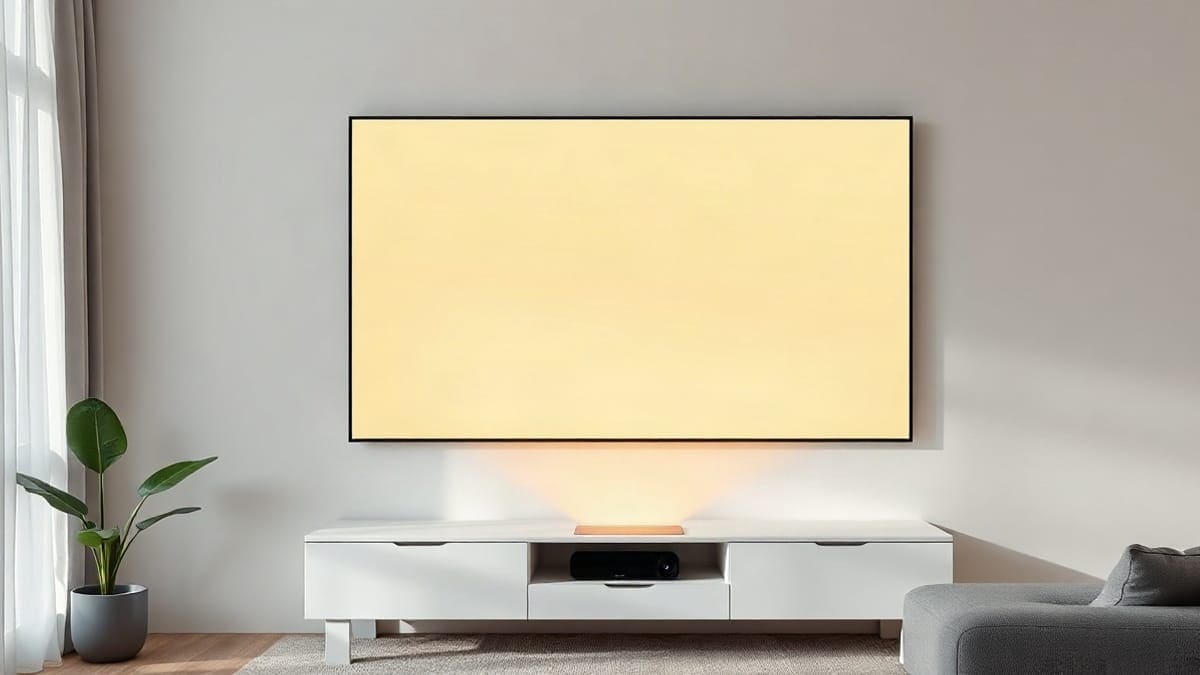
The Hisense PX3-Pro is the ultra short throw projector to start with: 4K, 3,000 ANSI lumens, a 25,000 hour laser and a 100 inch picture about 19 inches from the wall. Pick the Hisense L9Q for a room with windows (5,000 ANSI lumens) or the JMGO O2S Ultra for the lightest box (9.9 lb). We compared ten models on sale in the US with maker sheets and ProjectorCentral data, and we have not tested any. Each brightness figure names its test, because ANSI and ISO lumens are different measures.
Which one fits your room? Get this one, get that one
The question is less "which brand" than "how bright is my room and how big is my wall".
- Get the Hisense PX3-Pro if you want one projector for movies and a console in a living room you can dim, with a 100 to 120 inch picture, two HDMI 2.1 ports and a 50 W sound system.
- Get the Hisense L9Q if the room has daylight and you want 120 inches or more. It is rated at 5,000 ANSI lumens, and it weighs 28.4 lb.
- Get the JMGO O2S Ultra if you want the lightest body (9.9 lb), the shortest distance to the wall (about 1.2 to 1.4 feet for 100 to 120 inches) and a quiet fan rated at 26 dB.
- Neither if you have 4 feet or more behind the screen and a ceiling or shelf to use. Then a short throw projector costs less and does not need a flat screen two feet from the lens.
Our picks at a glance
- 1Hisense PX3-Proa living room you can dim, movies and consoles togetherCheck price
- 2Hisense PX4 Probuyers who want a little more light than the PX3-Pro and the newest modelCheck price
- 3Hisense L9Qa bright room and a 120 to 150 inch pictureCheck price
Quick answer: what to know before you buy
- Definition: an ultra short throw (UST) projector has a throw ratio below about 0.4:1. Every model here sits between 0.16:1 and 0.28:1.
- Distance: a 100 inch picture needs the lens 1.2 to 2.0 feet from the wall. A 120 inch picture needs 1.4 to 2.4 feet.
- Brightness: the ten models rate from 2,200 to 5,000 lumens. ANSI and ISO lumens come from different tests, so we label each number.
- Screen: use an ambient light rejecting (ALR) screen made for UST if the room is not dark. On a plain wall, bumps show.
- Life: the laser light sources are rated for 20,000 to 30,000 hours, which is 9 to 27 years at 3 to 6 hours a day.
- Skip: the AWOL Vision LTV-3500 Pro and the Epson LS800 are listed as discontinued by ProjectorCentral. The XGIMI Aura 3 Max is announced for December 2026.
What is an ultra short throw (UST) projector, and what does the term mean?
An ultra short throw projector is a projector that sits a foot or two from the wall and throws the picture up and onto it. "UST" is the common shorthand. The term describes the throw ratio, which is the distance to the screen divided by the width of the picture.
A 0.2:1 ratio means a 100 inch picture, which is 87.2 inches wide, needs the lens about 17.4 inches away. A standard projector at 1.2:1 needs 8.7 feet for the same picture. That gap is the whole point: the projector sits on a cabinet under the screen, like a television, and nobody walks through the beam.
Makers also sell UST models as "laser TVs" when they pair the projector with an ALR screen and a sound system. If the term is new, what is a laser TV explains the idea, and our Hisense laser TV page covers that maker's line. A UST laser projector is simply a UST projector whose light source is a laser rather than a lamp.
How does an ultra short throw projector work?
An ultra short throw projector bends the light with a wide-angle lens and an internal mirror, so the beam leaves the case at a steep upward angle and spreads across the wall from a few inches away. The picture rises above the lens, which is why the projector sits below the bottom edge of the screen.
Three things follow from the optics. The lens is usually fixed, with no zoom and no lens shift on the models we read about, so the distance sets the picture size. The beam travels across the wall at a graze, so a wavy wall shows as a wavy picture. And the light arrives from below, which decides what screen works.
The picture itself comes from the same chips as other projectors. Eight of the ten models here use a 4K DLP chip. The Epson uses three 1080p LCD panels with pixel shifting, and the Optoma uses a 1080p DLP chip.
Is a UST projector the same as a short throw or a standard projector?
No. The three groups differ in distance, in the screen they need and in how they handle a person walking past. Our short throw guide covers the 0.4:1 to 0.8:1 group, and the pillar guide covers standard models.
| Type | Throw ratio | Distance for a 100 inch picture | Screen | Best place |
|---|---|---|---|---|
| Ultra short throw | 0.16:1 to 0.28:1 here | 1.2 to 2.0 ft | ALR made for UST if the room is not dark | Cabinet under the screen |
| Short throw | 0.4:1 to 0.8:1 | 2.9 to 5.8 ft | Matte white or gray | Low table or ceiling |
| Standard | 1.2:1 and up | 8.7 ft and up | Any flat screen | Ceiling or shelf at the back |
Each distance is the ratio times 7.26 feet, the width of a 100 inch picture.
Which ultra short throw projector is best? The ten models side by side
For most rooms, the Hisense PX3-Pro and PX4 Pro give the best mix of brightness, ports and sound, and the L9Q wins when light is the problem. ProjectorCentral ranks the PX3-Pro first in its November 2026 UST list, with the L9Q second and the PT1 third.
We kept the models that ProjectorCentral lists as shipping and that a US buyer can order. The table gives the throw ratio, the brightness with its test, the resolution and the picture sizes.
| Model | Throw ratio | Brightness | Resolution | Image size |
|---|---|---|---|---|
| Hisense L9Q | 0.18:1 | 5,000 ANSI lm | 4K DLP | 79.6 to 200.4 in |
| Hisense PX4 Pro | 0.19:1 | 3,500 ANSI lm | 4K DLP | 80 to 200 in |
| Hisense PX3-Pro | 0.22:1 | 3,000 ANSI lm | 4K DLP | 50.1 to 150.2 in |
| Hisense PT1 | 0.20:1 | 2,500 ANSI lm | 4K DLP | 79.9 to 150.1 in |
| JMGO O2S Ultra | 0.16:1 | 3,600 ISO lm | 4K DLP | 79.2 to 150.6 in |
| Samsung Premiere 9 LPU9D | 0.19:1 | 3,450 ISO lm | 4K DLP | 99.8 to 130.4 in |
| Epson EpiqVision Ultra LS650 | 0.28:1 | 3,600 ISO lm | 1080p 3LCD, pixel-shifted 4K | 60 to 120 in |
| XGIMI Aura 2 | 0.18:1 | 2,300 ISO lm | 4K DLP | 89.5 to 150.1 in |
| Formovie Theater Premium | 0.21:1 | 2,200 ISO lm | 4K DLP | 80 to 150 in |
| Optoma GT3500HDR | 0.25:1 | 3,800 lm (ANSI per spec page) | 1080p DLP | 79.9 to 120.1 in |
Source: ProjectorCentral spec pages, checked November 2026. The Hisense PX4 Pro page lists 80 to 200 inches in its table and 80 to 150 inches in its highlights, and the PT1 page lists 90 to 130 inches in its highlights, so the maker's recommended range is narrower than the table range.
Hisense PX3-Pro: the one most people should look at first
The PX3-Pro is a 3,000 ANSI lumen RGB laser projector with a 0.22:1 lens, a 25,000 hour light source and 4K on a 0.47 inch DLP chip. ProjectorCentral calls it "one of the best living room UST's we've tested" and gave it an Editor's Choice award. It was the first RGB laser projector with the Designed for Xbox mark.
It throws 50 to 150 inches from 0.8 to 2.4 feet, has two HDMI 2.1 ports and one HDMI 2.0, and a 50 W Harman Kardon system with Dolby Atmos. It weighs 19.8 lb and carries a 2-year warranty.
Right for: a living room you can dim, movies and consoles together. Not for: pictures above 120 inches in a bright room, where 3,000 lumens runs thin.
Hisense PX4 Pro: the brighter successor
The PX4 Pro is the July 2026 follow-up: 3,500 ANSI lumens, 0.19:1, a triple laser rated for 25,000 hours and six 11 W speakers. ProjectorCentral lists 110% of BT.2020 color, IMAX Enhanced, Dolby Vision and HDR10+, and calls it "highly recommended" for 2026.
It has two HDMI 2.0 ports, not 2.1, which matters if you plan 4K at 120 Hz from a console. The body weighs 18.3 lb and carries a 2-year warranty.
Right for: buyers who want a little more light than the PX3-Pro and the newest model. Not for: a console player who needs HDMI 2.1.
Hisense L9Q: the brightest you can buy as a single box
The L9Q rates 5,000 ANSI lumens from a 25,000 hour RGB laser, with a 0.18:1 lens that throws 79.6 to 200.4 inches from 1.0 to 2.6 feet. ProjectorCentral lists it as shipping since June 2025, with 107% of BT.2020, Dolby Vision and HDR10+, four HDMI ports (two 2.1, two 2.0) and Dolby Atmos speakers.
It is the largest here: 28.4 lb and 24.6 inches wide. ProjectorCentral's spec page says a dedicated ALR screen is in the package, while its buyer's guide table says no screen is included. Read the retailer's listing before you order.
Right for: a bright room and a 120 to 150 inch picture. Not for: a narrow cabinet or a small wall.
Hisense PT1: the 4K model for dim rooms
The PT1 is a 2,500 ANSI lumen triple laser with 0.20:1, 4K, a 25,000 hour light source and two HDMI 2.1 ports, and it weighs 15.9 lb. ProjectorCentral calls it a budget RGB laser model best in dim rooms, and its review advises limiting the picture to 120 inches.
It lists IMAX Enhanced, Dolby Vision, HDR10+, stereo speakers and a 2-year warranty. It dates from September 2025.
Right for: a bedroom or a basement with the lights low. Not for: a sunny living room or a 150 inch wall.
JMGO O2S Ultra: the smallest and shortest
The JMGO O2S Ultra rates 3,600 ISO lumens at 0.16:1, so a 100 inch picture needs the lens about 1.2 feet from the wall, and it weighs 9.9 lb. It throws 79 to 151 inches from 0.9 to 1.8 feet, with two HDMI 2.1 ports, Dolby Vision and a 26 dB noise rating.
JMGO and ProjectorCentral disagree on a few numbers, including the throw ratio (0.16:1 or 0.18:1) and weight. Our JMGO O2S Ultra review lists each. The warranty is 1 year, and ProjectorCentral lists no laser hours.
Right for: a low cabinet, a quiet room and a lighter box. Not for: a buyer who wants a long warranty.
Samsung Premiere 9 LPU9D: the polished one with a high price
The Premiere 9 is a 4K triple laser rated 3,450 ISO lumens (3,200 ANSI in ProjectorCentral's guide), with a 0.19:1 lens, a 99.8 to 130.4 inch picture and a 40 W 2.2.2 speaker system. The laser is rated for 20,000 hours, the body weighs 25.6 lb, and the fan is rated at 33 dB.
ProjectorCentral's guide says color accuracy and a high price hold it back, and its input lag is high for gaming. It has three HDMI ports, Tizen and Samsung Gaming Hub.
Right for: a Samsung home that wants apps and sound in one body. Not for: a competitive gamer, or anyone who wants a picture above 130 inches.
Epson EpiqVision Ultra LS650: the 3LCD with the longest lens
The LS650 rates 3,600 ISO lumens, and ProjectorCentral measured 3,485 lumens, from a laser rated for 20,000 hours. It uses three 1080p LCD panels with pixel shifting to reach 4K, so there is no color wheel and no rainbow effect.
Its throw ratio is 0.28:1 on the spec page and 0.26:1 in the review, so a 100 inch picture needs the lens 2.0 feet away, and the picture tops out at 120 inches. Measured color is its weak side: 90.4% of Rec.709 and 72.4% of DCI-P3. Input lag measured 24 ms. It runs Android TV 11 without a Netflix app, and weighs 16.3 lb.
Right for: a room that gets some light and a buyer who dislikes rainbow artifacts. Not for: a color-critical movie fan or a 150 inch wall.
XGIMI Aura 2: the quiet mid-range one
The Aura 2 rates 2,300 ISO lumens from a laser and LED light engine rated for 20,000 hours, with 0.18:1 and 4K. It throws 89.5 to 150.1 inches from 1.2 to 1.9 feet, and has three HDMI ports, four 15 W speakers tuned by Harman Kardon, and a 32 dB noise rating.
It weighs 19.8 lb with a 1-year warranty and dates from September 2024. ProjectorCentral lists wall flatness and wall color adaptation among its features. Our XGIMI guide covers the brand.
Right for: a dim living room where the sound system matters. Not for: daylight, where 2,300 lumens is the lowest of the group.
Formovie Theater Premium: the quietest fan
The Formovie Theater Premium rates 2,200 ISO lumens from an RGB laser, at 0.21:1, with 4K, a 28 dB fan and two 15 W speakers tuned by Bowers & Wilkins. It throws 80 to 150 inches from 1.2 to 2.3 feet and weighs 21.6 lb.
It lists three HDMI 2.1 ports, but ProjectorCentral's review found it does not support FRL, so it tops out at 4K at 60 Hz. The measured contrast was about 3,200:1, and color accuracy was weak. The warranty is 2 years.
Right for: a quiet bedroom or a den. Not for: a console player who wants 4K at 120 Hz.
Optoma GT3500HDR: the 1080p one
The GT3500HDR is a 1080p laser projector rated 3,800 lumens, with a 0.25:1 lens, a light source rated up to 30,000 hours, and a weight of 8.6 lb. It throws 79.9 to 120.1 inches from 1.5 to 2.2 feet and measures 17 ms at 1080p/60 and 8.6 ms at 1080p/120 on the spec page.
It has two HDMI 2.0 ports, a 15 W mono speaker, no wireless and no operating system, so you add a streaming stick. Color stops at Rec.709. The warranty is 1 year.
Right for: a gamer or a low-cost build who accepts 1080p. Not for: a 4K movie fan or a buyer who wants built-in apps.
Which models should you skip or wait for?
Three models come up in guides but should not be your first order. ProjectorCentral lists the AWOL Vision LTV-3500 Pro as discontinued in September 2026 and the Epson EpiqVision Ultra LS800 as discontinued in June 2026. The XGIMI Aura 3 Max is announced, not shipping.
| Model | Status | Brightness | Throw ratio | Why it matters |
|---|---|---|---|---|
| AWOL Vision LTV-3500 Pro | Discontinued Sept 2026 | 3,000 ISO lm | 0.25:1 | Still found used or in stock; 1.5 to 2.7 ft, 21.0 lb |
| Epson EpiqVision Ultra LS800 | Discontinued Jun 2026 | 4,000 ISO lm | 0.17:1 | Measured 4,084 ANSI lm; 27.6 lb |
| XGIMI Aura 3 Max | Expected Dec 2026 | 5,700 ISO lm | 0.17:1 | 100 to 150 in; 20.7 lb; two HDMI 2.0 |
Some guides still list the AWOL as current. A used or leftover unit can be a fair buy, but check the warranty first. The Aura 3 Max is worth watching if 5,700 lumens is what you want in a lighter body than the L9Q, but wait for ProjectorCentral to list it as shipping.
How close does an ultra short throw projector need to be to the screen?
Multiply the throw ratio by the picture width. For a 100 inch picture, the lens sits 1.2 to 2.0 feet from the wall, depending on the model, and for 120 inches, 1.4 to 2.4 feet. That is the distance from the lens to the wall, not from the back of the case.
The table is calculated. A 100 inch 16:9 picture is 87.15 inches wide and a 120 inch picture is 104.58 inches wide.
| Throw ratio | Models | 100 inch picture | 120 inch picture |
|---|---|---|---|
| 0.16:1 | JMGO O2S Ultra | 13.9 in (1.16 ft) | 16.7 in (1.39 ft) |
| 0.18:1 | Hisense L9Q, XGIMI Aura 2 | 15.7 in (1.31 ft) | 18.8 in (1.57 ft) |
| 0.19:1 | Hisense PX4 Pro, Samsung LPU9D | 16.6 in (1.38 ft) | 19.9 in (1.66 ft) |
| 0.20:1 | Hisense PT1 | 17.4 in (1.45 ft) | 20.9 in (1.74 ft) |
| 0.21:1 | Formovie Theater Premium | 18.3 in (1.53 ft) | 22.0 in (1.83 ft) |
| 0.22:1 | Hisense PX3-Pro | 19.2 in (1.60 ft) | 23.0 in (1.92 ft) |
| 0.25:1 | Optoma GT3500HDR | 21.8 in (1.82 ft) | 26.1 in (2.18 ft) |
| 0.28:1 | Epson LS650 | 24.4 in (2.03 ft) | 29.3 in (2.44 ft) |
How close can a UST projector be? The shortest is the JMGO at about 14 inches for 100 inches. The longest in our group is the Epson at 24 inches.
Be careful with other numbers you see. ProjectorCentral's UST guide quotes about 6.6 inches for the JMGO O2S Ultra, 6.25 for the Formovie and about 7 for the Aura 2 at 100 inches. That is measured to the back of the case. The Aura 3 Max page lists 0.4 to 1.0 feet for a 0.17:1 lens, which does not match the 1.2 feet that the ratio gives, so it is measured from a different point. Always check which point the figure uses. Our throw distance calculator and the guide on how far a projector should sit from the screen cover other ratios.
How big a picture fits your wall and your ceiling?
A 100 inch picture is 87.2 by 49.0 inches, a 120 inch picture is 104.6 by 58.8, and a 150 inch picture is 130.7 by 73.5. Add about 2 inches for a screen frame. The picture also has to fit under the ceiling, because the bottom edge sits above the cabinet.
For an 8 foot (96 inch) ceiling, subtract the picture height to find the highest bottom edge.
| Picture | Width | Height | Highest bottom edge under a 96 in ceiling | Cabinet top (example) |
|---|---|---|---|---|
| 100 in | 87.2 in | 49.0 in | 47.0 in | fits easily |
| 120 in | 104.6 in | 58.8 in | 37.2 in | fits with a 24 in cabinet |
| 150 in | 130.7 in | 73.5 in | 22.5 in | needs a very low cabinet |
The 150 inch row is the trap. A cabinet 24 inches high puts a 150 inch picture's top at 97.5 inches, above an 8 foot ceiling. Only the Hisense L9Q, Hisense PX4 Pro, PX3-Pro, PT1, JMGO, XGIMI and Formovie reach 150 inches on the spec sheet, and only the L9Q and PX4 Pro list up to 200.
If your wall is smaller than you thought, read our guides for a 100 inch screen and a 120 inch screen before you pick the model.
How bright must an ultra short throw projector be?
For a room you can dim, 2,500 to 3,000 lumens is enough at 100 inches. For a room with windows, aim for 3,500 lumens or more and a screen made to reject light. A bigger picture spreads the same lumens over more area, so brightness falls fast.
The table divides each rating by the screen area, in foot-lamberts, for a screen with a gain of 1.0. A different gain raises or lowers the number. ANSI and ISO ratings are not identical, so use the table to compare sizes, not to rank two models one for one.
| Rating | Example | 100 in | 120 in | 150 in |
|---|---|---|---|---|
| 2,200 ISO lm | Formovie Theater Premium | 74.2 fL | 51.5 fL | 33.0 fL |
| 2,300 ISO lm | XGIMI Aura 2 | 77.5 fL | 53.8 fL | 34.5 fL |
| 2,500 ANSI lm | Hisense PT1 | 84.3 fL | 58.5 fL | 37.4 fL |
| 3,000 ANSI lm | Hisense PX3-Pro | 101.1 fL | 70.2 fL | 44.9 fL |
| 3,500 ANSI lm | Hisense PX4 Pro | 118.0 fL | 81.9 fL | 52.4 fL |
| 3,600 ISO lm | JMGO O2S Ultra, Epson LS650 | 121.3 fL | 84.3 fL | 53.9 fL |
| 5,000 ANSI lm | Hisense L9Q | 168.5 fL | 117.0 fL | 74.9 fL |
ProjectorCentral's UST guide says the larger the screen, the darker the image. It points out that the PX3-Pro may lack brightness above 120 inches, and that the L9Q's 5,000 lumens suit large screens. Our lumens guide explains ANSI and ISO in more detail, and the daylight projector guide ranks models for sunny rooms.
What is the brightest ultra short throw projector?
The Hisense L9Q at 5,000 ANSI lumens is the brightest in our selection of models you can buy as a normal home product. The brightest on paper is the XGIMI Aura 3 Max at 5,700 ISO lumens, but it is not shipping yet.
ProjectorCentral's guide lists brighter installation models, the Ricoh UHL3660 at 6,500 ANSI lumens and the Panasonic PT-CMZ50BU at 5,200 ISO lumens, but those are built for offices and venues. The Epson QS100 at 4,500 ISO lumens is a flagship home model, and the discontinued LS800 measured 4,084 ANSI lumens.
Which screen does a UST picture need: a special one or a white wall?
Yes, in any room that is not dark. A UST projector lights the screen from below at a steep angle, and an ALR screen made for that angle returns the picture to your eyes and rejects light from lamps and windows. In a dark room a plain wall works, with gray blacks and visible bumps.
ProjectorCentral says Epson recommends an ALR screen and that a UST is more usable in bright rooms with one. Some models ship with a screen: the Hisense L9Q per its spec page, and the Hisense L9H with a 100 inch Daylight screen. The JMGO O2S Ultra and the PT1 have ALR options.
| Surface | Works with a UST? | Room | Catch |
|---|---|---|---|
| Plain white wall | Yes, in the dark | Dark | Blacks turn gray; wall bumps show |
| Gray or matte screen | Yes, in the dark | Dim | Not made for a steep beam |
| Lenticular ALR for UST | Yes | Lit | ProjectorCentral's preferred type in one article |
| Fresnel ALR for UST | Yes | Lit | Called preferred in another; check the maker's flatness claim |
ProjectorCentral calls the lenticular type its preferred one in one article and the Daylight Fresnel type in another, so do not treat the choice as settled. Our guides cover the options: ALR screens, UST screens and projector and screen combos. The projector on a wall guide covers paint and plain walls.
How flat does the wall have to be?
Flatter than you would expect. We found no maker or reviewer who publishes a flatness tolerance in inches, so the safe rule is to use a rigid, fixed-frame screen on a solid wall. The beam grazes the surface, and a ripple of a fraction of an inch can bend a straight line in the picture.
The XGIMI Aura 2 lists wall flatness adaptation as a feature, which corrects the shape of the picture in software. Treat that as a helper, not a fix for a bowed wall.
How should you choose an ultra short throw projector? Seven checks
Choose in this order. Each step removes models from the list.
- Measure the wall. Pick 100, 120 or 150 inches and check the height against the ceiling, as in the table above.
- Rate the room's light. A dim room allows 2,500 to 3,000 lumens. A room with windows needs 3,500 or more and an ALR screen.
- Check the cabinet. It needs to be deep enough for the case and the lens distance.
- Count your HDMI devices. The PX3-Pro, PT1, L9Q, JMGO and Formovie list HDMI 2.1.
- Check the sound. If you use a soundbar, look for eARC.
- Check the apps. Look for Netflix and the apps you use.
- Check the warranty. It runs from 1 year (JMGO, XGIMI, Optoma) to 2 years (Hisense, Epson, Formovie, Samsung).
What size cabinet does an ultra short throw projector need?
It needs to be as wide as the case, deep enough for the case with a little air at the back, and low enough to leave the picture under the ceiling. The cases range from 10.6 to 15.7 inches deep and 12.3 to 24.6 inches wide, from the spec pages.
| Model | Width | Depth | Height | Weight |
|---|---|---|---|---|
| Hisense L9Q | 24.6 in | 12.5 in | 6.5 in | 28.4 lb |
| Hisense PX4 Pro | 21.3 in | 11.3 in | 5.6 in | 18.3 lb |
| Hisense PX3-Pro | 21.7 in | 11.7 in | 4.8 in | 19.8 lb |
| Hisense PT1 | 20.5 in | 11.1 in | 4.7 in | 15.9 lb |
| JMGO O2S Ultra | 12.3 in | 11.4 in | 5.5 in | 9.9 lb |
| Samsung LPU9D | 21.7 in | 15.1 in | 5.6 in | 25.6 lb |
| Epson LS650 | 18.4 in | 15.7 in | 6.2 in | 16.3 lb |
| XGIMI Aura 2 | 20.1 in | 10.6 in | 5.7 in | 19.8 lb |
| Formovie Theater Premium | 21.7 in | 13.8 in | 4.2 in | 21.6 lb |
| Optoma GT3500HDR | 12.9 in | 12.9 in | 4.3 in | 8.6 lb |
The Hisense PX4 Pro page lists 5.60 x 11.30 x 21.30 inches in the order height, width, depth, which looks swapped, so we show it as 21.3 wide by 11.3 deep like the other Hisense models. Check the maker's sheet before you buy furniture. Our UST projector cabinet guide covers furniture, and the laser TV cabinet page covers the matching stands.
What is the right order for setting up a UST at home?
Set the cabinet against the wall, place the projector at the distance from the table above, level it, and then adjust focus and the corners. Do it in that order. A fixed lens cannot fix a bad distance, so get the distance right first.
- Mark the wall. Draw the picture's bottom edge and sides in painter's tape.
- Set the distance. Measure from the lens, not from the back of the case.
- Level the case. Make it parallel to the wall, or the picture skews.
- Focus. Use the powered focus in the menu.
- Fix the corners. Use the corner adjustment only for small errors, because digital correction softens the picture.
- Fit the screen. Mount the screen to the tape marks before you finish.
For the general steps, our projector setup guide covers inputs and picture settings.
How do you mount an ultra short throw projector, and can it go on the ceiling?
Most go on a cabinet or a stand. Ceiling mounting is possible only when the maker supports an inverted mode and a mount. ProjectorCentral says the Formovie Cinema Edge works either on a tabletop or on the ceiling, which is a different model. For the ten here we could not confirm a ceiling mode on the sheets we read.
Do not drill before you ask the maker in writing. A UST projector weighs 8.6 to 28.4 lb, and the warranty is 1 to 2 years. Our ceiling mounted projector guide covers hardware in general, and UST ceiling mounts covers the short throw case.
Do ultra short throw projectors sound good, or do you need a hi-fi system?
Most have built-in sound that beats a small TV, and the Hisense models and the Aura 2 beat most of the rest. If you own a soundbar or a hi-fi receiver, check for an eARC or optical output. A UST projector can send sound out to it, but not every model has the port.
| Model | Built-in sound | Output we could confirm |
|---|---|---|
| Hisense PX3-Pro | 50 W Harman Kardon, Dolby Atmos | Optical and mini jack |
| Hisense PX4 Pro | 6 x 11 W (66 W), Harman Kardon, Dolby Atmos decoding | Not confirmed |
| Hisense L9Q | Dolby Atmos speakers, no wattage listed | Not confirmed |
| XGIMI Aura 2 | 4 x 15 W (60 W), Harman Kardon | Not confirmed |
| Samsung LPU9D | 40 W 2.2.2 | Not confirmed |
| Formovie Theater Premium | 2 x 15 W (30 W), Bowers & Wilkins | Not confirmed |
| JMGO O2S Ultra | 2 x 10 W (20 W), Dynaudio | eARC on one HDMI port |
| Epson LS650 | 2 x 5 W plus 10 W subwoofer | eARC on HDMI 2 per review |
| Optoma GT3500HDR | 15 W mono | 3.5 mm out; no eARC, no optical |
The watts are the makers' figures and do not tell you how loud a speaker plays without distortion. The "hi-fi" question usually means one thing: can I connect a real sound system? If the answer matters, buy the model with eARC, or add a streaming box and a soundbar through that.
Is an ultra short throw projector good for gaming?
Yes, for 4K at 60 Hz on almost all of them. For 4K at 120 Hz you need HDMI 2.1. The PX3-Pro lists 240 Hz at 1080p and the Designed for Xbox mark, and the PT1, L9Q and JMGO list HDMI 2.1.
| Model | HDMI 2.1 | Input lag figure | Note |
|---|---|---|---|
| Hisense PX3-Pro | 2 ports | not listed | 240 Hz at 1080p, auto low latency mode |
| Hisense PT1 | 2 ports | not listed | |
| Hisense L9Q | 2 ports | not listed | |
| JMGO O2S Ultra | 2 ports | not listed | |
| Formovie Theater Premium | listed, no FRL | not listed | tops out at 4K/60 |
| Epson LS650 | 2 ports per spec page | 24 ms measured | 4K/60 and 1080p/60, Fast mode |
| Optoma GT3500HDR | no (HDMI 2.0) | 17 ms at 1080p/60; 8.6 ms at 1080p/120 | spec page |
| Samsung LPU9D | not confirmed | high per ProjectorCentral | |
| Hisense PX4 Pro | no (HDMI 2.0) | not listed | |
| XGIMI Aura 2 | not confirmed | not listed |
For a long list by game genre, read our gaming projector guide and the 4K gaming guide.
Can you use an ultra short throw projector for a golf simulator?
Not well. A golf simulator needs the projector out of the line of the ball, and a UST projector sits one or two feet in front of the screen, which is where the ball and the club travel. We found no maker who rates these ten for golf. ProjectorCentral lists home theater and gaming uses.
The screen is also the problem. Golf impact screens are made to absorb a ball, and a UST picture needs a flat screen with a very steep beam. A short throw or standard projector hung above and behind the hitter is the usual choice. Our short throw guide covers distances for that setup.
How good are ultra short throw projectors, and are they better than a standard projector?
Good enough to replace a television in a living room, but not better than a standard projector in every way. The picture quality of the RGB laser models is strong. Hisense and JMGO claim 107% to 110% of BT.2020 color. A standard projector with lens shift is easier to set up and costs less per inch.
Native contrast is modest. ProjectorCentral lists 3,000:1 for the PX3-Pro and 4,000:1 for the JMGO, and measured about 3,200:1 on the Formovie. The Epson LS650's measured color is the weakest in the group, 72.4% of DCI-P3. The right comparison is with a large television. Our projector vs TV guide covers that choice, the home theater guide covers dark-room models, and the 4K projector guide explains native and pixel-shifted 4K.
Is an ultra short throw projector worth it?
Yes, if you want a 100 inch or larger picture in a room with a TV wall, and no, if you have a dark basement and a ceiling. The value is in the shape of the setup, not the picture: nothing hangs from the ceiling, no cable crosses the room, and nobody blocks the beam.
It is not worth it if your wall is uneven, if you want to move the projector from room to room, or if the room is lit all day and your budget stops at 2,500 lumens. In those cases a standard model, or a larger TV, makes more sense. The pillar projector guide compares every type.
Why are ultra short throw projectors so expensive?
Because they combine hard optics, a laser light source and a TV's worth of features in one case. The wide-angle lens and mirror must be precise to throw a sharp picture at a steep angle. The laser engine costs more than a lamp, and these models add speakers, an operating system and a heavier chassis.
We have no maker cost data, so this is our reading of the parts, not a quoted figure. Remember the screen too. An ALR screen is a second purchase unless the L9Q or a bundle includes one.
What is the cheapest ultra short throw projector?
Among the ten, the Optoma GT3500HDR is the lowest in ProjectorCentral's street price, at 1080p. The Hisense PT1 is the lowest-priced 4K model in our group. Check current prices, because they move.
Cheaper models exist, but they are dim. ProjectorCentral's guide lists the Optoma PHOTON GO at 650 ISO lumens, the LG CineBeam S at 500 ANSI lumens and the Yaber K300s at 1,000 ANSI lumens. At that brightness, a UST works only in a dark room. For a lower cost per lumen, a bright short throw model is the better route.
How many years does an ultra short throw laser last?
The laser light sources are rated for 20,000 to 30,000 hours: 20,000 (Aura 2, LS650, Samsung), 25,000 (Hisense) and up to 30,000 (Optoma). ProjectorCentral's baseline is at least 20,000 hours with essentially stable brightness. A rating is not a guarantee, and the warranty is 1 to 2 years.
| Rated hours | 3 hours a day | 4 hours a day | 6 hours a day |
|---|---|---|---|
| 20,000 | 18.3 years | 13.7 years | 9.1 years |
| 25,000 | 22.8 years | 17.1 years | 11.4 years |
| 30,000 | 27.4 years | 20.5 years | 13.7 years |
JMGO and Formovie do not list hours on ProjectorCentral. The fan, the speakers and the electronics may wear out before the laser does.
Which store or maker should you order a UST from?
Buy from the maker or from an authorized retailer, and check the warranty and the return window. Hisense sells through retailers such as Best Buy, and JMGO, XGIMI, Epson, Samsung and Formovie sell in their own stores. ProjectorCentral lists authorized retailers for each model.
Avoid unnamed third-party sellers for a model that weighs 20 lb and needs a 2-year warranty. Our Check price links lead to the current offer, and we do not publish prices because they move.
How we chose these projectors
We kept models that ProjectorCentral lists as shipping and that a US buyer can order from the maker or a retailer. We favored the Impact brands (JMGO, XGIMI, Hisense, Epson) when they were a real good choice, and added Samsung, Formovie and Optoma for range. We read the maker and ProjectorCentral spec pages and reviews, and we have not tested any of these projectors. We compared every number across sources and flagged each disagreement. Distances and foot-lamberts are our calculations from the published ratio and rating, shown in the tables.
FAQ
What does UST stand for in a projector?
UST stands for ultra short throw. It means a throw ratio below about 0.4:1, so the projector sits 1 to 2 feet from the wall for a 100 inch picture. Short throw models sit about 3 to 6 feet away, and standard ones sit 8 feet or more.
What is a UST laser projector?
A UST laser projector is an ultra short throw projector that uses a laser as its light source instead of a lamp. All ten models here are laser projectors, rated for 20,000 to 30,000 hours. Our laser projector guide covers the light source in general.
Does an ultra short throw projector work in a bright room?
Yes, if it is bright enough and the screen is an ALR type. With 3,000 lumens or more and an ALR screen, a living room with some daylight works. A projector below 2,500 lumens, such as the Aura 2 or the Formovie, is better in a dim room.
Can an ultra short throw projector replace a TV?
Yes, for a picture of 100 inches or more. You need a flat wall, a cabinet and, for a lit room, an ALR screen. Sound and apps are built in on most models. Our projector TV guide and projector vs TV compare the two.
Do ultra short throw projectors have lens shift or zoom?
Usually not. The JMGO O2S Ultra uses a fixed lens with no lens shift and no zoom, and the Epson LS650 has a fixed lens with no lens shift. The distance sets the size, so mark the wall before you place the cabinet.
Can a UST projector sit on the floor or a coffee table?
Only if the surface is low and level and the beam clears the screen's bottom edge. The usual place is a low cabinet. A picture that starts too low on the wall wastes screen height, and a tall coffee table can block the picture.
Do UST projectors come with a screen?
Rarely. ProjectorCentral says screens are now less often included. The Hisense L9Q lists an ALR screen on its spec page and the Hisense L9H comes with a 100 inch screen. Others sell one as an option or you buy it separately.
How loud is an ultra short throw projector?
Rated noise ranges from 23 to 36 dB: the JMGO at 26 dB, the Formovie at 28 dB, the Aura 2 at 32 dB, the Samsung at 33 dB, the Optoma at 34 dB (27 dB in Eco mode) and the Epson at 36 dB (23 dB in Eco mode). The Hisense pages do not list noise.
Do ultra short throw projectors have built-in streaming apps?
Most do, with different systems. The Samsung runs Tizen and the Epson LS650 runs Android TV 11 without a Netflix app, according to ProjectorCentral. The Optoma GT3500HDR has no wireless and no operating system, so you add a streaming stick.
Can an ultra short throw projector cause a rainbow effect?
Single-chip DLP projectors can, for the few viewers who notice it. ProjectorCentral notes that the Epson LS650's 3LCD design avoids rainbow artifacts. If you are sensitive to them, view a DLP model in a store before you commit.
Does the picture get dimmer over time?
The laser light sources are rated for 20,000 hours or more, and ProjectorCentral says the brightness stays essentially stable across that span. Heat, dust and the fan matter, so keep the vents clear of the cabinet's back panel.
Is a laser TV a different product from a UST projector?
A laser TV is a UST projector sold with a screen and sound as a TV replacement. The projector is the same type of product. Our what a laser TV is covers the term, and UST laser guide covers the light source.
Which ultra short throw projector is the best for a console?
The Hisense PX3-Pro and PT1 and the JMGO O2S Ultra list HDMI 2.1 for 4K at 120 Hz, and the PX3-Pro lists Designed for Xbox. Avoid the PX4 Pro and the Optoma if you need HDMI 2.1. Details are in the gaming table above.
Sources
- Hisense PX3 PRO specifications, ProjectorCentral
- Hisense PX4 PRO specifications, ProjectorCentral
- Projector Reviews: Hisense PX3-Pro review
- Hisense L9Q specifications, ProjectorCentral
- Hisense PT1 specifications, ProjectorCentral
- XGIMI Aura 2 specifications, ProjectorCentral
- XGIMI Aura 3 Max specifications, ProjectorCentral
- Epson EpiqVision Ultra LS650 specifications, ProjectorCentral
- Epson EpiqVision Ultra LS650 review, ProjectorCentral
- Epson: EpiqVision Ultra LS650 product page
- Epson EpiqVision Ultra LS800W specifications, ProjectorCentral
- Formovie Theater Premium specifications, ProjectorCentral
- Formovie Theater Premium review, ProjectorCentral
- Samsung The Premiere 9 LPU9D specifications, ProjectorCentral
- Optoma GT3500HDR specifications, ProjectorCentral
- AWOL Vision LTV-3500 Pro specifications, ProjectorCentral
- Top 10 Ultra Short Throw Projectors, ProjectorCentral
- 4K UST Laser TV Buyer's Guide, ProjectorCentral
Keep comparing
 Portable Projector 2026Nine real models compared on weight, rated and measured lumens, battery life and ports, with picks for travel
 Mini Projectors for 2026Nine real pocket models compared on weight, ANSI lumens, battery, ports and picture size
 Phone ProjectorsEight real models checked for AirPlay, Google Cast, USB-C video, Netflix, weight and lumens
 Outdoor Projectors in 2026The outdoor projectors for backyards, patios and campsites, with real brightness numbers, screen sizes